
An annual governance cycle is defined as a structured, recurring yearly process through which an organisation plans its assurance activities, collects evidence, reviews governance performance, publishes key statements, and tracks improvements to maintain effective oversight and compliance. In the non-profit sector, this cycle is the backbone of sound organisational governance, connecting your board's decision-making to the legal, strategic, and operational realities your organisation faces throughout the year. Rather than a single annual event, the cycle is a continuous rhythm that integrates planning, evidence-based review, reporting, and improvement into normal board and committee operations. Understanding it clearly is the first step toward using it well.
What is an annual governance cycle and why does it matter?
An annual governance cycle is the systematic yearly framework through which a board fulfils its oversight responsibilities, from setting assurance priorities at the start of the year to publishing governance statements and monitoring action plans at its close. The cycle is not simply about producing reports. It is about creating a repeatable, evidence-informed process that gives your board genuine confidence in the organisation's controls, risks, and compliance posture.
For non-profit boards, this matters because governance is not optional or informal. Charity legislation requires registered charities to conduct governance procedure reviews at least every three years, with annual returns confirming whether reviews occurred in the return year. This means your governance cycle must be deliberate enough to generate the evidence those reviews require, not assembled in a rush before a deadline.

The cycle also supports mission delivery. When your board has a clear picture of governance performance across the year, it can make timely, well-informed decisions about strategy, risk, and resources. That is what separates organisations that govern well from those that simply comply on paper. For a deeper look at how governance supports mission in the non-profit context, the distinction is worth understanding early.
What are the main steps in an annual governance cycle?
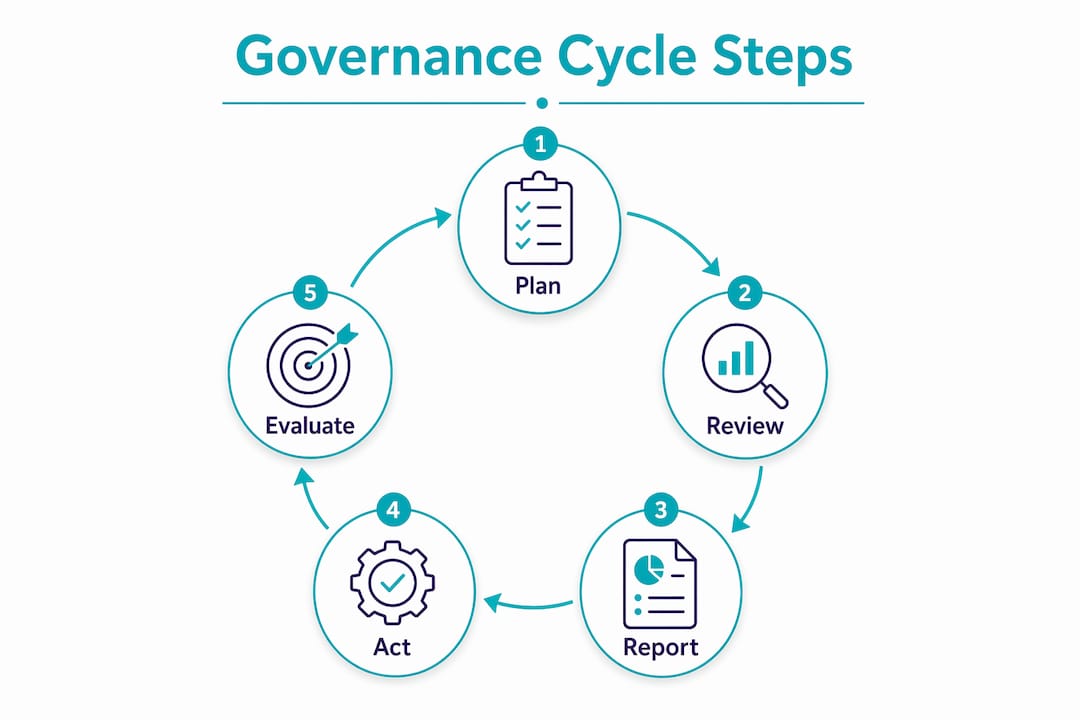
The annual governance process follows a logical sequence, though the exact timing varies by organisation. The Royal Borough of Kingston upon Thames provides a well-documented model through its Annual Governance Statement (AGS) process, which illustrates how these steps work in practice.
-
Plan assurance needs. At the start of the cycle, the board and governance team identify what assurance activities are required for the year. This includes deciding which audits, reviews, and performance assessments are needed, and who is responsible for each.
-
Collect evidence. Throughout the year, evidence is gathered from board and committee minutes, internal audit reports, external audit opinions, risk registers, performance data, and compliance confirmations. The AGS process at Kingston involves collecting this evidence continuously rather than at year end.
-
Review evidence critically. Governance teams and independent committees assess whether the evidence demonstrates adequate control effectiveness. This is where gaps and weaknesses are identified, not just documented.
-
Publish governance statements or reports. The cycle produces a formal output, typically an Annual Governance Statement or equivalent report, summarising findings for stakeholders, regulators, and the public. Kingston publishes its AGS in June, with the cycle feeding directly into that publication date.
-
Monitor and update action plans. Weaknesses identified through the review generate action plans that are tracked throughout the year and feed into the next cycle's evidence collection. This is the step most organisations underinvest in, and it is the one that drives genuine improvement.
Pro Tip: Map each step to a named owner and a calendar date at the start of your governance year. Vague ownership is the single most common reason action plans stall before the next cycle begins.
How does the annual cycle fit into broader governance rhythms?
The annual governance cycle does not operate in isolation. Governance cadence defines a structured, recurring rhythm with three distinct layers, each with different purposes and participants.
| Governance layer | Frequency | Primary focus |
|---|---|---|
| Operational | Weekly or fortnightly | Day-to-day compliance, incident management, operational reporting |
| Tactical | Monthly or quarterly | Performance tracking, risk updates, committee oversight |
| Strategic | Quarterly or annual | Board oversight, long-term direction, governance statement preparation |
The annual cycle sits at the strategic layer. It is the point at which your board steps back from operational detail and asks whether the organisation's governance systems are working as a whole. This is distinct from the monthly risk update or the quarterly finance report, though both feed into it.
"Governance is most effective when viewed as a continuous operating rhythm with defined evidence requirements and action tracking, rather than a one-off annual event." (Ridley & Co)
The practical implication for non-profit boards is that your annual cycle should be designed to receive and synthesise the outputs of your operational and tactical governance activities. If your monthly committee reports are not structured to generate the evidence your annual review needs, you will find yourself scrambling at year end. Governance cadences formalise when and how decisions, evidence, and actions are reviewed, improving accountability and reducing decision fatigue across the organisation.
Why does evidence design matter so much in the governance cycle?
Evidence design is the part of the annual governance framework that most boards get wrong, and the consequences are significant. GRC programs fail when governance systems are designed as documentation exercises rather than integrated operations with clear ownership, workflows, and evidence production aligned to daily activities. This means the problem is structural, not a matter of effort or intent.
For non-profit boards, this translates into a practical design question: does your governance evidence emerge naturally from how your board and committees already operate, or does someone have to compile it manually before each review? The answer shapes the quality and reliability of everything your cycle produces.
The Scottish Public Finance Manual requires governance statements to be informed by evidence gathered throughout the accounting period from audit opinions, risk management, and internal controls. External auditors review these statements for consistency and accuracy, which means end-of-year assembly is not sufficient. The evidence must be continuous and traceable.
Common pitfalls in evidence design include:
- Focusing on report production rather than assurance adequacy. Many boards treat the governance statement as the goal, when it is actually the output. The goal is demonstrating that controls are working.
- Unclear review criteria. Without defined standards for what "adequate assurance" looks like, governance reviews become subjective and difficult to defend.
- No named ownership. Evidence that belongs to everyone belongs to no one. Each governance activity needs a named owner and a documented workflow.
- Disconnected committee reporting. When audit, risk, and compliance committees report in silos, the board cannot form a coherent picture of governance health.
Pro Tip: Review your committee terms of reference and check whether each one specifies what evidence it is responsible for producing and when. If it does not, that is your starting point for redesigning your governance evidence architecture.
How do governance cycles support compliance and effectiveness in non-profits?
A well-designed annual governance process delivers benefits that go well beyond regulatory compliance, though compliance is a non-negotiable foundation. Here is what a functioning cycle makes possible for non-profit boards.
- Meeting legal obligations. Governance procedure reviews required under charity legislation are far easier to complete when your cycle has been generating relevant evidence throughout the year. The review becomes a synthesis exercise rather than a reconstruction effort.
- Timely strategic decisions. When your board receives aggregated assurance and risk data through a structured cycle, it can act on emerging issues before they become crises. The annual strategic cadence is critical for monitoring risk appetite, investments, and organisational outcomes.
- Stakeholder transparency. Published governance statements signal to funders, regulators, and the communities you serve that your organisation takes accountability seriously. This builds trust in ways that informal assurances cannot.
- Continuous improvement culture. Action plans generated through the cycle create a documented record of how your organisation identifies and addresses governance weaknesses. Over time, this record demonstrates maturity and responsiveness.
The table below summarises how the cycle connects to specific non-profit governance obligations.
| Governance cycle output | Non-profit benefit |
|---|---|
| Annual Governance Statement | Demonstrates accountability to regulators and funders |
| Action plans from identified gaps | Drives year-on-year improvement in control effectiveness |
| Evidence from audits and risk registers | Supports governance procedure reviews required by charity law |
| Board-level assurance synthesis | Enables timely, informed strategic decisions |
Understanding the difference between compliance and governance is useful here. Compliance confirms you have met a requirement. Governance determines whether your systems are designed to keep meeting it reliably. The annual cycle is the mechanism that connects the two.
Key takeaways
An annual governance cycle works because it converts continuous evidence collection, structured review, and tracked action plans into a repeatable system that gives boards genuine confidence in organisational controls and compliance.
| Point | Details |
|---|---|
| Define the cycle clearly | The annual governance cycle is a structured yearly rhythm, not a single event or report. |
| Follow the five steps | Plan, collect evidence, review, publish, and monitor action plans throughout the year. |
| Align with governance cadences | The annual cycle synthesises outputs from operational and tactical governance layers. |
| Design evidence into operations | Evidence should emerge from routine board and committee work, not be compiled at year end. |
| Connect cycle to legal obligations | Charity governance procedure reviews and annual returns depend on evidence the cycle produces. |
Why I think most non-profit boards are underusing their governance cycle
After nearly three decades working across Australia's human services sector, I have seen a consistent pattern: boards that treat their annual governance cycle as a compliance requirement produce governance statements. Boards that treat it as a strategic tool produce better organisations.
The difference is not resources or expertise. It is intent. When a board maps its governance cycle to its reserved matters and decision rights, as best practice recommends, it stops reacting to governance gaps and starts anticipating them. That shift changes the quality of board conversations entirely.
What I find most undervalued is the action plan stage. Most boards invest heavily in the review and reporting phases, then treat the resulting action plans as administrative tasks. In my experience, those plans are where the real governance work happens. They are the mechanism through which your cycle actually improves your organisation rather than simply documenting its current state.
The other thing worth saying plainly: governance cycles fail when they are owned by one person. Whether that is a CEO, a company secretary, or a governance manager, single-person ownership creates fragility. The cycle needs to be embedded in how your board and committees operate, with shared accountability and documented workflows that survive staff turnover.
If your current cycle feels like a once-a-year scramble, that is a design problem. It is fixable, and the fix starts with being honest about where your evidence actually comes from.
— Rachel
How Theplanningandpracticehub supports your governance cycle
If your board is ready to move from a reactive governance cycle to a deliberate, evidence-informed one, Theplanningandpracticehub works alongside non-profit executives and boards to design governance frameworks that fit your organisation's actual operating context.
Rachel Willis and the team at Theplanningandpracticehub bring close to three decades of experience in Australia's human services sector to governance cycle consulting. Whether you need support mapping your assurance activities to board decision rights, redesigning your evidence architecture, or meeting your governance procedure review obligations under charity legislation, the work is co-developed with your team rather than imposed on it. Explore the not-for-profit support services available to find out how a tailored governance partnership could work for your organisation.
FAQ
What is an annual governance cycle in simple terms?
An annual governance cycle is the structured yearly process through which an organisation plans its assurance activities, collects evidence, reviews governance performance, publishes key statements, and monitors improvement actions. It is a continuous rhythm, not a single event.
How often should a non-profit review its governance procedures?
Charity legislation requires registered charities to conduct governance procedure reviews at least every three years, with annual returns confirming whether a review occurred in the return year. A well-maintained annual governance cycle generates the evidence these reviews require.
What is included in an Annual Governance Statement?
An Annual Governance Statement summarises the evidence gathered throughout the year from audits, risk management, and internal controls, and confirms whether governance systems are operating effectively. It typically includes identified weaknesses and the action plans created to address them.
Why do governance cycles fail in practice?
Governance cycles most commonly fail because evidence is compiled at year end rather than captured continuously, ownership is unclear, and action plans are not tracked between cycles. These are design problems, not people problems, and they require structural fixes rather than more effort from existing staff.
How does the annual governance cycle connect to governance compliance reviews?
The annual cycle provides the evidence base that governance compliance reviews draw on. When your cycle is functioning well, compliance reviews become a structured assessment of existing evidence rather than a reactive documentation exercise.