A governance manual is a single, consolidated reference document that brings together the policies, structures, and procedures guiding a governing body's operations and decisions. Think of it as the operating handbook your board reaches for when roles are unclear, decisions need authority, or compliance questions arise. For Australian non-profits, it is the practical tool that translates abstract governance obligations into concrete, daily board practice. It connects directly to the Australian Charities and Not-for-profits Commission (ACNC) Governance Standards, giving Responsible Persons a clear reference for meeting their legal duties.
What is a governance manual and what does it contain?
A governance manual is defined as a practical guide that outlines roles, responsibilities, and accountability processes for boards and management. It is not a policy library or an archive of meeting minutes. It is a working document that tells decision-makers what they are authorised to do, how they do it, and who is accountable for what.
The typical contents of a governance manual cover the following areas:
- Roles and responsibilities of board members, committees, and senior management
- Decision-making and delegation processes, including what the board decides versus what it delegates
- Meeting procedures, quorum requirements, and agenda protocols
- Ethical standards and conflict-of-interest policies
- Risk oversight and compliance mechanisms
- Financial management controls and reporting obligations
- Charters for board committees such as audit, risk, and remuneration
The most effective manuals go beyond listing policies. They are structured around decision pathways, mapping what the board decides, what it delegates to management, and what committees recommend. That structure is what separates a usable governance tool from a document that sits unread on a shared drive.
| Component | Purpose |
|---|---|
| Roles and responsibilities | Clarifies authority and accountability for board and management |
| Delegation matrix | Defines what decisions require board approval versus management sign-off |
| Meeting procedures | Sets consistent protocols for quorum, notice, and voting |
| Conflict-of-interest policy | Documents disclosure obligations and management of conflicts |
| Risk and compliance oversight | Embeds monitoring processes into board and committee operations |

Pro Tip: Map your decision pathways as a matrix rather than prose. A one-page table showing board, committee, and management authority levels is more useful in a board meeting than three pages of narrative.
How does a governance manual support ACNC compliance?
The ACNC Governance Standards set five minimum standards that apply to every registered charity in Australia, regardless of size. Standard 5 is the most operationally demanding. It requires Responsible Persons to act with reasonable care, manage conflicts of interest, and maintain sound financial oversight.
A governance manual operationalises Standard 5 by embedding these duties into board and committee processes. Conflict-of-interest policies, financial delegation schedules, and board accountability frameworks move from ad-hoc assurances to documented, demonstrable practice. That distinction matters when the ACNC reviews your governance arrangements.
Documented governance also supports boards facing external compliance advice or regulatory scrutiny. The manual provides evidence that your organisation communicated its governance expectations, trained its people, and followed its own rules. Without that documentation, compliance becomes a matter of assertion rather than proof.
Key compliance functions a governance manual supports:
- Evidencing that Responsible Persons understand and have accepted their duties
- Recording conflict-of-interest disclosures and management decisions
- Documenting financial oversight and delegation authorities
- Supporting board induction and ongoing training
- Providing a reference point for internal audits and ACNC reviews
Why governance manuals must be treated as living documents
A governance manual is not a document you finalise once and file. Governance arrangements require regular reassessment to stay aligned with evolving obligations and organisational changes. The standard practice is an annual review, typically assigned to a governance or audit committee, with recommendations presented to the full board.
The operational risk of neglecting reviews is real. Inconsistent versions of governance manuals across onboarding packs, board papers, and committee charters create confusion and compliance gaps. A new board member inducted on an outdated version may operate under different assumptions than the rest of the board. That inconsistency affects decision accuracy and governance integrity.
A structured review cycle addresses this directly:
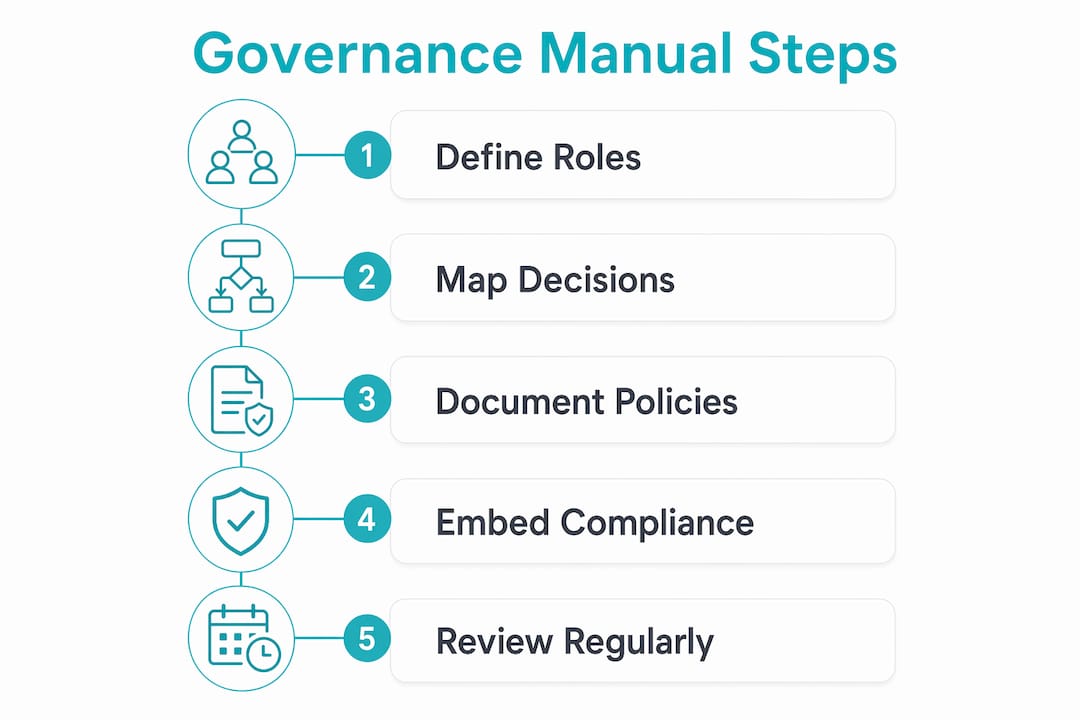
- Schedule the annual review as a standing agenda item for the governance or audit committee.
- Assign a named owner, typically the Company Secretary or CEO, to coordinate the review.
- Check all content against current ACNC requirements, the organisation's constitution, and any regulatory changes from the preceding year.
- Update committee charters, delegation matrices, and policy references as needed.
- Obtain board approval for the revised manual and distribute a single, version-controlled document to all board members.
Pro Tip: Use a version control table on the manual's cover page, listing the date of each revision, the sections changed, and the board resolution number approving the update. It takes five minutes to maintain and provides clear evidence of governance diligence.
How to create a governance manual for your non-profit
Building a governance manual from scratch is more manageable when you treat it as a structured project rather than a writing task. The goal is a document that reduces ambiguity for both new and experienced decision-makers by consolidating governance expectations into one accessible reference.
Follow these steps:
- Audit your existing governance documents. Collect your constitution, existing policies, committee charters, and delegation schedules. Identify gaps against the governance documentation essentials your organisation needs.
- Engage your stakeholders. Involve the board chair, CEO, and legal advisers early. Their input shapes the delegation matrix and ensures the manual reflects actual governance practice, not an idealised version of it.
- Draft core sections in priority order. Start with roles and responsibilities, then decision-making and delegation, then meeting procedures. Add ethics, risk, and compliance sections once the structural content is settled.
- Choose an accessible format. Electronically searchable documents support accountability and make the manual genuinely usable. A PDF with bookmarked sections or a shared intranet page both work well.
- Test it with users. Ask a new board member or committee chair to navigate the manual for a specific scenario. Their feedback will reveal gaps in clarity faster than any internal review.
- Integrate training. Introduce the manual formally at board induction and reference it in committee briefings. A document that people never open provides no governance value.
Pro Tip: Sector bodies including the ACNC and the Australian Institute of Company Directors publish governance templates and guidance notes. Use them as a structural starting point rather than writing from a blank page.
Key takeaways
A governance manual is the single most practical tool a non-profit board has for translating governance obligations into consistent, documented practice.
| Point | Details |
|---|---|
| Clear definition | A governance manual consolidates policies, roles, and decision-making processes into one operating handbook. |
| ACNC compliance | It operationalises Standard 5 duties by embedding conflict-of-interest and financial controls into board processes. |
| Living document | Annual reviews with version control prevent outdated content from creating compliance and decision-making risks. |
| Decision pathways | Structuring the manual around what the board decides versus delegates makes it genuinely usable. |
| Practical creation | Audit existing documents, engage stakeholders, and prioritise electronic accessibility to build an effective manual. |
The governance manual most boards already need but haven't written
After nearly three decades working across Australian human services and non-profit governance, I have seen the same pattern repeat. Boards operate for years on institutional memory, unwritten norms, and the assumption that everyone understands their role. Then a leadership transition happens, a complaint is lodged, or the ACNC asks a pointed question, and the absence of a governance manual becomes very visible, very quickly.
The manuals I have seen work best are not the longest or the most formally drafted. They are the ones that reflect how the organisation actually governs, not how it aspires to govern. That means the delegation matrix matches what the CEO actually signs off, and the conflict-of-interest policy reflects the real disclosure process the board follows. When the document and the practice diverge, the manual loses credibility and people stop using it.
The boards that treat their governance manual as a living reference, reviewing it annually and updating it when the organisation changes, are the ones that handle regulatory scrutiny with confidence. That confidence is not accidental. It comes from knowing your governance house is in order before anyone asks.
If your board does not have a current, version-controlled governance manual, that is the governance gap worth addressing first. What would your board do differently tomorrow if every member had a clear, shared reference for how decisions get made?
— Rachel
Governance manual support for Australian non-profits
The Planning and Practice Hub works with Australian non-profit boards and executives to develop, review, and align governance manuals with ACNC requirements and sector-specific obligations.
Rachel Willis and the team bring close to three decades of firsthand experience across human services governance, compliance, and operational frameworks. Whether you are building a governance manual from the ground up or reviewing an existing document against current standards, the hub provides practical, co-developed support tailored to your organisation's structure and regulatory context. For non-profits seeking dedicated NFP governance consulting or broader human services consulting, The Planning and Practice Hub offers clear pathways to stronger governance practice.
FAQ
What is a governance manual?
A governance manual is a consolidated reference document that defines a governing body's roles, responsibilities, decision-making processes, and compliance obligations. It functions as an operating handbook for boards and management.
What should be in a governance manual for an Australian non-profit?
A governance manual should include board and committee roles, a delegation matrix, meeting procedures, conflict-of-interest policies, financial oversight controls, and risk management processes aligned with ACNC Governance Standards.
How often should a governance manual be reviewed?
Governance manuals should be reviewed at least annually. A governance or audit committee typically leads the review and presents recommended updates to the full board for approval.
How does a governance manual help with ACNC compliance?
A governance manual operationalises ACNC Standard 5 by documenting how Responsible Persons discharge their duties, including conflict-of-interest disclosures, financial management, and accountability processes.
How do I start creating a governance manual?
Audit your existing governance documents, identify gaps, engage your board and legal advisers, and draft sections in priority order starting with roles, responsibilities, and delegation authorities.