
Values are the operative principles that determine how governance systems behave when rules run out. The role of values in governance extends far beyond policy statements or codes of conduct. Values shape which decisions get made, how leaders respond under pressure, and whether compliance frameworks actually hold. The 2026 IFAC/CIPFA framework defines good governance as the operationalisation of clear values through integrity, transparency, and accountability controls. Without that operationalisation, values remain aspirational text on a wall.
How values influence governance decision-making
Values act as both motivators and the basis for choice in governance, guiding what leaders consider good and shaping the identity of the organisation itself. This is not abstract. When a board weighs up a procurement decision, the values embedded in its governance system determine whether cost efficiency or community benefit takes precedence. That weighting is rarely written in a policy. It lives in culture, in discretion, and in the unspoken expectations of leadership.
The practical effects of values on governance outcomes include:
- Strategic direction. Values determine which goals an organisation pursues and which trade-offs it accepts. An organisation that genuinely holds equity as a value will set different KPIs than one that treats equity as a reporting requirement.
- Risk appetite. Governance bodies with transparency as a lived value surface problems earlier. They build reporting lines that reward disclosure rather than punish it.
- Accountability culture. Where integrity is embedded in oversight mechanisms, not just stated in a charter, staff and leaders are more likely to act consistently with expected standards.
- Compliance behaviour. Organisations that align their compliance systems with their stated values see fewer breaches, because staff understand the purpose behind the rule, not just the rule itself.
Pro Tip: Ask your board or executive team to name the three values that most influenced a recent significant decision. If the answers are vague or inconsistent, your values are not yet embedded in governance practice.
Understanding the importance of ethics in governance means recognising that ethical leadership is not a personality trait. It is a structural outcome. Leaders make better decisions when governance architecture supports values-based reasoning, not just legal compliance.

Values-based governance vs compliance-only models
Legal compliance alone does not produce effective governance. This is the central argument of value-based governance (VBG) theory, and it has direct implications for how you design your governance systems.
| Dimension | Compliance-only governance | Values-based governance |
|---|---|---|
| Primary driver | Legal obligation | Stakeholder values and norms |
| Decision basis | Rules and procedures | Values as heuristic and filter |
| Legitimacy source | Regulatory authority | Social and organisational values |
| Response to gaps | Wait for regulation | Apply values reasoning |
| Conflict management | Procedural resolution | Ongoing normative reasoning |
VBG treats governance as inherently normative, requiring active management of value conflicts rather than procedural compliance. This matters because most governance failures do not occur because an organisation broke a rule. They occur because no rule existed for the situation, and the organisation had no values architecture to fill the gap.
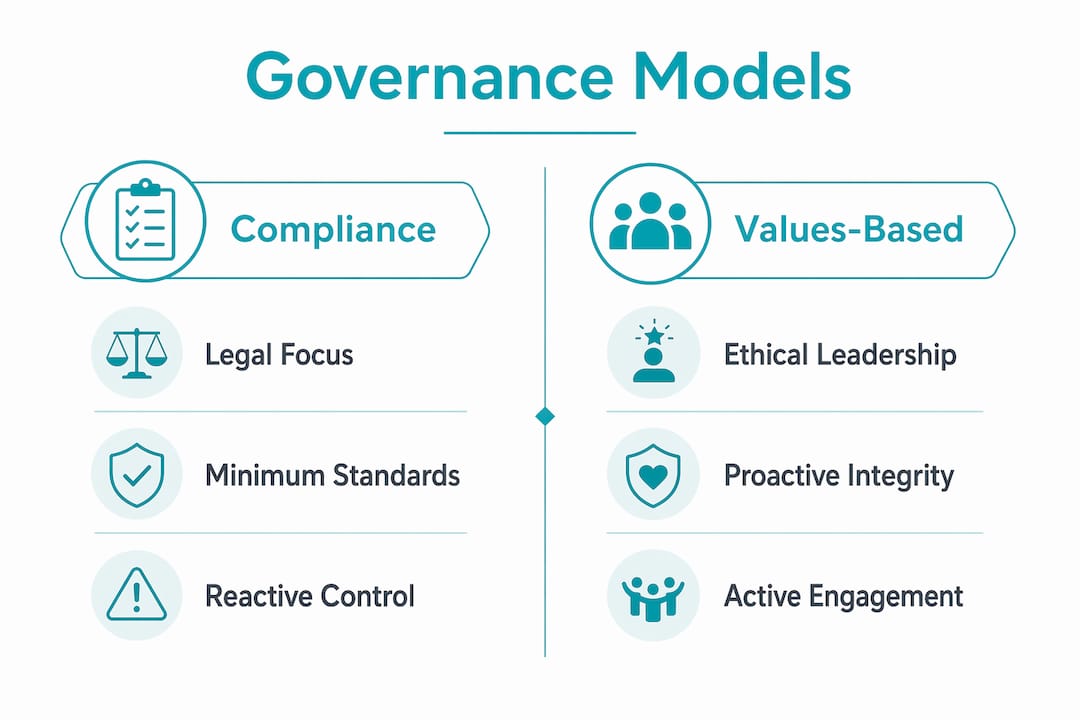
Legal norms alone cannot deliver effective governance without alignment to social values and administrative translation mechanisms. The integrated model that emerges from this research combines legal norms, social values, and administrative practices. For governance professionals in Australia's human services sector, this is particularly relevant given the density of regulatory obligations across more than 50 bodies. Compliance with each body's requirements is necessary but not sufficient. The question is whether your governance system holds together as a coherent expression of your organisation's values.
How to manage value conflicts in governance systems
Value conflicts are not edge cases. They are a permanent feature of governance, and managing them is a core ongoing function requiring normative reasoning rather than instrumental compromise. Expecting full resolution is a governance design error.
Practical steps for managing value conflicts include:
- Name the conflict explicitly. When two values produce competing imperatives, state that openly in governance deliberations. Unnamed conflicts produce covert decisions.
- Apply a values hierarchy. Not all values carry equal weight in every context. Governance frameworks should specify which values take precedence in defined circumstances.
- Build coping mechanisms into process. Governance arrangements that acknowledge recurring value tensions can design specific decision pathways for them, rather than leaving each instance to individual discretion.
- Document the reasoning. When a decision involves a value trade-off, record the reasoning. This creates accountability and supports learning over time.
- Review regularly. Value conflicts evolve as stakeholder expectations and regulatory environments change. Periodic review of known conflict points is governance hygiene, not a sign of weakness.
"Values are not slogans but must be embedded as controls guiding decisions and behaviour, using diagnostic questions to uncover real practices." — IFAC/CIPFA 2026 Framework
The OECD's 2026 Anti-Corruption and Integrity Outlook provides a concrete example. Judicial and prosecutorial integrity depends on merit-based, impartial appointments with enforceable appeal rights. The OECD found only partial implementation of these rights across jurisdictions, which means the integrity value exists in policy but not in operational architecture. That gap is where corruption risk concentrates.
Pro Tip: Map your organisation's known value conflicts before your next governance review. Identify which ones have explicit decision pathways and which ones rely on individual judgement. The latter are your highest governance risk points.
Practical ways to embed values in governance culture
Embedding values in governance culture requires auditing the translation layer where values become operational. Legal compliance needs alignment with organisational values through processes, discretion points, and controls. Without that audit, you cannot know whether your stated values are actually shaping behaviour.
The following diagnostic areas are drawn from the IFAC/CIPFA 2026 framework and are worth applying directly to your governance system:
- Decisions. Are integrity, transparency, and accountability visibly present in how significant decisions are made and recorded?
- Reporting lines. Do your reporting structures reward candour and surface problems, or do they create incentives for concealment?
- Oversight mechanisms. Are your assurance processes designed to test values alignment, or only to verify procedural compliance?
- Discretion points. Where individuals exercise judgement, what values guidance exists? Discretion without values architecture is governance risk.
| Translation layer | What to audit | Red flag |
|---|---|---|
| Decision processes | Values reasoning in board minutes | Decisions justified only by legal obligation |
| Reporting structures | Disclosure incentives and protections | Absence of whistleblower mechanisms |
| Assurance mechanisms | Scope of internal audit | Audits limited to financial compliance |
| Discretion points | Guidance for individual judgement | No documented values guidance for grey areas |
Governance leadership must move beyond stating values to testing their actual embedding in decisions, reporting, and assurance. The IFAC/CIPFA diagnostic questions are a practical tool for this. They are not a checklist. They are prompts for honest reflection about whether your governance system is doing what you think it is. For leaders who want to go deeper, embedding governance culture requires sustained attention to the organisational conditions that make values-based behaviour the default, not the exception.
Key takeaways
Values-based governance requires embedding integrity, transparency, and accountability as active decision filters, not stated principles, across every layer of governance architecture.
| Point | Details |
|---|---|
| Values drive decisions | Values determine strategic choices and risk appetite, not just organisational identity statements. |
| Compliance alone is insufficient | Legal norms without social values alignment leave governance gaps that rules cannot fill. |
| Value conflicts are permanent | Governance systems must build coping mechanisms for recurring value tensions, not expect resolution. |
| Audit the translation layer | Check where values become operational through processes, discretion points, and assurance mechanisms. |
| Leadership must test, not state | Use diagnostic frameworks like IFAC/CIPFA 2026 to verify values are live in governance practice. |
What I have learned about values and governance after nearly three decades
The most common failure I see is treating values as a communications exercise. An organisation publishes its values, trains staff on them once, and considers the job done. Then a governance failure occurs and everyone is surprised. The values were on the wall. They were in the annual report. They were not in the decision-making process.
What I have found, working across government and non-profit organisations in Australia's human services sector, is that values only function as governance tools when they are embedded in the architecture. That means they appear in board papers as explicit reasoning, not as background assumptions. It means reporting lines are designed to surface value tensions, not smooth them over. It means discretion points have documented guidance, because the absence of guidance is not neutrality. It is an invitation for values drift.
The other thing I want to name directly: value conflicts do not get resolved. They get managed. Organisations that expect to reach a stable equilibrium between competing values, say efficiency and equity, will keep being disappointed. The work is ongoing. The governance professional's job is to build systems that handle that tension productively, cycle after cycle, without it becoming destabilising.
Values-based governance is not softer than compliance governance. It is harder. It requires more rigour, more honesty, and more willingness to examine what is actually happening rather than what the policy says should happen. That is the work. And it is worth doing.
— Rachel
Work with The Planning and Practice Hub on governance that holds
If this article has prompted questions about whether your governance system is genuinely values-driven or primarily compliance-driven, that is a productive place to start. The Planning and Practice Hub works with government agencies, non-profits, and community service organisations across Australia to build governance frameworks that connect stated values to operational reality. Rachel Willis brings nearly three decades of sector experience to this work, with deep knowledge of the regulatory environment across human services. Explore our human services consulting to see how we approach governance in practice, or review our full range of consulting services to find the right starting point for your organisation.
FAQ
What is the role of values in governance?
Values serve as the guiding principles that shape leadership decisions, organisational behaviour, and compliance frameworks within governance structures. The IFAC/CIPFA 2026 framework defines good governance as the operationalisation of values like integrity, transparency, and accountability through controls and oversight mechanisms.
How do values differ from legal compliance in governance?
Legal compliance sets minimum obligations, while values determine how an organisation behaves when no rule exists for a situation. Value-based governance treats governance as inherently normative, using values as a heuristic to fill the gaps that legislation cannot cover.
How should governance leaders handle value conflicts?
Value conflicts are a permanent feature of governance, not problems to be solved once. Effective governance builds coping mechanisms into decision processes, names conflicts explicitly, and documents the reasoning behind value trade-offs to maintain accountability over time.
What does it mean to operationalise values in governance?
Operationalising values means embedding them as active decision filters across processes, reporting lines, discretion points, and assurance mechanisms. Auditing the administrative translation layer where values become operational is the practical test of whether stated values are actually shaping governance behaviour.
Why is ethical leadership central to governance outcomes?
Ethical leadership in governance is a structural outcome, not a personal quality. When governance architecture supports values-based reasoning through clear frameworks, diagnostic tools, and accountability mechanisms, leaders are more likely to make decisions that align with organisational and community values.