
Practice leadership in community services is the board-and-CEO ownership of safe, compliant, high-quality service delivery and practice assurance. It is not frontline supervision. It is not a quality manager's job title. It is the governing body's responsibility to set the conditions, approve the systems, and hold the organisation accountable for what actually happens to the people it supports.
Three actions your board and CEO should take this quarter:
- Update your delegation schedule and board charter to make practice accountabilities explicit: who owns what, at what threshold, and what must come back to the board.
- Appoint or confirm a named practice assurance lead with a defined reporting cadence to the CEO and, where material risks arise, directly to the chair.
- Add practice indicators to your board dashboard alongside financial metrics so the board receives a complete picture of organisational health at every meeting.
The AICD Not-for-Profit Governance Principles (2024) are explicit: boards must document chair and CEO responsibilities, approve delegation frameworks, and own CEO performance evaluation. The Victorian Community Services Quality Governance Framework goes further, stating that ignorance of regulatory change or service failure is not an acceptable defence. The Planning and Practice Hub works with boards and CEOs across the sector to build exactly this kind of governance line of sight.
Key takeaways
Effective practice leadership in community services requires the board to own the conditions for safe, compliant service delivery, not just receive reports about it.
| Point | Details |
|---|---|
| Define practice leadership clearly | Practice leadership is board-and-CEO ownership of practice quality and assurance, not frontline supervision. |
| Update charter and delegations | Review and reapprove your delegation schedule and board charter early to make practice accountabilities explicit. |
| Appoint a named assurance lead | A practice assurance lead with a direct escalation path to the chair is a non-negotiable governance structure. |
| Add practice indicators to the board dashboard | Incident rates, complaint themes, and workforce turnover belong on the board dashboard alongside financial metrics. |
| The Planning and Practice Hub | Supports boards and CEOs with practice assurance frameworks, compliance calendars, and governance advisory across Australian human services. |
Why practice leadership in community services matters right now
Regulatory expectations have shifted. Boards are no longer judged solely on financial stewardship. The Victorian Community Services Quality Governance Framework places collective accountability for service quality squarely on the board, executives, and managers together. Royal Commissions into aged care, disability services, and child protection have each found that governance failures, not just frontline failures, contributed to harm. The message from every major inquiry is consistent: the board knew, or should have known.
Regulator expectations are now codified across multiple frameworks your organisation likely operates under:
- NDIS Practice Standards require registered providers to demonstrate governance and operational management that keeps participants safe and supports their rights.
- ACNC Governance Standards require charity boards to act in the charity's best interests, manage conflicts, and maintain financial oversight, with Standard 5 specifically addressing the suitability of persons in governance roles.
- State frameworks such as the Victorian Community Services Quality Governance Framework require boards to review systems and processes so service quality stays central.
Weak practice leadership creates compounding risk. Incidents that should have been escalated are not. Workforce concerns that signal cultural problems go unread. Community feedback that would have changed a service model never reaches the board. The reputational, regulatory, and human cost of these gaps is well documented.
What does a practice governance framework actually contain?
The ACWA model practice governance framework identifies leadership and culture, roles and responsibilities, continuous improvement, and explicit levers of practice quality as the foundational components. For a board, this translates into a set of artefacts and activities the governing body must approve and monitor.
| Component | What the board approves or monitors |
|---|---|
| Leadership and culture | CEO performance framework; values and culture statement; whistleblower policy |
| Roles and responsibilities | Board charter; CEO delegation schedule; practice assurance lead position description |
| Practice assurance system | Audit and review calendar; incident escalation policy; peer review process |
| Levers and systems | Supervision framework; critical incident management policy; workforce development plan |
| Community voice | Feedback and complaints mechanism; community advisory structure; participation policy |
| Workforce development and succession | Capability framework; succession plan; board induction and continuing education programme |
The Our Community code of governance reinforces that boards must provide induction, continuing support, and clear policies so directors can fulfil their oversight responsibilities. Without these artefacts approved and current, the board cannot demonstrate it has exercised its duty.
A strong chair and CEO relationship underpins every component. The AICD principles require documented role statements, agreed delegation limits, and a proactive briefing rhythm. When those three elements are absent, the board is routinely surprised, and surprises in community services rarely carry good news.
How do you build this in 3 to 12 months?
A sequenced roadmap prevents the common trap of trying to fix everything at once and finishing nothing.
Step 1: Readiness assessment (Month 1) Map your current regulatory obligations across NDIS Practice Standards, ACNC Governance Standards, and any applicable state framework. Identify who currently signs off on practice quality and where the gaps sit. The CEO's role in governance requires the CEO to maintain up-to-date regulatory knowledge and own emerging risks. If that briefing is not happening systematically, start there.
Step 2: Charter and delegation update (Month 1 to 2) Review your board charter and delegation schedule against the AICD principles. Define CEO and chair accountabilities for practice quality explicitly. Set performance measures the board will use to evaluate the CEO against practice outcomes, not just financial targets.
Step 3: Appoint a practice assurance lead (Month 2 to 3) This person is not the quality manager doing compliance paperwork. They hold named accountability for the practice assurance system, report to the CEO, and have a direct escalation path to the chair for material risks. The Victorian Department of Health's board education and CEO leadership capability framework provides a useful model for how capability expectations can be formalised at both board and executive level.
Step 4: Design the KPI dashboard (Month 3 to 4) Practice indicators belong on the board dashboard alongside financial metrics. Include incident rates and resolution times, complaint volumes and themes, workforce participation and turnover, audit findings and closure rates, and community feedback sentiment. Set escalation triggers so the chair is notified outside the normal reporting cycle when a threshold is breached.

Step 5: Embed community voice (Month 4 to 6) Independent community feedback mechanisms reduce the risk that local concerns are filtered through management only. Build a feedback channel that reaches the board directly, not only through the CEO's report. This is particularly critical in community-controlled organisations where cultural safety and self-determination must be reflected in governance decisions.
Step 6: First 12-month assurance cadence (Month 6 to 12) Schedule board workshops on practice leadership, an independent external assurance review, and a mid-year check on the delegation schedule. Allocate a resourcing budget for this work. Governance capability building is not a one-off event.
Quarterly milestone guide: Month 1 to 3: assessment, charter, lead appointed. Month 4 to 6: dashboard live, community feedback active. Month 7 to 12: external review complete, board workshop held, succession plan approved.
What governance pitfalls should boards fix first?
AICD director tools identify the trap of "managing by the paper" as one of the most persistent risks in not-for-profit governance. Boards that rely solely on management-prepared reports cannot independently verify that what is reported reflects what is actually happening. External compliance advice is often the fastest way to close this gap.
Common pitfalls and the quickest board action for each:
- Delegating accountability without oversight: Require the CEO to report on practice quality at every board meeting, not just when something goes wrong.
- Managing by the paper: Add a standing agenda item for non-management feedback, such as a de-identified community or workforce survey result.
- Unclear delegations: Review and reapprove the delegation schedule annually, not only when a problem surfaces.
- Bypassing the CEO to management: The chair communicates with management through the CEO. Document this in the charter and hold to it.
- Weak chair and CEO relationship: Schedule a monthly one-on-one briefing between the chair and CEO with a standing agenda covering emerging risks and regulatory changes.
- No independent practice assurance function: Commission an external assurance review at least once every 12 months, separate from any internal audit.
When a board identifies that it cannot answer basic questions about its own practice quality, that is the signal to seek external independent advice. Regulators expect boards to act on what they know, and to find out what they do not.
How one community-controlled service tightened governance and improved outcomes
A small community-controlled organisation in a regional area had a board that met quarterly, received a CEO report, and approved financials. Practice quality was not on the agenda. After a concerning incident, the board commissioned an external governance review.
The review found no delegation schedule, no practice assurance lead, and no community feedback mechanism that bypassed management. Board members had received no induction on the NDIS Practice Standards the organisation was registered against.
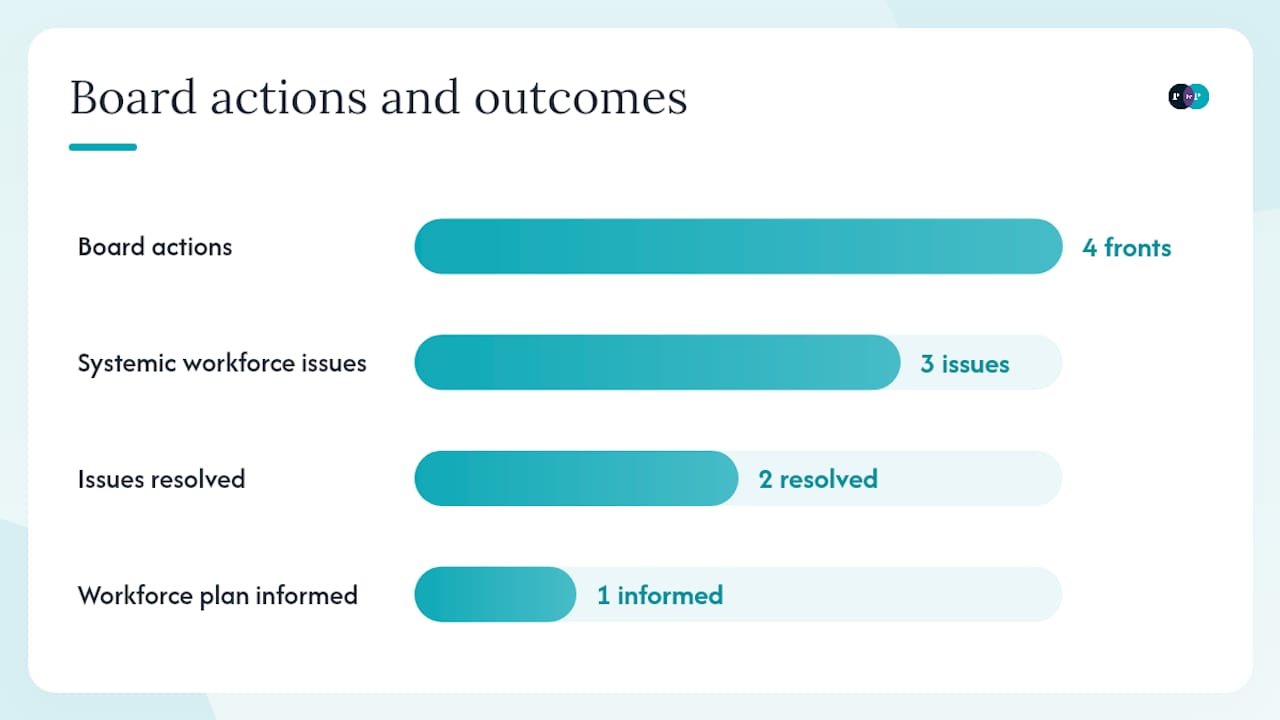
The board acted on four fronts:
- Updated the charter to include explicit practice accountabilities for the CEO and a named escalation path to the chair.
- Appointed a senior practitioner as practice assurance lead, with a quarterly report to the board.
- Introduced a community feedback survey administered independently, with results tabled directly at board meetings.
- Held a half-day board workshop on NDIS Practice Standards and the organisation's regulatory obligations.
Within six months, the board could answer the question: "How do we know our services are safe?" The practice assurance lead's first report identified three systemic workforce issues that had not appeared in any previous management report. Two were resolved within the quarter. The third informed a workforce development plan that the board approved and funded.
The lesson the chair took away: a board that only reads what management writes will only know what management knows.
Practice governance is active capital, not a compliance cost
Boards that treat governance as a quarterly compliance exercise miss the point entirely. The organisations I see building genuine practice leadership are the ones where the chair and CEO have a shared language about risk, where the board dashboard tells a practice story as clearly as a financial one, and where community feedback reaches the boardroom without being sanitised first.
The Planning and Practice Hub works with boards and CEOs who are ready to move from passive oversight to active assurance. The question I ask every chair I work with is this: if your regulator called tomorrow and asked how you know your services are safe, what would you say, and could you prove it?
The Planning and Practice Hub supports boards and CEOs with practice governance
The Planning and Practice Hub works with boards and CEOs in Australian human services to build practice governance frameworks that hold up under regulatory scrutiny. Services include governance advisory, practice assurance framework design, board workshops, and a compliance calendar that keeps your regulatory obligations visible across the full year.
If your board cannot currently answer the question "how do we know our services are safe?", that is where to start. Contact The Planning and Practice Hub to book an initial governance conversation.
Sources
- Community services quality governance framework
- AICD Not-for-Profit Governance Principles (2024)
- Health service boards and governance (Victorian Department of Health)
FAQ
What is practice leadership in community services?
Practice leadership in community services is the board-and-CEO responsibility for ensuring safe, compliant, and high-quality service delivery through approved governance systems, practice assurance mechanisms, and clear accountability structures. It is distinct from frontline supervision or day-to-day management.
What do NDIS Practice Standards require from boards?
The NDIS Practice Standards require registered providers to demonstrate governance and operational management that keeps participants safe, supports their rights, and maintains a capable and accountable leadership structure.
How often should a board review its practice governance framework?
Boards should review their practice governance framework at least annually, with a mid-year check on the delegation schedule and a 12-month external assurance review as part of a structured governance cadence.
What is a practice assurance lead and why does the board need one?
A practice assurance lead is a named executive accountable for the organisation's practice assurance system, including audits, incident oversight, and community feedback. Without a named lead, practice quality accountability diffuses across management and rarely reaches the board with sufficient clarity.
How can The Planning and Practice Hub help with practice governance?
The Planning and Practice Hub works with boards and CEOs to design practice assurance frameworks, update charters and delegation schedules, build compliance calendars, and facilitate board workshops on governance obligations across NDIS, ACNC, and state-based frameworks.