
TL;DR:
- Building a compliance matrix and confirming eligibility are the first steps after receiving an OOHC tender. Evaluators prioritize mandatory gates and documented evidence over persuasive writing, so responses must be tailored to scoring criteria. Eligibility requires applicants to have a valid ABN and not be sole traders, with ongoing adherence to pricing and contract requirements.
When an OOHC tender lands in your inbox, the first action is not to start writing. Build a compliance matrix immediately, confirm your entity's eligibility, and check the lodgement deadline before anything else. For the NSW Department of Communities and Justice (DCJ) Casework Support Scheme (CSS), that means confirming you hold a valid ABN, that your entity is not a sole trader, and that you can deliver against the fixed price schedule. The Planning and Practice Hub works with organisations across Australia on exactly this process.
Do these four things first:
- Assign one internal owner for the compliance matrix before the end of day one.
- Create a mandatory requirement register listing every "must", "shall", and required attachment with owner and status.
- Confirm whether sole traders are excluded (they are under DCJ CSS) and check your entity type.
- Lock the file-naming convention and submission method specified in the tender pack.
Pull your certificate of currency, governance documents, and any existing accreditation records at the same time. The lodgement deadline is non-negotiable.
Why OOHC tenders are a compliance exercise, not a creative brief
Evaluators do not read OOHC funding applications looking for compelling prose. They work through a scoring matrix, checking compliance gates first and then awarding marks against weighted selection criteria. A response that reads beautifully but fails a mandatory gate is removed from scoring before anyone reads the narrative.
This matters because most organisations invest their effort in the wrong place. They write persuasive introductions and spend little time on evidence. Panels score against criteria; a criterion worth a large percentage of the total requires deeper evidence and stronger case studies than a low-weight criterion. Effort must follow weighting.
Evaluators prioritise in this order:
- Pass/fail mandatory gates (missing one disqualifies the response).
- Scored selection criteria, each weighted and marked against documented evidence.
- Measurable outcomes and performance data, not assertions.
- Alignment with the National Principles for Child Safe Organisations and, where relevant, Aboriginal child placement principles.
Generic templates consistently fail here because they omit the localised requirements evaluators look for, including cultural safety obligations and community-specific engagement evidence.
What every OOHC tender response in Australia must show
Start with eligibility. Under the DCJ CSS, approved providers must be organisations or entities with a valid ABN; sole traders are excluded. Providers enter a Panel Deed and must deliver services against the CSS price schedule without adding unapproved costs.
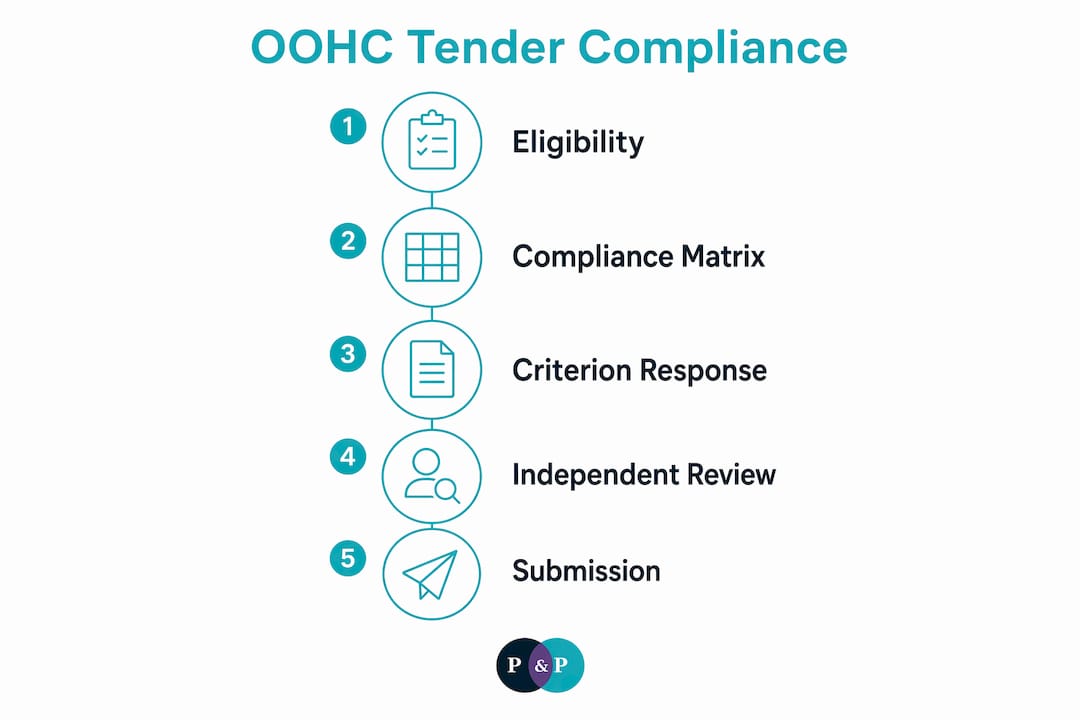
Build your compliance matrix by converting the tender pack into a register that separates pass/fail requirements, scored criteria, returnable schedules, pricing instructions, and contract terms. This is the control document that maps each requirement to a response location, evidence owner, and status.
| Criterion | Evidence to attach | Owner | Status |
|---|---|---|---|
| Governance and organisational structure | Board constitution, ACNC Governance Standards compliance, org chart | CEO / Company Secretary | Ready / Not ready |
| Child safe policies | Policies mapped to National Principles for Child Safe Organisations | Quality Manager | Ready / Not ready |
| Workforce capability | Supervision model, VET qualifications, staff registers | HR Manager | Ready / Not ready |
| Risk and safeguarding | Risk register, incident management policy, WWCC records | Quality Manager | Ready / Not ready |
| Performance measurement | Outcome data, KPI reports, previous contract performance evidence | Program Manager | Ready / Not ready |
| Pricing and value for money | Completed pricing schedule, value-for-money statement | Finance Manager | Ready / Not ready |
Document checklist:
- Certificate of currency (public liability and professional indemnity).
- Signed declarations and returnable schedules as specified.
- Case studies using STAR metrics (situation, task, action, result) with named outcomes.
- Referee contacts from recent, relevant contracts.
- Completed pricing spreadsheet aligned to the agency price schedule.
How to structure each selection criterion answer
Lead every criterion response with a direct statement that answers the question. Then prove it. Then quantify the outcome. Then note what you improved.

The micro-template is: Statement → Evidence → Measure → Improvement.
A short exemplar using STAR: "Our organisation has delivered supervised contact services across three DCJ districts since 2021 (Situation/Task). We introduced a dedicated coordination model with a qualified supervisor-to-worker ratio of 1:6 (Action). Across 2023–24, we completed 98% of scheduled contacts with zero critical incidents (Result). Following a mid-year review, we reduced average response time to new referrals from five days to two (Improvement)."
Sentence starters to brief your writing team:
- "Our organisation has [specific experience] demonstrated by [evidence source and date]."
- "We meet this requirement through [policy/process], which is attached as [Attachment X]."
- "Our workforce capability is evidenced by [qualification data, supervision model]."
- "Performance against this criterion is measured by [KPI], with [result] achieved in [period]."
- "Continuous improvement is managed through [process], most recently resulting in [change]."
When referencing attachments, use consistent labels throughout (e.g. "refer to Attachment 3: Supervision Policy") so evaluators can locate supporting documents without searching.
Common reasons OOHC tender responses fail
Most failures are compliance or evidence gaps. The writing quality rarely causes disqualification; missing a mandatory document does.
- Missing mandatory attachments. A missing certificate of currency or unsigned declaration is a pass/fail disqualifier. Mitigation: the compliance matrix owner signs off every mandatory item before submission.
- Generic templates. Templates that omit Aboriginal engagement detail or National Principles for Child Safe Organisations alignment score poorly. Mitigation: localise every criterion response to the specific geography and community.
- Pricing departures. DCJ CSS contracted providers cannot exceed price rates or add additional costs. Mitigation: finance manager cross-checks the completed schedule against the published price schedule before lodgement.
- Late lodgement. Portals close at the stated time; late submissions are rejected automatically. Mitigation: complete a lodgement rehearsal 48 hours before the deadline.
- Inconsistent claims. Workforce numbers or outcome figures that differ between sections raise compliance flags. Mitigation: one person reconciles all figures in a final read-through.
When to bring in specialist tender-writing support
Engage a specialist when your organisation has gaps in compliance mapping, evidence collation, or when the timeline is under three weeks and internal capacity is stretched. Use internal teams when you have a strong prior submission record, a dedicated quality manager, and time for an independent compliance review.
Decision factors:
- Complexity of the panel deed and price schedule obligations.
- Whether you have existing, measurable outcome data ready to cite.
- Internal capacity and your organisation's prior tender success rate.
- Whether the tender requires ACCO partnership evidence you have not documented before.
A typical specialist engagement covers: compliance matrix build, criterion drafting for highest-weighted items, evidence collation, pricing schedule review, and a final compliance pass before lodgement. Expect two to four weeks for a full engagement, with the compliance matrix completed in the first three days.
For Aboriginal Community Controlled Organisations (ACCOs), AbSec offers up to 16 hours of free independent tender support for drafting and strategic design, available regardless of membership status.
Anonymised practice example: A mid-sized child and family organisation in regional NSW had submitted two previous CSS responses without success. Both responses had strong narrative sections but were missing a completed pricing schedule and lacked any reference to the National Principles for Child Safe Organisations. A compliance-led rewrite over 12 days addressed both gaps, added STAR-format case studies with outcome data, and completed a lodgement rehearsal. The organisation was accepted onto the CSS panel at the next round.
Pro Tip: Use an independent reviewer for the final compliance pass who has not been involved in drafting. Fresh eyes catch file-naming errors, missing attachments, and inconsistent figures that writers overlook.
Key takeaways
Compliant OOHC tender responses in Australia require a mandatory requirement register, criterion-specific evidence mapped to panel scoring, and a final independent compliance pass before lodgement.
| Point | Details |
|---|---|
| Build the compliance matrix first | Map every "must", "shall", and required attachment to an owner and status before drafting begins. |
| Eligibility gates are absolute | Confirm ABN, entity type, and insurances; sole traders are excluded from DCJ CSS. |
| Evidence beats persuasion | Panels score documented outcomes, not assertions; use STAR-format case studies with measurable results. |
| Pricing must match the schedule | DCJ CSS providers cannot exceed price rates or add unapproved costs; finance must sign off the schedule. |
| The Planning and Practice Hub | Provides compliance matrix build, criterion drafting, evidence collation, and lodgement support for OOHC tenders. |
7-day plan: Assign owners, collect mandatory documents, and draft responses for the two highest-weighted criteria.
21-day plan: Full draft complete, pricing finalised, independent compliance pass done, lodgement rehearsal completed.
What nearly 30 years in sector teaches you about OOHC tenders
The organisations that consistently win panel placements are not the ones with the most polished writing. They are the ones that treat the tender as a compliance audit of their own practice. When a client comes to me after a failed submission, the gap is almost always the same: strong intent, weak evidence. They know they do good work. They just have not documented it in a way that maps to the scoring guide.
The shift that changes outcomes is deciding, before you write a single word, that the compliance matrix is the document that governs everything else. Every criterion response, every attachment, every pricing cell flows from that register. When it is built well, the writing almost writes itself.
One organisation I worked with had been submitting OOHC funding applications for three years without success. When we rebuilt their compliance matrix and mapped their existing policies to the National Principles for Child Safe Organisations, we found they already had most of the evidence. It was sitting in their quality management system, unlabelled and unattached. The rewrite took less than two weeks. They were accepted onto the panel.
Which two people in your organisation will you assign to own the compliance matrix today?
The Planning and Practice Hub supports OOHC tender preparation
For organisations preparing out-of-home care proposals under tight timelines, The Planning and Practice Hub offers a fixed-scope OOHC tender support service: compliance matrix build, criterion drafting, evidence collation, pricing schedule review, and a final compliance pass before lodgement. Rachel Willis brings close to 30 years of sector experience across child and family, NDIS, aged care, and community services, working directly with CEOs and quality managers rather than delegating to junior staff.
Engagement shapes range from a rapid compliance audit (three to five days) through to a full tender preparation package (two to four weeks). There are no ongoing fees attached to a single tender engagement. If you are weighing whether to prepare this submission internally or bring in specialist support, the consulting services page sets out current availability and how to start a conversation.
Useful sources and further reading
These are the primary documents your team should have open during tender preparation.
- DCJ Casework Support Scheme guidelines: Eligibility rules, Panel Deed obligations, price schedule requirements, and performance monitoring expectations. Keep this open during the compliance matrix build.
- BidShortlist: how to write a tender response: Practical guidance on structuring criterion responses, weighting, and evidence requirements. Useful for briefing internal writing teams.
- AbSec tender writing support: Up to 16 hours of free independent support for ACCOs, regardless of membership. Contact AbSec early; availability is limited.
- Doreva: understanding tender requirements: Clear guidance on building a compliance matrix and separating pass/fail requirements from scored criteria.
- CapabilityStatement: tender compliance: Covers final compliance checks including formatting, file naming, portal upload, and receipt capture.
| Source | Most useful for |
|---|---|
| DCJ CSS guidelines | Eligibility, Panel Deed, price schedule rules |
| BidShortlist | Criterion structure, weighting, evidence technique |
| AbSec | Free tender support for ACCOs |
| Doreva | Compliance matrix build and requirement mapping |
| CapabilityStatement | Final compliance pass and lodgement checklist |
Keep these links in your compliance matrix and cite them in clarification responses when an evaluator queries your methodology.
FAQ
What is a compliance matrix in an OOHC tender?
A compliance matrix is a register that lists every mandatory requirement, scored criterion, and required attachment from the tender pack, mapped to an owner, response location, and status. Building it before drafting is the single most effective control against disqualification.
Can sole traders apply for the DCJ Casework Support Scheme?
No. The DCJ CSS requires applicants to be organisations or entities with a valid ABN; sole traders are not eligible to apply.
How do you structure a selection criterion response for an OOHC tender?
Use the Statement → Evidence → Measure → Improvement structure: open with a direct answer to the criterion, support it with documented evidence, quantify the outcome, and note a continuous improvement action.
When should an organisation engage a specialist tender-writing consultancy?
Engage a specialist when internal capacity is limited, evidence is not documented against scoring criteria, or the timeline is under three weeks. ACCOs can access up to 16 hours of free support through AbSec before considering paid consultancy.
What happens after an OOHC tender is submitted?
Providers accepted onto a panel, such as the DCJ CSS, enter a Panel Deed and are subject to ongoing performance monitoring and audits. Pricing must continue to adhere to the agency price schedule throughout the contract term.