
TL;DR:
- Preparing homelessness services tenders requires organizational readiness, compliance, and structured evidence before deadlines. Small nonprofits can compete effectively by framing their size as an advantage and using disciplined project management. Building a strong evidence base, addressing risks openly, and following a Claim-Evidence-Benefit approach increases chances of winning.
Homelessness services tender writing is a structured, evidence-driven process that demands compliance, clear capability demonstration, and direct alignment with government evaluation criteria. Most nonprofits underestimate the preparation required. A quality tender response takes 40–100 hours of staff time, the majority spent on content rather than portal registration. That investment is only worthwhile when your organisation understands what evaluators are actually scoring, what accreditation you need before you can sign a contract, and how to frame your evidence so it lands. This guide covers all three.
What does homelessness services tender writing actually require?

Winning a specialist homelessness services tender is not primarily a writing exercise. It is a compliance and strategic communication exercise. The NSW Building Crisis Housing Plan and similar state-funded programmes require providers to demonstrate organisational maturity, sector-specific accreditation, and measurable service outcomes before a contract can be executed.
Evaluators read your submission against explicit, weighted criteria. They are not looking for passion or mission statements. They are looking for evidence that your organisation can deliver the contracted outcomes without creating risk for the funder. That framing changes how you approach every section of a response.
The government tender writing process for homelessness services sits at the intersection of procurement regulation, sector accreditation, and organisational governance. Getting all three right before you write a single word is the difference between a credible submission and a disqualified one.
What prerequisites do you need before submitting a homeless services proposal?
Accreditation is the first gate. Homelessness Accreditation Framework compliance is mandatory for signing contracts under programmes like the NSW Building Crisis Housing Plan, and achieving it typically takes 12–18 months depending on your organisation's maturity. That timeline means you cannot start the accreditation process when a tender is released. You need to be well into it, or already certified, before the opportunity appears.
Beyond accreditation, you need:
- Procurement portal registration. NSW uses eTendering NSW; Victoria uses Tenders VIC. Registration is free and takes less than a day, but you cannot submit without it.
- Current insurance certificates. Public liability, professional indemnity, and workers' compensation are standard requirements. Check the specific RFT for minimum coverage amounts.
- Organisational licences and certifications. Working with Children Checks, police clearances, and any state-specific community services licences must be current and documented.
- Capacity prequalification. Some programmes require prequalification before you can even access the tender documents. Check this early.
If your organisation is not yet accredited, partnering with an accredited provider is a legitimate path. The arrangement must be clearly documented in your submission, with defined roles, governance structures, and accountability mechanisms. Evaluators will scrutinise the partnership model carefully.
Pro Tip: Register on procurement portals and gather your compliance documents before any tender is released. Scrambling for an expired insurance certificate two days before closing is avoidable.
How do you structure a tender response to score well?
The Claim-Evidence-Benefit structure is the most reliable framework for answering selection criteria in homelessness service tenders. Make a direct claim, support it with quantified evidence, then explain the benefit to the funder's stated outcomes. Generic statements about your organisation's commitment to client wellbeing do not score. Specific metrics do.
Here is a practical sequence for structuring each criterion response:
- Mirror the criterion language exactly. Use the same terminology the RFT uses. If the document says "trauma-informed practice," use that phrase, not "person-centred care." Evaluators score against the criterion as written.
- Lead with your strongest claim. Evaluators read dozens of submissions; placing your most compelling evidence at the start of each section maximises impact before attention drops.
- Quantify every outcome you cite. "We supported 47 people into stable housing over 12 months, with 82% maintaining tenancy at six months" is scoreable. "We have strong outcomes" is not.
- Use the STAR method for case examples. Situation, Task, Action, Result. Keep it tight. One well-constructed example per criterion is more persuasive than three vague ones.
- Respect word limits. Exceeding a word limit signals poor judgement. Staying well under it signals you had nothing to say. Aim for 90–95% of the allocated limit.
Tone matters too. Match the register of the tender documents. Government RFTs are formal and precise. Your response should be the same. Avoid marketing language, superlatives, and anything that reads like a brochure.
Pro Tip: Print the evaluation criteria and physically tick each one as you address it. Missed criteria are the single most common reason for low scores.
What project management practices improve tender writing efficiency?
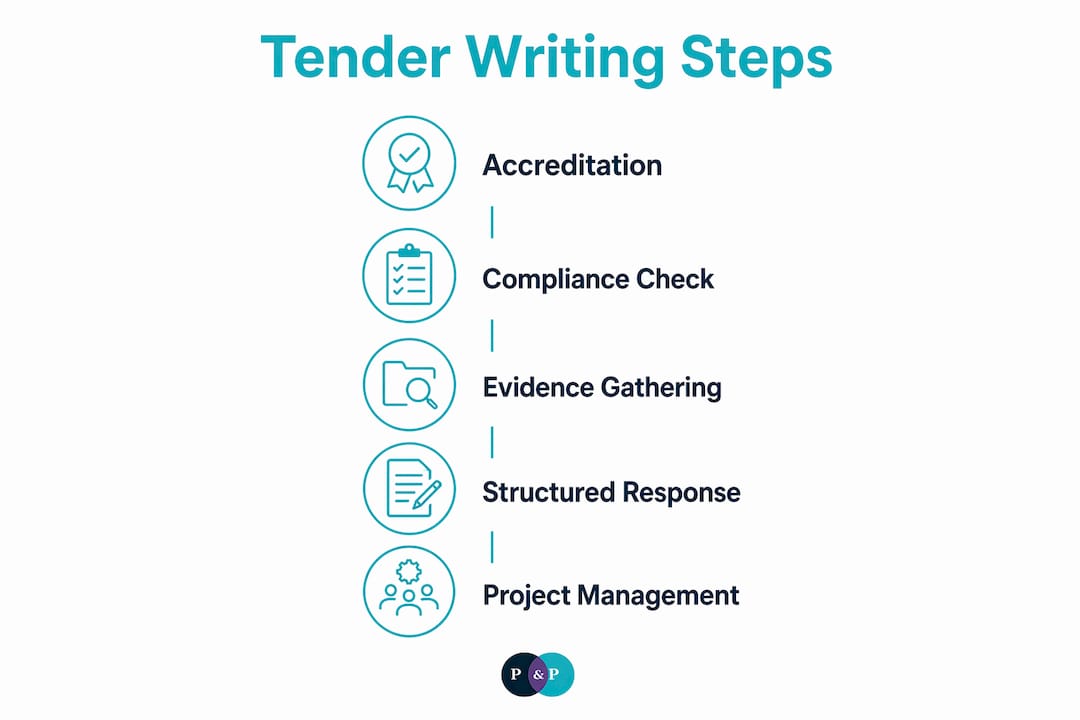
Treating a tender submission as a project, not a writing task, is what separates organisations that submit consistently good bids from those that scramble every time. The Go/No-Go decision is the first step. Build a compliance matrix spreadsheet that maps every mandatory and weighted requirement against your current organisational capability. If you cannot meet three or more mandatory criteria, do not submit. The 40–100 hours of staff time is better spent on the next opportunity.
Once you decide to proceed, the following practices reduce errors and improve quality:
- Set internal deadlines at least three days before the official closing date. This buffer allows a final compliance pass, formatting checks, and portal upload without time pressure.
- Assign clear roles. One person drafts each section. A second person reviews for compliance. A third person, ideally a senior leader, approves the final submission. Never let the drafter self-approve.
- Build a content library. Reusable company profiles, case studies, CVs, methodology descriptions, and outcome data cut writing time significantly on future bids. Investment in a content library reduces writing time and improves quality over time.
- Familiarise yourself with the submission platform before the closing week. Portal technical issues are common. Submitting 48 hours early eliminates that risk entirely.
| Practice | Purpose |
|---|---|
| Compliance matrix | Identifies gaps early and supports Go/No-Go decision |
| Internal deadline buffer | Allows final quality checks without time pressure |
| Content library | Reduces writing time and improves consistency across bids |
| Role assignment | Separates drafting, review, and approval to catch errors |
| Early platform testing | Prevents last-minute technical submission failures |
What are the most common pitfalls in homeless services proposal writing?
Most tender losses are preventable. The patterns repeat across organisations of all sizes.
- Failing to read the full tender document. Addenda, clarification notices, and appendices often contain mandatory requirements that are not in the main body. Missing one disqualifies your submission.
- Overclaiming without evidence. Stating your organisation is a "leader in trauma-informed care" without data to support it damages credibility. Evaluators are experienced. They recognise inflation.
- Underpricing to win. A budget that does not reflect the true cost of delivery signals either inexperience or an intention to cut corners. Direct negotiation commissioning still requires transparent budgeting and clear value-for-money evidence.
- Neglecting risk identification. Procurement evaluators assess risk as much as capability. A submission that does not identify service delivery risks and explain how you manage them reads as naive.
Ignoring the agency's stated priorities and submitting a generic response is the most expensive mistake a nonprofit can make. Evaluators can tell within two paragraphs whether you read their strategic plan. Responses that do not reflect the funder's language, priorities, and risk concerns score poorly regardless of organisational quality.
Addressing perceived weaknesses is also worth doing directly. Smaller organisations that frame their size as an advantage, citing leadership attention, agility, and high service levels, score better than those who avoid the topic entirely. Transparency builds credibility. Silence invites doubt.
Key takeaways
Effective homelessness services tender writing requires accreditation, structured evidence, and disciplined project management well before the submission deadline.
| Point | Details |
|---|---|
| Accreditation comes first | Homelessness Accreditation Framework certification takes 12–18 months; start before a tender is released. |
| Structure every criterion response | Use Claim-Evidence-Benefit with quantified outcomes; mirror the RFT's exact terminology. |
| Decide early with a compliance matrix | A Go/No-Go decision based on mandatory criteria prevents wasted effort on unwinnable bids. |
| Build a content library | Reusable case studies, CVs, and methodology descriptions reduce writing time on future submissions. |
| Address risk and weaknesses directly | Evaluators score risk mitigation heavily; transparent framing of organisational limitations builds credibility. |
What I have learned from working with homelessness nonprofits on tenders
The organisations I see win consistently are not necessarily the largest or the most experienced. They are the ones who treat tender writing as a project management discipline, not a creative exercise. They make the Go/No-Go call early, they build their evidence base between tender rounds, and they write directly to the funder's stated risks rather than their own organisational story.
The hardest conversation I have with clients is about underpricing. There is a persistent belief that a lower budget signals commitment to the cause. It does not. It signals that you have not costed the work properly, and that creates a risk flag for evaluators. Price your services to deliver them sustainably.
Smaller organisations often worry that their size works against them. My experience is the opposite. A well-run organisation of ten people that can demonstrate leadership oversight, low staff turnover, and consistent client outcomes will outscore a larger organisation with a generic response every time. The key is framing that story with data, not just assertion.
Post-submission debriefs are underused. Most government agencies will provide feedback on unsuccessful bids if you ask. That feedback is the most specific, actionable intelligence you can get for the next round. Build the debrief request into your process as a standard step, not an afterthought.
What does your organisation currently do between tender rounds to build the evidence base you will need for the next submission?
— Rachel
How The Planning and Practice Hub supports homelessness tender submissions
Preparing a credible, compliant tender for homelessness services takes more than good writing. It takes organisational readiness, clear governance, and evidence that holds up under scrutiny.
The Planning and Practice Hub works with nonprofits across Australia to build that readiness. From homelessness sector consulting that aligns your service model with funder priorities, to human services consulting that supports tender strategy, content development, and submission management, the work is practical and grounded in nearly three decades of sector experience. If your organisation is preparing for an upcoming funding round, or building capability for the next one, reach out to discuss where support would make the most difference.
FAQ
How long does a homelessness services tender take to prepare?
A quality tender response typically requires 40–100 hours of staff time. Most of that time goes to content preparation rather than portal registration or administrative tasks.
Is accreditation mandatory for homelessness service tenders?
Accreditation under the Homelessness Accreditation Framework is mandatory for signing contracts under programmes like the NSW Building Crisis Housing Plan. The process takes 12–18 months, so organisations need to begin well before a tender opportunity arises.
What is the best structure for answering tender selection criteria?
The Claim-Evidence-Benefit structure works consistently well. State a direct claim, support it with quantified evidence, and explain the benefit to the funder's stated outcomes. Mirror the exact terminology used in the RFT.
Can a small nonprofit compete against larger organisations in homelessness tenders?
Yes. Smaller organisations that frame their size as an advantage, citing leadership attention, agility, and consistent client outcomes, regularly outscore larger providers who submit generic responses.
What is a compliance matrix and why does it matter?
A compliance matrix is a spreadsheet that maps every mandatory and weighted tender requirement against your organisation's current capability. It supports the Go/No-Go decision and prevents wasted effort on bids your organisation cannot credibly win.