
An OOHC governance framework has one job above all others: it must establish clear system stewardship, measurable outcomes and a board that can prove, on demand, that it holds live line of sight over practice quality. Everything else, policy binders, audit schedules, org charts, is scaffolding around that single obligation.
The reference points are no longer optional reading. The NSW Out-of-Home Care Strategy sets the stewardship agenda through the Department of Communities and Justice (DCJ), the National Standards for out-of-home care set the quality floor every jurisdiction builds on, and the Office of the Children's Guardian (NSW) sets the accreditation bar providers must clear.
A board-ready framework needs, at a glance:
- An accountability framework that names who owns what, from board to caseworker
- An outcomes and quality assurance regime tied to national indicators
- A commissioning or system design approach matched to provider capability and cohort need
- Cultural governance with genuine Aboriginal and Torres Strait Islander participation
- An accreditation and evidence pathway with a KPI reporting cadence the board actually reads
Pro Tip: If your board can't name its current OOHC Accountability Framework owner in under ten seconds, you don't have one. You have a policy document.
Key Takeaways
An OOHC governance framework must combine an accountability structure, measurable outcomes reporting and cultural governance to satisfy both accreditation and board oversight duties.
| Point | Details |
|---|---|
| Name framework owners | Assign a named accountable person to every element of the OOHC Accountability Framework before the next board cycle. |
| Track the right indicators | Map board KPIs to National Standards indicators covering safety, stability, permanency and cultural support. |
| Treat reportable conduct as live risk | Audit notification timeliness against statutory windows every quarter, not just at accreditation time. |
| Embed ACCO participation | Give Aboriginal Community Controlled Organisations real decision influence in co-design structures, not consultation only. |
| Get structured support | The Planning and Practice Hub's quality compliance consulting helps boards build accountability frameworks and accreditation-ready evidence systems. |
What leading government frameworks require now
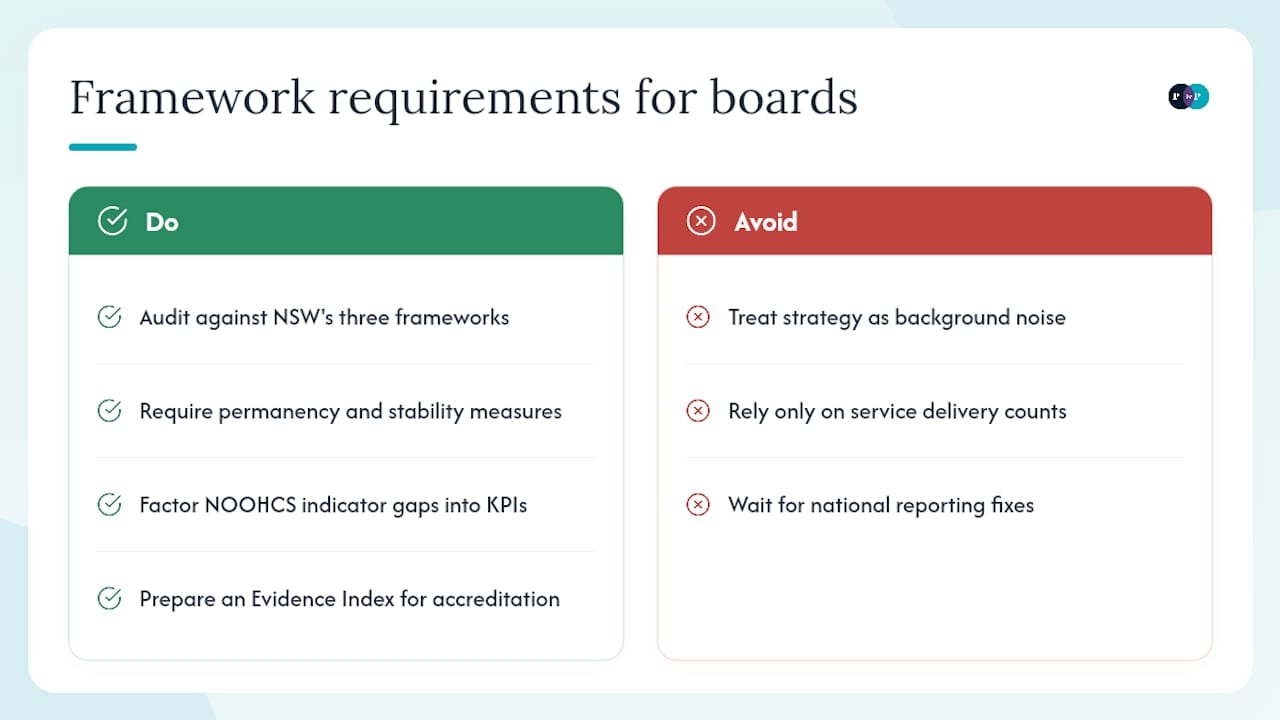
Boards in this sector are used to reading strategy documents as background noise. That's a mistake with the current reform wave, because the requirements are specific enough to audit against.
The NSW strategy introduces three named frameworks: the OOHC Accountability Framework, the System Design Framework, and the Integrated Quality Assurance Framework. Together, they re-establish DCJ's stewardship role over commissioning and performance, which matters because stewardship has drifted for years into a patchwork of contract management without a coherent system view.
The shift on paper is from compliance monitoring to outcomes-based stewardship. In practice, that means DCJ expects to see providers reporting against permanency and stability measures, not just service delivery counts, and providers should expect commissioning decisions to follow that evidence.
The National Standards remain the baseline every provider must clear regardless of jurisdiction. The NOOHCS framework includes 23 indicators spanning safety, stability, cultural support and participation, though not every indicator is currently reportable in practice, a gap boards should factor into their own KPI design rather than wait for a national fix.
Accreditation expectations have sharpened too. The Office of the Children's Guardian's accreditation guide requires agencies to prepare an Evidence Index and undergo staged direct evidence assessments, meaning assessors want to see practice in action, not just policies on a shelf.
Core components of an effective OOHC governance framework
Get the division of labour wrong here and everything downstream suffers. The board sets risk appetite, approves strategy and demands assurance; DCJ acts as system steward setting commissioning criteria and outcome expectations; the executive runs operations and reports evidence upward. Confusing these roles is the single most common governance failure our team sees in provider organisations.
A working framework needs each of these components explicitly assigned to a named role:
- Accountability framework: who owns outcomes reporting, escalation and board sign-off
- Performance management: KPIs mapped to National Standards indicators, reviewed at fixed intervals
- Commissioning alignment: criteria matching provider capability to cohort and region, reviewed annually
- Financial stewardship: budget variance reporting and probity checks at every board cycle
- Risk and probity: a live risk register covering both child safety and organisational exposure
- Reportable conduct processes: clear notification pathways and record retention under section 170
- Data governance: defined privacy, sharing and retention protocols for practice data
System reviews and parliamentary reporting have specifically called for clearer accountability settings and stronger KPI regimes across the sector, a signal that generic "we have policies" governance won't satisfy scrutiny going forward.
For your next board meeting, three actions:
- Table the current accountability framework document and confirm every role has a named accountable person.
- Ask the executive to produce evidence of the last reportable conduct notification, including the date it was lodged against the statutory window.
- Request the current Evidence Index status ahead of the next accreditation cycle, not the week before assessors arrive.
Boards that treat reportable conduct as a compliance formality rather than a live risk are the ones who get caught out. Missing a statutory notification window can threaten accreditation standing and public confidence in a single incident, so this belongs on every board agenda, not buried in a quarterly compliance pack.
Operational detail: accreditation, KPIs and the evidence index
Accreditation under the Office of the Children's Guardian is not a paperwork exercise. Assessors expect an Evidence Index supported by staged direct evidence, meaning file audits, case observations and practice interviews, not just policy attestations. Standard 23 specifically requires ongoing strategic planning and evaluation, so a static strategic plan reviewed once every three years won't clear the bar.
Boards should be asking executives for a dashboard, not a narrative report, at every cycle:
| Dashboard item | What the board should see |
|---|---|
| Placement stability | Rate of placement breakdown against target, by region |
| Permanency progress | Proportion of children with a permanency plan on track |
| Cultural support | Compliance with cultural support plans for Aboriginal children |
| Reportable conduct | Number of notifications, timeliness against statutory windows |
| Complaints and feedback | Volume, themes and resolution timeframes |
Where this breaks down most often is data infrastructure. Many organisations under-resource the analytics capability needed to move from compliance snapshots to genuine outcome tracking, leaving boards reading anecdote dressed up as evidence.
Cultural governance and ACCO participation
Cultural governance can't sit as an addendum to the main framework. Western Australia's OOHC outcomes framework treats cultural approach and Aboriginal Community Controlled Organisation participation as core to system design, not a parallel track, and that's the model worth following.
Practical mechanisms boards should look for:
- A standing co-design committee with genuine decision rights, not consultation theatre
- ACCO representation on the board or a formal advisory body with real influence over commissioning
- Cultural safety indicators reported alongside mainstream KPIs, not in a separate annex
A short adoption checklist:
- Confirm ACCO representation exists at governance level, not just program delivery.
- Set cultural safety indicators with the same reporting rigour as safety and permanency measures.
- Review co-design terms of reference annually against actual influence on decisions made.
Phased implementation: sequencing and timelines
Reform fatigue is real in this sector, so sequence matters more than ambition.
- 0 to 30 days: stabilise current placements and confirm no disruption to existing service arrangements.
- 30 to 90 days: strengthen oversight, confirm accountability owners and stand up the reportable conduct pathway.
- 90 to 180 days: implement the outcomes framework reporting cadence and begin commissioning alignment reviews.
Use contract extensions or transitional funding arrangements to protect placement stability while structural change proceeds. A board that rushes commissioning changes before oversight is solid risks the exact instability the reform is meant to prevent.
An anonymised practice example and improvement plan
A mid-sized regional provider we've observed had strong compliance paperwork but no live outcomes data. Placement breakdowns were tracked manually, reportable conduct notifications sometimes slipped past the statutory window, and the board reviewed a narrative report each quarter with no comparative KPIs.
Once the organisation adopted a structured accountability framework with monthly dashboard reporting, placement stability improved within two reporting cycles, and the board could finally distinguish a genuine safety concern from routine casework noise.
The levers used were straightforward: a data system replacing manual tracking, a commissioning review matching caseloads to worker capacity, and a formalised reportable conduct escalation path with named owners.
A six-point board improvement checklist drawn from that shift:
- Adopt a single accountability framework document with named owners
- Move from narrative reporting to a KPI dashboard reviewed every board cycle
- Audit the last twelve months of reportable conduct notifications for timeliness
- Confirm ACCO participation has real decision influence, not just consultation
- Test the Evidence Index readiness before the next accreditation cycle
- Where capability gaps exist, bring in dedicated governance advisory support rather than stretching internal resources thin
What experience tells us about this shift
The move from compliance checklists to outcomes stewardship is overdue, and the boards getting it right are the ones asking for evidence every cycle, not just at accreditation time. What's your board's line of sight on practice quality between now and your next audit?
How The Planning and Practice Hub can help
Building an OOHC governance framework from scratch, or repairing one that's fallen behind the accreditation curve, is exactly where most boards lose momentum: the frameworks exist on paper, but nobody owns the evidence trail day to day. The Planning and Practice Hub works alongside boards and executives to build the accountability structures, KPI regimes and reportable conduct pathways this article has walked through, without the guesswork of building it solo against a moving reform timeline.
If accreditation is on your horizon or your board wants a live dashboard instead of a quarterly narrative, our quality compliance consulting service is built for exactly this gap. Book a scoping conversation and bring your current Evidence Index status to the table.
Sources
- NSW Out-of-Home Care Strategy (2026)
- National Standards for out-of-home care | Department of Social Services
- National Standards for Out-of-Home Care (NOOHCS) — METeOR (AIHW)
- Accreditation guide | Office of the Children’s Guardian (NSW)
- Protecting children at risk: special report (NSW Parliament, 2024)
FAQ
What is an OOHC governance framework?
It's the structure a board and executive use to assign accountability, track outcomes and meet accreditation obligations across an out-of-home care service, anchored to the National Standards and jurisdictional strategies like the NSW OOHC Strategy.
Who is responsible for OOHC system stewardship in NSW?
The Department of Communities and Justice (DCJ) holds the system stewardship role under the NSW Out-of-Home Care Strategy, setting commissioning criteria and outcome expectations providers must meet.
How many indicators are in the National Standards for out-of-home care?
The NOOHCS framework includes 23 indicators, though not all are currently reportable, which means boards should design their own KPI reporting to cover the gap.
What does the Office of the Children's Guardian require for accreditation?
Agencies must prepare an Evidence Index and undergo staged direct evidence assessments, with Standard 23 requiring ongoing strategic planning and evaluation rather than a static plan.
How can boards start improving OOHC governance quickly?
Start by naming an owner for every element of the accountability framework and auditing recent reportable conduct notifications for timeliness. The Planning and Practice Hub's quality compliance consulting supports boards building these structures from the ground up.