
TL;DR:
- The 2026 NDIS reform package includes new registration, pricing, and safeguarding rules already in effect. Providers must ensure compliance with expanded powers, electronic claiming, and revised participant budgets by scheduled deadlines. The reforms emphasize strategic governance and documentation updates ahead of full implementation through 2030.
The NDIS Amendment (Integrity and Safeguarding) Act 2026 received Royal Assent on 8 April 2026, and a second, broader Bill — the National Disability Insurance Scheme Amendment (Securing the NDIS for Future Generations) Bill 2026 — was introduced to Parliament on 14 May 2026 and is currently before the Senate Community Affairs Legislation Committee. Together, these two instruments reshape registration, claiming, planning, pricing and safeguarding across the scheme. For registered providers, the immediate obligations are not theoretical: mandatory registration for Supported Independent Living and platform providers began on 1 July 2026, and Participant budgets for social, civic and community participation supports will reset to average 2023 levels on 1 October 2026; critical supports remain unchanged.
Three actions belong on your board agenda this week:
- Confirm your organisation's registration status and enrolment category against the new mandatory registration schedule.
- Validate the bank account nominated for NDIS payments and confirm your claims system is ready for electronic claiming under the Integrity and Safeguarding Act.
- Brief your board on the plan-suspension provisions and the 1 October 2026 budget reset, which aligns participant budgets for social, civic and community participation supports to average 2023 levels.
What does the NDIS Amendment Act 2026 actually change?
The reforms span five policy areas. Each carries distinct obligations for providers, boards and participants.
Integrity and safeguarding
The Integrity and Safeguarding Act 2026 expands the powers of the NDIS Quality and Safeguards Commission, enables electronic claiming, and clarifies plan variation powers. These provisions are already in force from 8 April 2026. Providers must now meet stricter documentation standards for claims and face heightened Commission scrutiny of incident reporting and staff screening.
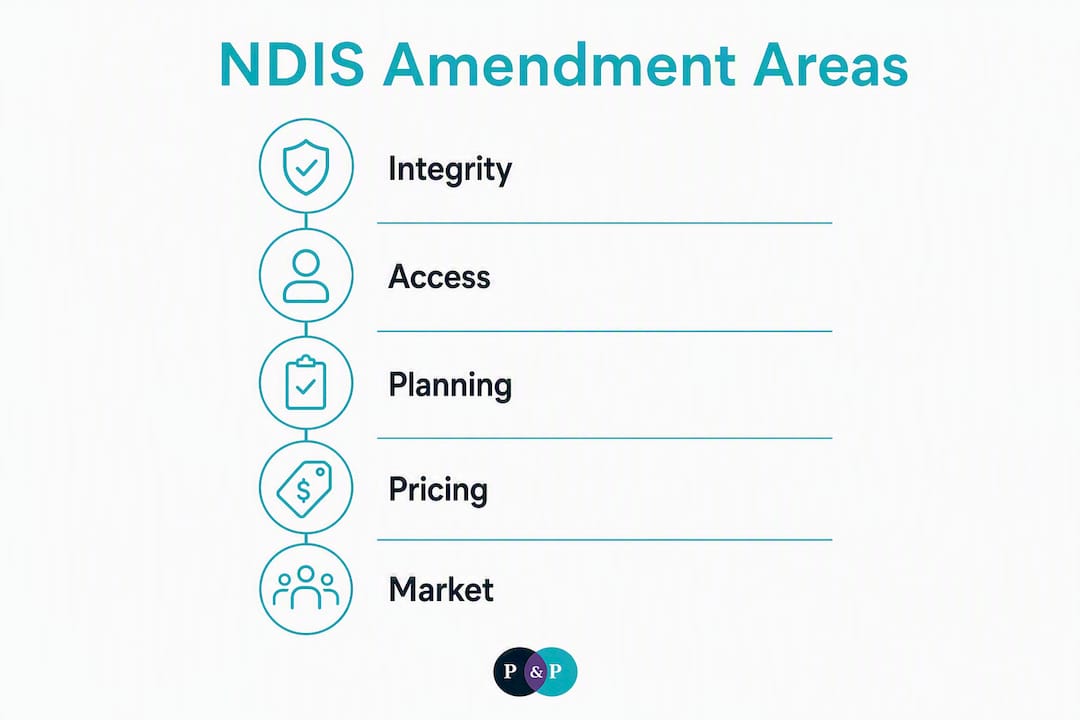
Eligibility and access
The Securing the NDIS for Future Generations Bill introduces a statutory definition of "functional capacity" as the basis for access decisions. Unscheduled plan reassessments are limited, and support needs must be directly related to a participant's disability. New applicants will be assessed under a standardised functional capacity assessment starting in early 2028; existing participants will be reassessed progressively in the following years.
New framework planning
A new planning framework begins transition from 1 April 2027. The Department of Health, Disability and Ageing is consulting on the framework's design, including how Supported Independent Living commissioning and the Inclusive Communities Fund will operate within it.
Pricing and ministerial determinations
The Bill gives the Minister power to determine maximum prices for NDIS supports. The NDIA must provide advice to the Minister and table a summary in Parliament within five days of any pricing determination, creating a transparency mechanism that providers should monitor closely for fee-schedule implications.
Provider registration and market reforms
Mandatory registration rolls out in stages: SIL and platform providers starting mid-2026, broader expansion beginning mid-2027, and full registration across the market by the end of the decade. The Department's fact sheet summarises the agreed amendments that emerged from Senate negotiations, including limits on ministerial funding-reduction powers.
The Senate inquiry process has been the primary avenue for negotiated amendments that limit ministerial funding-reduction powers and clarify administrative safeguards. Organisations tracking committee progress reports have obtained the clearest early indication of final drafting — and that lead time has operational value.
What do the integrity reforms require of your organisation?
The Integrity and Safeguarding Act 2026 is not a future obligation. It is in force now, and the Commission's expanded powers mean providers need to audit their current practice against the new requirements, not wait for the next audit cycle.

The Commission can now initiate investigations based on electronic claiming anomalies, not only on complaints or referrals. That changes the risk profile for any organisation with high-volume or complex claiming patterns. Your NDIS quality management system needs to reflect the new incident reporting thresholds and documentation requirements.
Provider-level compliance priorities under the Act:
- Registration: Confirm your registration category is current and matches your service delivery scope, particularly if you deliver SIL or platform-based supports.
- Incident reporting: Review thresholds against the updated NDIS Practice Standards requirements and update your incident management policy accordingly.
- Staff screening: Audit NDIS Worker Screening clearances for all workers in risk-assessed roles and document supervision arrangements.
- Electronic claiming: Test your claims system against the new electronic claiming requirements and confirm your nominated bank account is validated.
- Documentation: Strengthen contemporaneous record-keeping for support delivery, particularly for high-cost or complex supports that attract Commission attention.
Triggers for heightened regulatory attention include claiming patterns inconsistent with participant plans, gaps in worker screening records, and delayed or incomplete incident notifications. Penalties under the expanded framework include civil penalty provisions and, in serious cases, registration suspension or cancellation.
Who does the NDIS Amendment Act 2026 affect, and how?
The reforms do not affect all stakeholders equally. Understanding where your organisation sits in the matrix determines which actions are urgent and which can be scheduled.

Participants face the most significant long-term change through the eligibility and planning reforms, though most existing participants will not be reassessed until after January 2028. Children under nine are a priority cohort for early intervention planning under the new framework, and families should be briefed now on what the functional capacity assessment process will involve.
Registered providers have the most immediate compliance obligations: mandatory registration (SIL and platform providers from 1 July 2026), electronic claiming readiness, and the budget reset on 1 October 2026 for social, civic and community participation supports.
Boards and executives need to review risk appetite in light of the ministerial pricing determination power, which can affect fee schedules with limited notice. A board-level briefing on the plan-suspension provisions and the budget reset is not optional governance — it is a fiduciary responsibility.
The NDIA and the Commission gain new operational powers. The Commission's expanded investigation and enforcement capacity means the regulatory environment for providers is materially more active from April 2026 onward.
Auditors will need to update audit frameworks to reflect the new registration categories, incident reporting standards, and claiming documentation requirements. Certification audits scheduled for late 2026 or 2027 should be scoped against the updated NDIS Practice Standards.
Immediate priorities by group:
- SIL and platform providers: confirm registration status and enrolment data by 1 July 2026 (already in effect).
- All registered providers: validate nominated bank account and test electronic claiming workflow.
- Boards: schedule a deep-dive on pricing determination risk and plan-suspension policy before 1 October 2026.
- Quality managers: update incident management policy and staff screening audit schedule.
What is the implementation timeline for the 2026 NDIS changes?
| Date | Milestone |
|---|---|
| 8 April 2026 | Integrity and Safeguarding Act 2026 receives Royal Assent; Commission powers expanded, electronic claiming enabled |
| 14 May 2026 | Securing the NDIS for Future Generations Bill introduced to Parliament |
| 1 July 2026 | Mandatory registration begins for SIL and platform providers |
| 14 August 2026 | Senate Community Affairs Legislation Committee final reporting date |
| 1 October 2026 | Participant budgets for social, civic and community participation supports reset to average 2023 levels |
| 1 April 2027 | New framework planning commences transition |
| 1 July 2027 | Broader mandatory registration expansion |
| 1 January 2028 | Standardised functional capacity assessment takes effect for new applicants; existing participants reassessed progressively over three years |
| December 2030 | Full mandatory registration across provider market |
| 2029 | Independent review of the reforms mandated; reviewer must have no prior links to the NDIA or the Department |
The Senate Community Affairs Legislation Committee reported on 14 August 2026. Providers should monitor the Parliament of Australia committee page for any further amendments before the Bill passes both chambers.
Critical supports are explicitly excluded from the 1 October 2026 budget reset. The reset applies only to social, civic and community participation supports, and the Department has confirmed this in its guidance.
What should providers do in the next 30 to 90 days?
One medium-sized community services organisation we worked with recently discovered, during a registration review, that three of its service streams had been categorised under registration groups that no longer matched its actual delivery model. The fix was straightforward once identified, but it required a board resolution, updated enrolment data, and a revised claims workflow — none of which could happen overnight. The lesson: do not assume your current registration profile is accurate. Check it now, not when an audit triggers the question.
30-day actions
- Confirm registration category and enrolment data with the Commission.
- Validate nominated bank account for NDIS payments.
- Test electronic claiming system and resolve any technical gaps.
- Brief the board on the 1 October 2026 budget reset, which aligns social, civic and community participation supports budgets to average 2023 levels, and its communication implications for participants.
60-day actions
- Update incident management policy to reflect new NDIS Practice Standards thresholds.
- Complete a staff screening audit and document supervision arrangements for risk-assessed roles.
- Review NDIS policies and procedures against the updated claiming and documentation requirements.
- Develop participant communication materials explaining the budget reset.
90-day actions
- Schedule a board governance review of pricing determination risk and plan-suspension policy.
- Update service agreements and contract templates to reflect new planning framework provisions.
- Map your organisation's position against the mandatory registration timeline to 2030.
- Engage with the Senate committee process if your organisation has not yet made a submission.
Providers who treat the staged commencement dates as fixed deadlines — rather than as the latest possible action point — consistently manage the transition with less disruption. Build your compliance calendar from the earliest relevant date, not the last.
For boards wanting a structured governance framework to sit alongside this checklist, the NDIS registered provider governance guide sets out the board-level oversight responsibilities in detail. Building a compliance programme with clear role assignments is the structural foundation that makes the checklist above stick.
Where do you find the primary documents and how do you use them?
The bill text, explanatory memorandum, and committee materials are the authoritative sources for clause-level interpretation. Here is how to use each.
- Bill text and schedules: The Federal Register of Legislation holds the consolidated Act text for the Integrity and Safeguarding Act 2026 (record C2026A00041). For the Securing the NDIS for Future Generations Bill, the Parliament of Australia Bills Search page carries the current version.
- Explanatory memorandum: Read the intent paragraphs alongside each clause. When a clause is ambiguous, the memorandum's intent statement is the first place a tribunal or court will look. Focus on the sections covering functional capacity, plan variation, and pricing determinations.
- Senate committee materials: The Community Affairs Legislation Committee page holds all submissions, progress reports, and the final report. Progress reports are particularly useful for tracking likely drafting changes before the Bill passes.
- Department fact sheets: The Department of Health, Disability and Ageing publishes plain-language summaries of agreed amendments and implementation dates. These are the best starting point for operational planning.
- NDIA guidance: The NDIS website's integrity and safeguarding page covers the provisions already in force and is updated as new guidance is released.
Making a submission to the Senate committee
If your organisation has not yet submitted, structure your submission around three headings: impact on participants you work with, operational feasibility of the proposed provisions, and any recommended drafting amendments. Send submissions through the committee's online portal on the Parliament of Australia website. The committee's final reporting date was 14 August 2026; check the page for any extended consultation windows.
Documents required before making a submission: bill text, explanatory memorandum, and the Department's fact sheet summarising agreed amendments.
Key takeaways
The NDIS Amendment Act 2026 is already in force in part, with staged obligations running to 2030 and a mandated independent review in 2029 — boards that treat this as a single compliance event will be caught short.
| Point | Details |
|---|---|
| Integrity Act is in force now | The Integrity and Safeguarding Act 2026 received Royal Assent on 8 April 2026; Commission powers are active. |
| Registration deadline passed for SIL providers | Mandatory registration for SIL and platform providers began 1 July 2026; confirm your status immediately. |
| Budget reset on 1 October 2026 | Social, civic and community participation supports budgets reset to average 2023 levels; critical supports are excluded. |
| Planning and access changes are staged | New framework planning from 1 April 2027; functional capacity assessments for new applicants from 1 January 2028. |
| Independent review in 2029 | A mandated review must assess access, outcomes and market viability; providers should document their experience for submissions. |
A practice perspective on what this reform cycle actually demands
Most reform cycles produce a compliance checklist. This one demands something harder: a genuine governance reset.
The ministerial pricing determination power is the provision that concerns me most for the sector's medium-term stability. The transparency mechanism — requiring the NDIA to table advice in Parliament within five days — is a meaningful safeguard, but it does not give providers the forward notice they need to adjust fee structures, renegotiate contracts, or communicate with participants. Boards need to treat pricing risk as a standing agenda item, not a one-off briefing.
The 2029 independent review is, in my view, the most underused lever available to providers right now. The review must assess access outcomes, provider market viability, and the impact of foundational supports. Organisations that document their experience systematically from 2026 onward will be far better positioned to contribute evidence to that review — and to influence the next legislative cycle. That is not a compliance task. It is a strategic one.
The Senate inquiry process has already demonstrated that organised, evidence-based submissions shift drafting outcomes. The limits on ministerial funding-reduction powers that appear in the current Bill text were not in the original draft. They are there because sector organisations made the case clearly and early. That is worth remembering as the Securing the NDIS for Future Generations Bill moves toward passage.
Ready to work through your compliance priorities?
If your board needs a structured review of your registration status, governance obligations, or operational readiness for the staged commencement dates, The Planning and Practice Hub works with NDIS providers and human services organisations across Australia to build compliance frameworks that hold up under scrutiny.
Talk to our team about your NDIS compliance needs
Useful sources
The following primary documents are the authoritative references for clause-level interpretation, operational planning, and Senate submissions.
| Document | Best used for |
|---|---|
| Integrity and Safeguarding Act 2026 — Federal Register of Legislation | Clause-level drafting queries; provisions already in force |
| Securing the NDIS for Future Generations Bill 2026 — Parliament of Australia | Bill text, schedules, and second reading speech |
| Senate Community Affairs Legislation Committee — inquiry page | Submissions, progress reports, and final report; consultation timelines |
| Department of Health, Disability and Ageing — about the changes | Implementation dates, operational guidance, budget reset details |
| Department fact sheet — agreed amendments | Summary of negotiated changes; required reading before making a submission |
| NDIS integrity and safeguarding page | Operational guidance on Commission powers and electronic claiming |
| 2026 amendments to the NDIS Act — Department overview | Chronological summary of all 2026 amendments and passage dates |
FAQ
Has the NDIS Amendment Act 2026 passed?
The NDIS Amendment (Integrity and Safeguarding) Act 2026 passed Parliament on 1 April 2026 and received Royal Assent on 8 April 2026. The broader Securing the NDIS for Future Generations Bill 2026 was introduced on 14 May 2026 and was before the Senate Community Affairs Legislation Committee with a final reporting date of 14 August 2026.
What are the main changes to the NDIS in 2026?
The 2026 reforms expand NDIS Quality and Safeguards Commission powers, introduce mandatory registration for SIL and platform providers from 1 July 2026, reset participant budgets for social, civic and community participation supports to average 2023 levels on 1 October 2026, and establish a new planning framework and standardised functional capacity assessment rolling out from 2027 to 2028.
Who is being removed from the NDIS?
No existing participants are being removed as a direct result of the 2026 amendments. The reforms tighten eligibility criteria through a statutory definition of functional capacity, which will apply to new applicants from 1 January 2028; current participants will be reassessed progressively over three years from that date, with the process designed to protect those with permanent and significant disability.
What is the NDIS Amendment (Securing the NDIS for Future Generations) Bill?
It is the second major legislative instrument in the 2026 reform package, introduced to Parliament on 14 May 2026. It covers eligibility and access changes, new framework planning, ministerial pricing determination powers, staged mandatory provider registration, and the mandated 2029 independent review of the reforms.
What changes are coming to the NDIS in 2027 and 2028?
New framework planning begins transitioning from 1 April 2027, with broader mandatory provider registration expanding from 1 July 2027. From 1 January 2028, standardised functional capacity assessments apply to new NDIS applicants, and existing participants begin a three-year progressive reassessment process.