
TL;DR:
- A legislative register in human services is a centralized, living document tracking all laws and obligations organizations must meet. It strengthens governance by assigning ownership, enabling reviews, and providing audit evidence across federal, state, and sector-specific regulations. Maintaining an active, comprehensive register enhances compliance, reduces risks, and supports organizational accountability.
A legislative register in human services is a living, centralised record that captures every law, regulation, and obligation your organisation must meet to demonstrate compliance across Australia's complex regulatory environment. Most organisations have policies. Fewer have a systematic register that assigns ownership, tracks review dates, and produces evidence during audits. That gap is where regulatory risk lives. The legislative register is the industry term for what some call a "compliance register" or "register of human services laws," and the distinction matters: it is an operational governance tool, not a filing cabinet.
What legislation must human services organisations track?

The scope of a legislative register for human services organisations is wider than most boards initially expect. Your register must capture obligations across federal and state jurisdictions, sector-specific frameworks, and contractual conditions tied to funding agreements.
Core federal legislation every human services organisation must include:
- Work Health and Safety Act 2011 — duties of care, incident reporting, and safe systems of work
- Fair Work Act 2009 — employment conditions, enterprise agreements, and modern award compliance
- Privacy Act 1988 — collection, storage, and disclosure of personal information
- Aged Care Act 2024 — from 1 november 2025, all government-funded aged care providers must register under designated categories, each carrying specific legal and reporting obligations
- NDIS Act 2013 — registration conditions, NDIS Practice Standards, and worker screening requirements
- Corporations Act 2001 and ACNC Act 2012 — governance, reporting, and director duties
Sector-specific regulatory bodies add another layer. The Aged Care Quality and Safety Commission (ACQSC) holds providers accountable not just for general laws but for registration category requirements. The Australian Charities and Not-for-profits Commission (ACNC) maintains a public register with strict reporting deadlines. State human services regulators in Queensland apply the HSQF, while Victorian community services organisations work within the Department of Families, Fairness and Housing quality governance framework.
Your register must also distinguish between three types of obligations: legislation (statutory duties), codes and standards (NDIS Practice Standards, Aged Care Quality Standards (Strengthened), National Principles for Child Safe Organisations), and contractual obligations (funding agreement conditions, grant deed requirements). Each type carries different consequences for non-compliance and different review cycles.
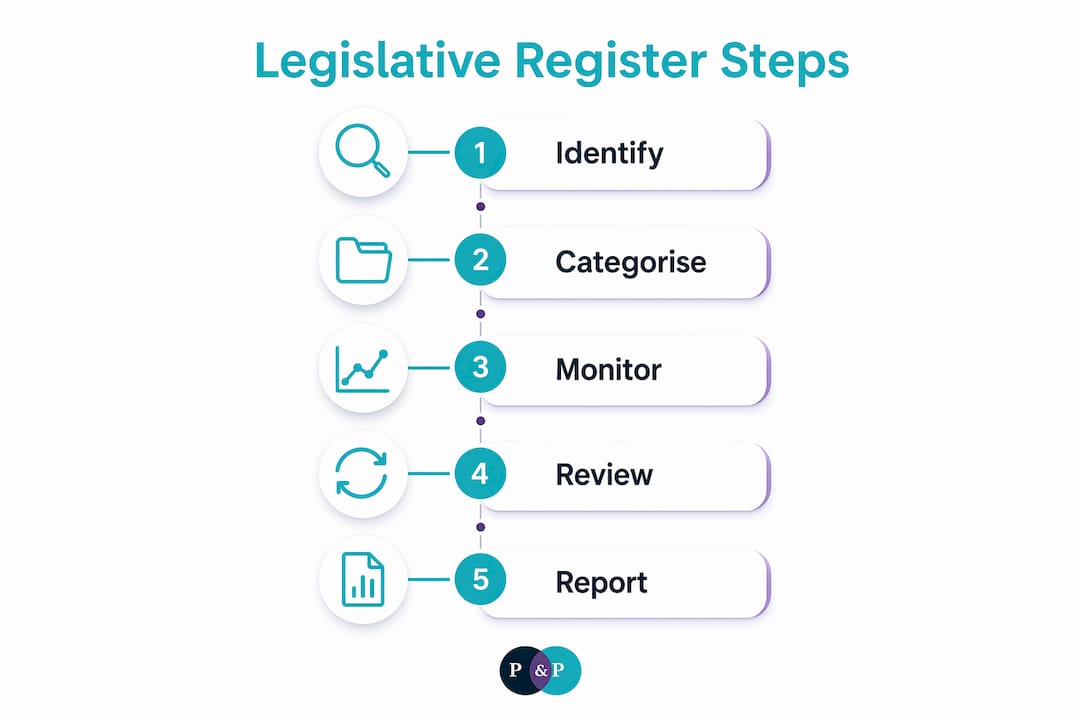
How to build and maintain an effective legislative register
Building a register that actually works in practice follows a clear sequence. Skipping steps produces a document that looks complete but fails under scrutiny.
- Scope your obligations. Map your organisation's activities, jurisdictions, workforce arrangements, and data practices. A homelessness service operating across two states has different obligations than a single-site NDIS provider.
- Identify every applicable law and standard. Work through federal, state, and territory legislation, sector standards, and funding conditions systematically. Do not rely on memory or a single staff member's knowledge.
- Document each obligation in plain language. A well-constructed legislative register includes the legislation name, a plain-language description of the obligation, the jurisdiction, the responsible person, the controls in place, the last review date, and the current compliance status.
- Assign an accountable owner. Every obligation needs a named person responsible for monitoring and evidencing compliance. Shared ownership produces gaps.
- Set a review schedule. Legislation changes. Registration conditions change. Build a calendar of review dates into the register itself, not a separate document.
- Centralise and make it auditable. Static spreadsheets are insufficient for managing complex compliance obligations across multiple frameworks. A centralised, auditable dashboard reduces the risk of missed deadlines and keeps funding compliance visible.
Pro Tip: Treat your legislative register review as a standing board agenda item, not an annual compliance task. Boards that see the register quarterly catch legislative changes before they become audit findings.
One community services organisation working across child safe and NDIS frameworks initially maintained separate spreadsheets for each framework. When the NDIS Practice Standards were updated, the change was captured in one spreadsheet but not the other. The gap was only discovered during an internal audit, three months after the obligation had changed. A single centralised register with a linked review calendar would have caught it immediately.
What is the difference between public and internal registers?
This distinction trips up many governance teams, and it matters practically.
Public registers are externally accessible records maintained by regulators. The ACNC charity register is the clearest example. Registered charities must notify the ACNC of changes to key personnel, service addresses, or purposes within 28 days. Failure to meet these obligations can result in enforcement action, including removal of directors or loss of charity status. The ACQSC provider register operates similarly for aged care. These are records you are legally required to keep current with the regulator.
Internal legislative registers are operational tools your organisation maintains for its own compliance management. They are not submitted to regulators, but regulators expect providers to maintain a living system capturing obligations, controls, owners, and review dates. The distinction is important: a public register tells the regulator who you are; an internal register proves you are managing your obligations systematically.
The consequences of neglecting each type differ. Failing to update a public register produces an immediate, visible breach with a regulator. Failing to maintain an internal register produces a systemic gap that surfaces during audits, often at the worst possible time, such as a funding renewal or a complaint investigation.
Key risks of inadequate internal registers:
- Missed legislative changes leading to undetected breaches
- Inability to produce compliance evidence during ACQSC or NDIS Commission audits
- Funding agreement conditions not tracked, leading to reporting failures
- Compliance breaches and funding risks when registration category conditions change without the register being updated
How do legislative registers support governance and quality standards?
A legislative register is a governance document as much as a compliance tool. Personal liability under the Corporations Act 2001 is increasing, and regulators require evidence of a systematic compliance approach. A well-maintained register is that evidence.
For boards, the register supports delegations of authority by making clear which obligations sit with which roles. It connects directly to the ACNC Governance Standards, which require charities to take reasonable steps to manage financial affairs and comply with the law. For aged care providers, the Aged Care Quality Standards (Strengthened) require demonstrated governance of compliance obligations, not just policy existence.
Quality frameworks reinforce this. Governance frameworks in community services should move beyond administrative tasks to use compliance registers as tools underpinning safety and quality outcomes. The register becomes the mechanism through which your board demonstrates due diligence, your quality manager tracks controls, and your CEO reports to funders with confidence.
Pro Tip: Link your legislative register directly to your risk register. Every unmet obligation is a risk event. When the two documents talk to each other, your board gets a clearer picture of organisational exposure.
Funding bodies increasingly ask for evidence of systematic compliance management at contract renewal. An organisation that can produce a current, reviewed legislative register with named owners and documented controls is in a materially stronger position than one that produces a policy folder.
Key takeaways
A legislative register is the single most practical governance tool a human services organisation can maintain, because it converts abstract legal obligations into assigned, evidenced, and reviewable actions.
| Point | Details |
|---|---|
| Scope broadly from the start | Include legislation, sector standards, and funding conditions across all jurisdictions your organisation operates in. |
| Document in plain language | Each obligation needs a named owner, plain-language description, controls, and a review date to be audit-ready. |
| Distinguish public from internal registers | Public registers satisfy regulators; internal registers prove you are managing obligations systematically every day. |
| Centralise and automate reviews | A single auditable system reduces the risk of missing legislative changes across multiple frameworks. |
| Connect to board governance | Boards that review the register regularly demonstrate due diligence and reduce personal liability exposure. |
What I have learned from organisations that get this wrong
After nearly three decades working across Australian human services, I have seen the same pattern repeat. An organisation invests in policies, trains staff, and genuinely believes it is compliant. Then an audit arrives, and the auditor asks one question: "Can you show me your legislative register and the last time it was reviewed?" The silence that follows is not about incompetence. It is about a sector that has historically treated compliance as a documentation exercise rather than an operational discipline.
I worked with one aged care provider that had a register, but it had not been reviewed since the Aged Care Act 2024 commenced. The registration category conditions had changed. The register did not reflect them. That is not a minor administrative oversight. That is a governance failure with real consequences for funding and registration.
The shift I advocate for is not about adding more paperwork. It is about treating the legislative register as a live governance instrument that your board owns, your quality manager maintains, and your CEO uses to make decisions. The organisations that do this well are not the ones with the biggest compliance teams. They are the ones where leadership has decided that knowing your obligations is a non-negotiable part of running the organisation.
The legislative landscape in 2026 is not getting simpler. The Aged Care Act 2024, ongoing NDIS reform, and strengthened ACNC governance expectations mean your register needs to be agile. Build the system now, before the next audit cycle finds the gap.
— Rachel
Working with The Planning and Practice Hub on legislative compliance
Knowing what belongs in a legislative register and keeping it current across multiple frameworks are two different challenges. The Planning and Practice Hub works with human services organisations to build registers that hold up under regulatory scrutiny, from initial scoping through to audit preparation and governance reporting.

Whether you are an NDIS provider, an aged care organisation navigating the new registration model, or a community services NFP managing ACNC and state-based obligations, The Planning and Practice Hub offers human services consulting grounded in nearly three decades of sector experience. Rachel Willis and the team work alongside your leadership to build compliance systems that your board can stand behind. Get in touch to discuss where your register stands.
FAQ
What is a legislative register in human services?
A legislative register in human services is a centralised, living document that records every law, regulation, standard, and contractual obligation an organisation must comply with, including the responsible owner, controls in place, and last review date.
Is a legislative register legally required in Australia?
No Australian law explicitly mandates a legislative register by name, but systematic compliance management is effectively required by regulators including the ACQSC, NDIS Commission, and ACNC, who expect organisations to demonstrate active, evidenced management of their obligations.
How often should a legislative register be reviewed?
A legislative register should be reviewed at least annually, with triggered reviews whenever legislation changes, registration conditions are updated, or a new funding agreement is signed. Quarterly board oversight is best practice.
What is the difference between a public register and an internal compliance register?
A public register, such as the ACNC charity register, is maintained with a regulator and has strict 28-day notification requirements. An internal compliance register is an operational tool your organisation maintains to manage and evidence its obligations day to day.
How does a legislative register support board governance?
A legislative register supports board governance compliance by providing directors with evidence of systematic compliance management, reducing personal liability exposure under the Corporations Act 2001 and ACNC Governance Standards.