
If your organisation's total annual funding sits above $317,000, you're almost certainly on the certification pathway, not self-assessment, and your first move this week is to pull out your service agreement and check the funding band against the current HSQF thresholds. Do this before anything else:
- Confirm your demonstration method with your contract officer, in writing.
- If certification applies, check when your last audit closed and where you sit in the three-year cycle.
- If you're unsure which pathway applies, ask before you plan any readiness work, because the evidence you need to gather differs sharply between the two.
Most Queensland providers already know their pathway. What catches people out is assuming last year's answer still holds after a funding change or a new service type.
Key Takeaways
Passing an HSQF audit depends on demonstrable practice across the six standards, not documentation volume, and readiness needs a 12-month runway built around real evidence.
| Point | Details |
|---|---|
| Confirm your pathway first | Check your funding band against the $120,000 and $317,000 thresholds before planning any readiness work. |
| Certification runs on a fixed rhythm | Expect audits roughly every 18 months within a three-year certification cycle. |
| Evidence beats paperwork | Map each policy to where staff and clients can actually demonstrate it in daily practice. |
| Corrective actions need substance | Show root cause, assigned action, timeframe and monitoring, not just a completed tick box. |
| Get external readiness support | The Planning and Practice Hub runs gap analyses and mock audits aligned to your actual certification date. |
What does a Human Services Quality Framework audit actually assess?
HSQF exists to give funders and communities confidence that funded human services organisations run safely, fairly, and consistently. It applies to organisations funded by the Queensland Department of Families to deliver in-scope human services, and it's built around six standards that auditors test against real practice, not policy folders.
- Governance and management – whether leadership, planning and risk oversight actually function.
- Service access – how fairly and clearly people get into your service.
- Response to need – whether service delivery genuinely matches what a person needs.
- Safety, wellbeing and choice – how you protect and respect the people you support.
- Feedback and complaints – whether people can raise concerns and see them acted on.
- Human resources – whether your workforce is capable, supported and appropriately supervised.
The framework is deliberately non-prescriptive on format. Official guidance is explicit that auditors focus on the effectiveness of systems in practice, and on whether staff and clients understand how those systems work day to day. A beautiful policy nobody follows scores worse than a rough one everybody uses.
How does the certification audit process actually run?
Certification runs on a three-year cycle, and within that cycle you'll face audits roughly every 18 months, including your initial certification audit and a mid-term surveillance audit. That rhythm matters for resourcing. It means you're never more than a year and a half from an auditor's attention, so readiness isn't a once-off project, it's an operating rhythm.
The certification cycle in numbers: three years per full cycle, audits at roughly the 18-month mark, and certification bodies must hold accreditation from JAS-ANZ before they can issue or maintain your certificate.
A typical audit moves through predictable stages:
- Desktop or documentation review, usually before the site visit.
- On-site (or remote, where agreed) observation and file sampling.
- Staff and, often, client or carer interviews.
- A written report setting out observations, non-conformities or major non-conformities.
Choosing your certification body isn't a commodity decision. Beyond the JAS-ANZ requirement, sector-specific audit experience in disability, family support or child protection genuinely changes the quality of the interview process and the usefulness of the feedback you get.
Should your organisation self-assess or seek certification?
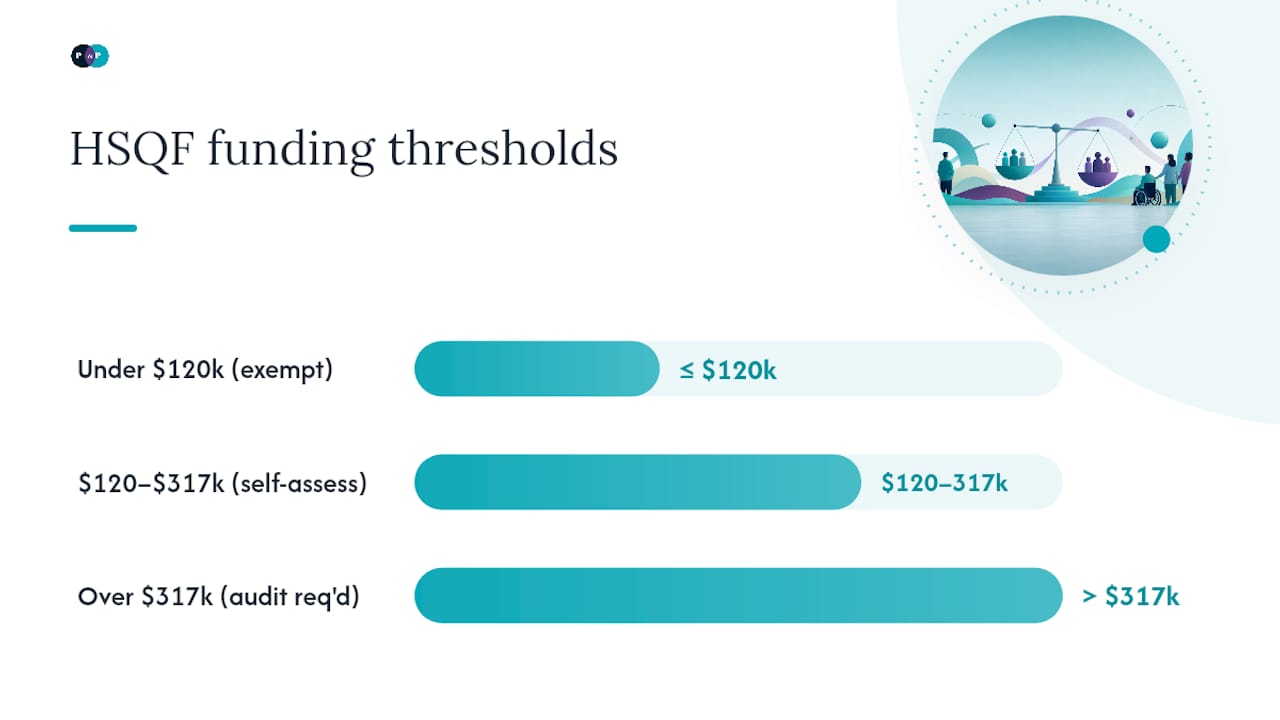
The answer largely comes down to money, though not entirely. As of July 2025, HSQF funding thresholds set the pathway as follows:
- Under $120,000 in total annual funding: generally exempt from formal demonstration.
- $120,000 to $317,000: self-assessment applies.
- Over $317,000: independent third-party audit and certification is required.
Service type, client vulnerability and departmental discretion can shift this, so treat the thresholds as the starting point, not the final word, and confirm with your contract officer.
If you're self-assessable, the clock starts the moment you sign your service agreement. You must complete your first self-assessment within 18 months, and a continuous improvement plan is due within 30 months. Recognition of other accreditation, where you already hold a comparable quality certification, can sometimes substitute for HSQF certification, but expect a gap analysis first. Rarely does another scheme map cleanly onto all six standards without some additional work.
How should you prepare for an HSQF audit?
Start the clock 12 months before your certification is due, not three. Cultural change inside a service, new incident reporting habits, better feedback handling, doesn't happen because a policy was updated last month. Build in at least a three-month buffer for genuine practice change before the auditor arrives.
- Map your evidence. Build a register that links each policy to where an auditor would actually see it in action: a file note, a roster, a supervision record, a client file.
- Run a gap analysis early. Identify where your documented intent and your daily practice diverge, and be honest about it internally before someone else finds it for you.
- Train staff for interviews. Run a mock audit with real questions ("Show me how you'd handle a complaint today") rather than a policy quiz.
- Document corrective actions properly. Mature systems show root cause, assigned action, a timeframe, and monitoring, not just a tick to say the problem is "fixed."
- Talk to your contract officer or certification body early if something disrupts your timeline. HSQF Operations supports flexibility during major disruptions, including remote audits or extensions, but only if you raise it before the deadline, not after.
Pro Tip: Ask three frontline staff, unprompted, how they'd handle a specific complaint or incident. If their answers don't roughly match your policy, that's your real gap analysis, and it's more useful than any document review.
A compliance framework built for evidence, not just paperwork makes this whole process considerably less painful the second time around.
Where do you find the official HSQF tools and templates?
You don't need to build your own paperwork from scratch. The Department of Families publishes the core kit: the HSQF User Guide - Certification, a self-assessment workbook, and a Quality Pathway Kit that helps you work out which pathway applies and what evidence each standard expects.
Beyond the official documents, QCOSS templates, eTraining modules and sector webinars fill practical gaps, particularly for smaller organisations without a dedicated quality manager. A health check of your HR and workforce documentation is also worth running alongside your HSQF prep, since the Human Resources standard leans heavily on demonstrable supervision and capability records.

Internally, keep it simple: an evidence register, a staff competence tracker, and an incident and feedback log. Three spreadsheets, well maintained, beat one elaborate system nobody updates.
What do auditors actually look for in practice, not paperwork?
Auditors cross-check your policy against what staff say, what clients experience, and what your records show. If those three don't line up, that's where non-conformities come from, not from a missing signature on a document.
The organisations that struggle most in an HSQF audit aren't the ones with thin policies. They're the ones with excellent policies that nobody on the floor can explain in their own words. An auditor asking a support worker "what would you do if a client raised a safety concern" and getting a blank look tells them more than any file review.
We've seen a mid-sized disability provider go through this exact pattern. Their governance documents were strong, but frontline staff couldn't describe the complaints process without checking a laminated card. The fix wasn't new policy, it was six weeks of team meetings walking through real scenarios, followed by a mock audit that surfaced the same gaps the real auditor later found, minus the non-conformity. Allow months for that kind of shift, not days.
A peer reflection on what audit readiness really means
Practice truth: an audit doesn't create good practice, it only reveals whether it already exists. What question would your board ask if the auditor walked in tomorrow?
— Rachel
How The Planning and Practice Hub supports your audit readiness
There's a reason some organisations sail through their HSQF audit while others scramble in the final month: the sailing ones treated readiness as a 12-month program, not a paperwork sprint. That's where a structured external check earns its keep.
The Planning and Practice Hub works alongside quality managers and boards on the practical mechanics of readiness: gap analyses that mirror what an auditor will actually test, mock audits that surface the same blank looks a real auditor would find, and a compliance calendar that keeps your evidence register and staff training aligned to your certification date rather than scattered across the year. Our practice assurance service is built specifically around demonstrating lived practice, not producing thicker manuals. If your certification audit is on the horizon, get in touch to scope a gap analysis before your certification body books its site visit.
Sources
- Certification - Quality requirements and resources | Human Services Quality Framework
- Overview of the framework | Human Services Quality Framework
FAQ
What triggers a certification audit versus self-assessment?
Total annual funding decides it: organisations with total annual funding above a defined threshold generally require certification, between $120,000 and $317,000 requires self-assessment, and under $120,000 is generally exempt.
How often does an HSQF certification audit happen?
Certification operates on a three-year cycle with audits approximately every 18 months, conducted by a JAS-ANZ accredited certification body.
What happens if my organisation gets a non-conformity?
You'll need a corrective action plan showing the root cause, the specific action taken, a timeframe, and how you'll monitor it, which auditors treat as part of normal continuous improvement.
Can another accreditation replace HSQF certification?
Recognition of other accreditation is possible in some cases, but expect a gap analysis first, since most other schemes don't map cleanly onto all six HSQF standards.
How far in advance should we start preparing?
Start readiness work around 12 months before your certification is due, allowing at least a three-month buffer for genuine practice change, not just document updates. The Planning and Practice Hub's practice assurance work is typically structured on that same timeline.