
Your funding agreement is the first document to open, not a standards PDF. Whether your organisation must meet the Human Services Quality Framework (HSQF, Queensland only), the NDIS Practice Standards, the Aged Care Quality Standards (Strengthened), Victoria's Social Services Standards, or the ACNC Governance Standards depends on four things: who funds you, what services you deliver, how vulnerable the people you work with are, and how long your contract runs.
The immediate action is straightforward: pull your current funding agreement and confirm which quality pathway it specifies — certification by a JAS-ANZ accredited body, self-assessment, or recognition of other approved accreditation.
At a glance:
- HSQF applies to Queensland Department of Families, Seniors, Disability Services and Child Safety funded organisations delivering ongoing human services.
- NDIS Practice Standards apply to registered NDIS providers, with obligations scaled by support type and risk level.
- Aged Care Quality Standards (Strengthened) apply to Commonwealth-funded aged care providers under the new Aged Care Act.
- Victoria Social Services Standards apply to Victorian Department of Families, Fairness and Housing funded community service organisations.
- ACNC Governance Standards apply to registered charities and intersect with all of the above through governance obligations.
Key takeaways
The compliance framework in human services is determined by your funding agreement, service type, and contract duration — not by which standards look most familiar.
| Point | Details |
|---|---|
| Check your funding agreement first | Your contract specifies the required quality pathway: certification, self-assessment, or recognition of other accreditation. |
| Certification bodies must be JAS-ANZ accredited | An audit by an unaccredited body does not satisfy Queensland government compliance requirements. |
| Boards must evidence oversight, not just hold policies | Minutes recording quality performance discussion and corrective action follow-up are what auditors examine. |
| One quality system can satisfy multiple frameworks | Cross-referencing service agreements, risk registers, and incident records reduces duplication across HSQF, NDIS, and aged care obligations. |
| The Planning and Practice Hub | Supports organisations through HSQF certification, self-assessment, and board governance reviews across Queensland and nationally. |
What is the compliance framework in human services?
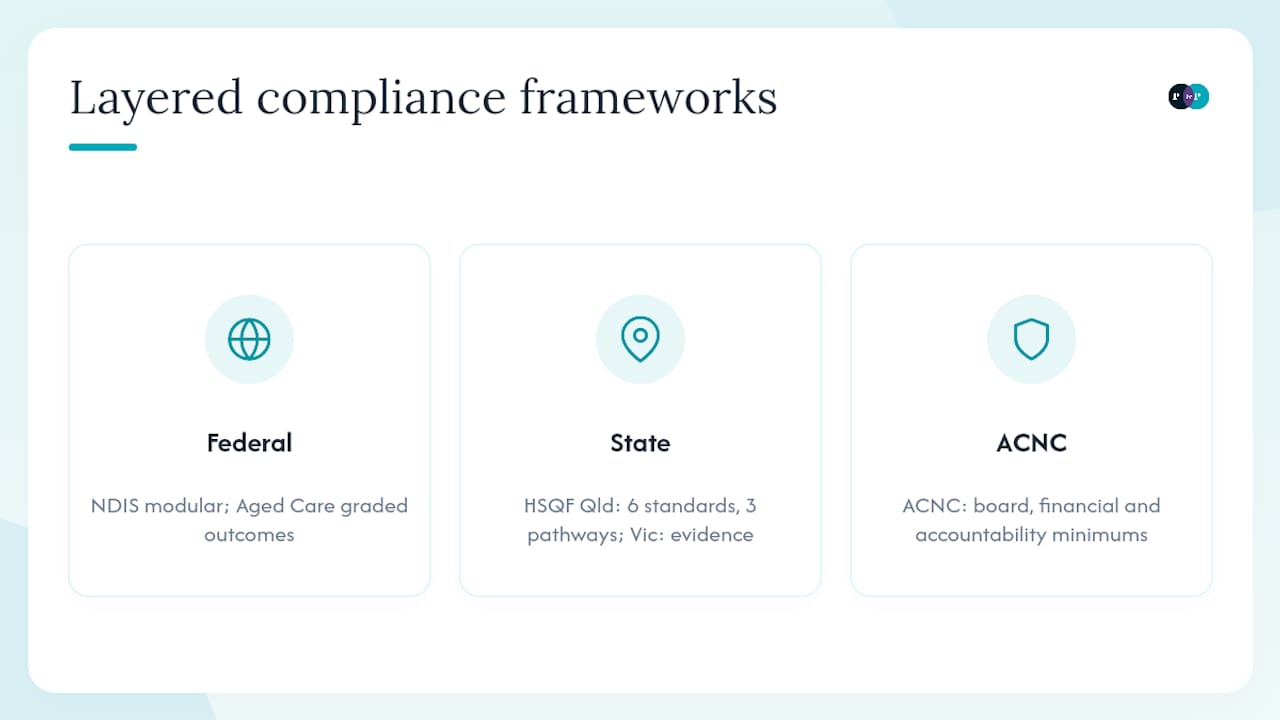
The term "compliance framework" in human services describes the structured set of standards, quality pathways, and regulatory obligations an organisation must meet to hold a government funding contract or maintain provider registration. In Australia, no single national framework covers every service type. Instead, a layered system operates: state-based frameworks like the HSQF sit alongside federal schemes like the NDIS Practice Standards and the Aged Care Quality Standards (Strengthened).
HSQF (Queensland only) is administered by the Department of Families, Seniors, Disability Services and Child Safety. The HSQF Version 9.0 user guide sets six Human Services Quality Standards, three quality pathways, and the rules for which organisations must demonstrate compliance. Its purpose is continuous improvement, not a one-time tick-box exercise.
NDIS Practice Standards are administered by the NDIS Quality and Safeguards Commission. They use a modular structure: a core module for higher-risk supports and a verification module for lower-risk services. Auditors assess compliance against quality indicators specific to each module.
Aged Care Quality Standards (Strengthened) reflect a deliberate shift toward measurable outcomes under the new Aged Care Act. The Aged Care Quality and Safety Commission describes these as more detailed and specific than previous standards, with graded assessment outcomes replacing the binary pass/fail approach.
Victoria Social Services Standards apply to organisations funded by the Victorian Department of Families, Fairness and Housing. They share structural similarities with the HSQF but carry distinct evidence requirements tied to Victorian funding schedules.
ACNC Governance Standards apply to all registered charities. They set minimum expectations for board conduct, financial oversight, and accountability — obligations that sit underneath every other framework your organisation operates within.
The six core standards and what auditors look for
The six Human Services Quality Standards form the backbone of the HSQF. Each standard carries performance indicators that auditors use to assess both documentation and practice.
- Governance and management — Auditors look for board minutes recording quality performance discussions, a current risk register, and evidence that the governing body acts on corrective actions, not just approves policies.
- Service access — Evidence includes documented intake processes, eligibility criteria, waitlist management records, and service agreements signed before supports begin.
- Responding to individual need — Auditors expect individual support plans, review records showing plans are updated, and evidence that people using services have contributed to their own planning.
- Safety, wellbeing and rights — Incident registers, complaint records, and staff training logs are the primary evidence. Auditors will ask frontline workers how they report incidents and what happens next.
- Feedback and complaints — A documented complaints process is necessary but not sufficient. Auditors check whether complaints are analysed for trends and whether outcomes are reported to the board.
- Human resources — Position descriptions, recruitment records, induction checklists, supervision logs, and professional development plans all feature. Auditors commonly ask staff directly whether they have received supervision in the past three months.
The distinction auditors draw consistently is between organisations that have policies and those where staff can demonstrate how those policies guide daily practice. Board minutes, service agreements, incident records, and individual plans are the four document types that appear in almost every audit request list.
Which organisations must meet these standards?
Scope under the HSQF turns on three principles: funding arrangement duration, service complexity, and the vulnerability of people receiving supports. Organisations funded for 18 months or more to deliver ongoing human services are generally required to demonstrate compliance. The specific quality pathway — certification, self-assessment, or recognition of other accreditation — is stated in the funding schedule attached to the contract.
In-scope services typically include disability accommodation supports, out-of-home care, funded family support programmes, homelessness services, and community mental health programmes. Short-term pilot contracts or one-off project grants are commonly out of scope, though this must be confirmed in the funding agreement itself, not assumed.
For NDIS, registration triggers compliance with the NDIS Practice Standards. Providers delivering specialist disability accommodation, behaviour support, or early childhood supports face the full core module audit. Lower-risk supports may qualify for the verification module, which is less intensive. NDIS provider responsibilities also include consumer law obligations, accurate pricing, and recordkeeping requirements regulated by the NDIS Quality and Safeguards Commission.
The practical check: locate HSQF Part 3 in the user guide and cross-reference it against your funding schedule. The schedule will name the required pathway. If it does not, contact your funding body before assuming self-assessment applies.
How do you demonstrate compliance with the HSQF?
The HSQF certification resources page describes three quality pathways, and the right one for your organisation is determined by your funding agreement, not by preference.
Certification is conducted by an independent third-party certification body accredited by JAS-ANZ. Selecting a body that is not JAS-ANZ accredited invalidates certification for government compliance purposes. Certification cycles typically run for multi-year periods, with audits occurring periodically. Organisations should engage a certification body well in advance of their due date to allow adequate preparation time.
Self-assessment is used by organisations in lower-risk service streams or shorter funding arrangements. It requires a documented self-assessment against each standard, supported by evidence, and submitted to the funding body. It is not a lighter-touch option in terms of evidence — the same documentary standards apply.
Recognition of other accreditation applies where an organisation already holds accreditation under an approved scheme (for example, the NDIS Practice Standards or the Aged Care Quality Standards). The funding body recognises that accreditation as meeting HSQF obligations, reducing duplication. This pathway requires formal application and is not automatic.
Certification bodies auditing HSQF must hold JAS-ANZ accreditation. An audit conducted by an unaccredited body does not satisfy the Queensland government's compliance requirements, regardless of the audit's findings. Confirm accreditation status before signing an engagement agreement.
Documents auditors commonly request: current board minutes (last 12 months), all active service agreements, the risk register, incident register, complaints register, staff training records, and at least three individual support plans with corresponding review records.
How audits work and what happens after non-conformance
Audits follow a consistent sequence: preparation, on-site assessment, draft report, corrective action, and follow-up verification. Preparation involves submitting a document pack to the certification body; on-site assessment includes interviews with executives, board members, and frontline staff, plus file reviews.
Audit outcomes under both the HSQF and the Aged Care Quality Standards (Strengthened) use a graded scale: conformance, minor non-conformance, and major non-conformance. Minor non-conformances require a corrective action plan with a defined timeframe. Major non-conformances carry greater urgency and may trigger increased regulatory oversight or, in serious cases, suspension of certification.
After a non-conformance finding, the escalation path runs from the organisation to the certification body to JAS-ANZ. The board must record the non-conformance and the corrective action plan in minutes, demonstrating active oversight rather than delegating the matter entirely to management. Regulators expect boards to evidence this oversight — not merely hold a policy library — through minutes that record discussion on quality performance, risk registers, and corrective action follow-up.
A 90-day governance toolkit for boards and managers
The table below maps a realistic 90-day implementation sequence for an organisation preparing for certification or a scheduled audit.
| Fortnight | Activity | Key output |
|---|---|---|
| 1–2 | Review funding agreement; confirm quality pathway and due date | Pathway confirmed in writing |
| 3–4 | Self-assessment gap analysis against all six standards | Gap register with priority ratings |
| 5–6 | Evidence collection: board minutes, service agreements, incident records | Evidence folder by standard |
| — | Staff briefings on audit process; update incident and complaints registers | Briefing records; updated registers |
| 9–10 | Engage JAS-ANZ accredited certification body (if certification pathway) | Engagement letter signed |
| — | Mock audit or internal review; close remaining gaps | Corrective action log closed |
Board governance checklist:
- Quality performance reports tabled at every board meeting, not just annually.
- Minutes record discussion of quality data, not just receipt of reports.
- Risk register reviewed and updated at least quarterly.
- Corrective action plans tracked to closure with board sign-off.
- Annual self-assessment or audit outcome reported to the full board.
Practical HSQF tools and resources — including self-assessment workbooks and continuous improvement templates — are available from the Department of Families, Seniors, Disability Services and Child Safety. Peer feedback across the sector consistently shows that practical, staff-friendly templates increase compliance and ownership more effectively than long policy manuals.
Anonymised practice example: A medium-sized Queensland community service organisation operating out-of-home care and family support programmes had completed self-assessment for three consecutive cycles. When their funding body moved them to the certification pathway, a gap analysis revealed two major non-conformances: board minutes contained no quality performance discussion, and individual support plans lacked documented review dates. Over 10 weeks, the organisation introduced a one-page quality dashboard tabled at each board meeting and updated all active support plans with review schedules. Both non-conformances were closed at the certification audit. The certification body noted the board minutes as a particular strength.
For organisations building or rebuilding a quality management system, the NDIS quality management system guide offers a step-by-step approach that cross-maps to HSQF requirements.
How does HSQF relate to NDIS, aged care and child-safe standards?
Where an organisation holds multiple funding contracts or registrations, obligations under different frameworks frequently overlap. The practical rule is to build one quality system and cross-reference it to each framework, rather than maintaining separate systems.
Common evidence that satisfies multiple frameworks simultaneously: service agreements (HSQF Standard 2, NDIS Practice Standards core module), risk registers (HSQF Standard 1, Aged Care Quality Standards governance standard, ACNC Governance Standards), incident registers (HSQF Standard 4, NDIS Practice Standards, Aged Care Quality Standards), and staff training records (HSQF Standard 6, NDIS Practice Standards, Aged Care Quality Standards).
Scenario 1: An NDIS registered provider in Queensland delivering community participation supports under an HSQF-funded contract must meet both the NDIS Practice Standards (verification module) and HSQF. Recognition of other accreditation may apply if the NDIS audit already covers the relevant standards. Confirm with the funding body before assuming recognition is automatic.
Scenario 2: An aged care provider that also supports NDIS participants faces dual obligations under the Aged Care Quality Standards (Strengthened) and the NDIS Practice Standards. The strengthened Aged Care Quality Standards use graded assessments aligned closely with the NDIS approach, so a single evidence base — with clear cross-referencing — can satisfy both regulators. Boards governing these organisations should read the aged care governance guide for the specific oversight obligations the strengthened standards introduce.
The NDIS Practice Standards' modular structure means that a provider delivering both higher-risk and lower-risk supports may face both the core module and the verification module in the same audit cycle. Understanding which supports trigger which module is a prerequisite for accurate audit preparation.
The governance blind spot most boards still carry
Most boards in this sector now understand that compliance is not a management task delegated downward and reported upward once a year. What still catches organisations out is the gap between holding a policy library and evidencing that the policies actually shape practice.
In my experience working with boards across Queensland and beyond, the most common finding at certification audits is not missing policies. It is board minutes that record receipt of a quality report without any recorded discussion, question, or decision. Regulators read minutes carefully. A minute that says "Quality report noted" tells an auditor that the board received information. It does not tell them the board governed.
The shift I have seen make the most difference is the introduction of a short quality dashboard — one page, four or five metrics, tabled at every meeting — that forces a conversation rather than a nod. When boards start asking questions about complaint trends or incident rates, management responds by improving the underlying systems. The dashboard does not create compliance. It creates the conditions for the board to govern compliance, which is what regulators are actually looking for.

Work with The Planning and Practice Hub on your compliance pathway
Knowing which framework applies is the starting point. Closing the gap between your current practice and what an auditor will find is where the real work happens.
The Planning and Practice Hub works with Queensland and national human services organisations on HSQF certification support, self-assessment facilitation, board governance reviews, and compliance calendar setup. Rachel Willis brings nearly 30 years of direct experience across NDIS, aged care, child and family, and community services — which means advice grounded in what regulators actually look for, not generic quality management theory.
If your next audit is within 12 months, or your board has not received a quality performance report in the last quarter, a compliance health check is a practical first step. Contact The Planning and Practice Hub through the human services consulting page to discuss your organisation's current position and what a structured pathway to certification or self-assessment looks like in practice.
Sources
FAQ
What is a compliance framework in human services?
A compliance framework in human services is the structured set of standards, quality pathways, and regulatory obligations an organisation must meet to hold a government funding contract or maintain provider registration. In Australia, the applicable framework depends on funding source, service type, and jurisdiction.
Which organisations must comply with the HSQF?
Queensland organisations funded by the Department of Families, Seniors, Disability Services and Child Safety for 18 months or more to deliver ongoing human services are generally required to demonstrate compliance with the HSQF. The specific quality pathway is stated in the funding schedule attached to the contract.
What are the three quality pathways under the HSQF?
The HSQF offers certification by a JAS-ANZ accredited body, self-assessment, and recognition of other approved accreditation. The funding agreement specifies which pathway applies; recognition of other accreditation requires a formal application and is not granted automatically.
What is the policy framework in community services?
Community services in Australia operate under a layered policy framework: state-based standards such as the HSQF (Queensland) or Victoria's Social Services Standards, federal schemes including the NDIS Practice Standards and Aged Care Quality Standards (Strengthened), and cross-cutting governance obligations under the ACNC Governance Standards for registered charities.
How do HSQF and NDIS Practice Standards intersect?
Where an organisation holds both HSQF-funded contracts and NDIS registration, common evidence — service agreements, risk registers, incident records, and staff training logs — can satisfy both frameworks. Recognition of other accreditation may reduce duplication, but must be confirmed with the Queensland funding body before it is relied upon.