
The single biggest lever in EOI writing for community services isn't polished prose. It's alignment: every objective mapped to the funder's stated priorities, every budget line matched to an activity, every eligibility box ticked before you write a word of narrative. Assessors reject far more EOIs for technical non-compliance than for weak ideas.
Before drafting anything, build one central document, a "source of truth" that pulls together the program guidelines, eligibility criteria, and your draft budget in one place. Every section of your EOI should trace back to it. Two things worth anchoring to early: the NDIS Practice Standards if your service intersects disability supports, and whichever state's grants portal (often Grants Gateway or a program-specific system) governs lodgement.
- Confirm eligibility against the guidelines first, not last
- Build your source-of-truth document before drafting narrative
- Map every dollar in the budget to a named activity and outcome
Key Takeaways
A competitive EOI depends on aligning the narrative, budget, and technical attachments to the funder's own guidelines before a single sentence of prose is polished.
| Point | Details |
|---|---|
| Build a source-of-truth document | Consolidate guidelines, eligibility criteria, and budget in one place before drafting narrative. |
| Pass the technical checklist first | Confirm attachments, templates, and portal rules, since technical non-compliance causes early disqualification. |
| Match budget to activity line by line | Use a budget-to-activity matrix so every cost visibly funds a named, measurable outcome. |
| Collect specific evidence, not generic goodwill | Request letters of support that name an active contribution and timeframe. |
| Get independent review before lodgement | The Planning and Practice Hub reviews EOIs for compliance and budget-narrative alignment before submission. |
Getting the EOI writing community services checklist right
Most EOIs don't fail because the project idea was weak. They fail because a mandatory attachment was missing, the wrong template was used, or a word count was exceeded and the portal truncated the submission. Assessors regularly disqualify EOIs for exactly this kind of technical non-compliance, often before anyone reads the narrative properly.
Run this sequence before you write a single paragraph of narrative:
- Read the eligibility criteria twice, then check your organisation's structure, ABN status, and service area against them line by line.
- List every mandatory attachment named in the guidelines: financial statements, ABN registration, board declarations, supplier quotes, insurance certificates.
- Confirm the required template. Program guidelines often specify a particular Word or PDF format, and submitting the wrong one is treated as non-compliance.
- Note word or character limits per section, and check whether the portal (Grants Gateway, SmartyGrants, or a program-specific system) requires pre-registration.
- Confirm accepted file formats and maximum file sizes before you're staring down a failed upload at 4:58pm.
- Save a screenshot or confirmation email as proof of lodgement, every time.
Victorian Government guidance is blunt on this point: draft your responses in a document before you go near the online form, check every required document exists, and register early if the portal demands it. Program guideline PDFs, like those for the Volunteer Grants program, spell out exactly which attachments are mandatory, and applicants who skim rather than follow them exactly are the ones who get knocked out early.
Pro Tip: Print the guideline document and physically tick off each mandatory attachment as you gather it. A checklist in your head is not a checklist.
How do you write the project narrative?
Open with your outcome, not your organisation's history. Assessors reading dozens of EOIs want to know, in the first two sentences, what changes for the community if this project is funded. State that plainly, then link it directly to the funder's own stated objectives, not your organisation's general mission statement.
From there, keep your objectives short and specific, and attach a measurable indicator to each one. "Improve social connection for isolated older residents" is vague. "Run 12 weekly peer-support sessions reaching 40 residents, measured by attendance and a pre/post wellbeing survey" gives the assessor something to score.
The trap most non-profits fall into is reusing last year's EOI, or one written for a different funder, with the names swapped. Assessors read hundreds of these submissions and spot recycled language quickly, which is one reason plain, specific, unpadded English consistently scores better than broad description.
- Lead with the outcome statement, aligned word-for-word to the funder's priorities
- Give each objective one measurable indicator, not a paragraph of ambition
- Rewrite for this funder specifically, never copy-paste from a previous submission
- Keep your source-of-truth document open while drafting, so narrative and budget stay consistent
If your organisation also submits tenders, the discipline is similar; see our guide to grant writing for community services in NSW for sector-specific detail on tone and structure.
How do you map the budget to project activities?
Assessors mark down EOIs constantly for one specific failure: a budget that doesn't visibly connect to the activities described in the narrative. If you've written about running 12 workshops but your budget shows a lump sum for "program delivery" with no breakdown, that mismatch reads as a red flag, not a rounding error.
Build a budget-to-activity matrix as your working document. Every row is a budget line; every row also names the specific activity it funds and the outcome it contributes to. This single source-of-truth approach is what regional grant advisers recommend precisely because it prevents the inconsistencies assessors flag most often.
- Write a one-line justification for each major cost, referencing the guideline's eligible-expense list
- Get supplier quotes for anything over a few hundred dollars. A guessed figure looks careless next to a quoted one
- Clearly label in-kind or matched contributions as separate line items, not folded into cash requests
- Common mismatch: claiming staff wages for an activity the narrative doesn't mention. Fix it by either adding the activity or removing the cost
Do this matrix work before you write your final narrative draft, not after. It's far easier to adjust a sentence than to reconcile a spreadsheet against six pages of prose the night before lodgement.
What evidence do assessors actually want to see?
Assessors weigh sustainability heavily. A project that quietly folds the day the grant runs out reads as a poor investment, no matter how compelling the need. Funders consistently favour applications showing the project will continue through other funding, partnerships, or embedded organisational capacity.
Strong evidence is specific and short: a local statistic on service demand, a two-paragraph case study, a letter of support that names an active role rather than a vague endorsement.
- Local data: council demographic profiles or service-gap statistics carry more weight than national figures
- A short case study: one real (anonymised) example of unmet need, told in three or four sentences
- Letters of support: request these early, and ask partners to name what they'll actually contribute
- Sustainability plan: name the funding sources, partnerships, or in-kind arrangements that continue after the grant ends
Letters of support work best when they're specific, time-bound, and describe an active commitment rather than generic goodwill.
One regional non-profit we've supported learned this the hard way: their first letters of support said little more than "we support this application." A second round, requesting each partner name a specific contribution and timeframe, transformed the same partnerships into evidence assessors could actually score.
What should happen in the final days before lodgement?
Build in an independent review before lodgement, ideally from someone who hasn't drafted a word of it. Fresh eyes catch inconsistencies between narrative and budget that the writer stops seeing after the fifth read-through.
Draft and finalise everything in Word first. Victorian Government guidance recommends this explicitly: manage word counts and formatting offline, then transfer to the portal only once the content is locked. Portal text boxes rarely handle formatting well, and some auto-truncate at the character limit without warning.
- Have at least one independent reviewer check the EOI against the eligibility checklist, not just for typos
- Set up two staff logins to the portal where the program allows it, so a single login failure doesn't block submission
- Test-upload attachments early if the portal allows drafts, rather than discovering a file-format error at 4:55pm
- Save every submission receipt and confirmation, and log the outcome (successful or not) in your grants calendar
- If unsuccessful, request assessor feedback and record it against the guideline clause it relates to, ready for next round
Pro Tip: Ask your independent reviewer to check the budget-to-activity matrix specifically, not just the narrative. Most reviewers default to proofreading prose and skip the numbers.
Writing an introduction that earns the assessor's attention
Your executive summary carries more weight than its length suggests, because it's often the only section every assessor reads in full before scoring. Open with the outcome, stated plainly: who benefits, by how much, and by when. Save your organisation's history for a later section.
A strong introduction does three things in roughly four sentences: names the specific community need, states the project response, names the measurable outcome, and signals the funding amount requested. Skip the mission statement. Skip the "since 1998" preamble. Assessors reading forty EOIs in a sitting reward the ones that respect their time.
One useful test: read your executive summary aloud in under 30 seconds. If it takes longer, it's carrying weight that belongs deeper in the document. If a reader with no background in your sector can understand the ask and the outcome from that summary alone, you've written it correctly.
How do you show community need without padding the page?
Generic need statements ("there is a lack of services in this area") tell an assessor nothing they can score. Specific ones do the work for you.
Pair one local statistic with one human-scale detail. A council data point showing service-gap numbers, alongside a short, anonymised example of what that gap looks like in practice, gives assessors both the scale and the texture of the problem. Avoid stacking five statistics in a row; one well-sourced figure, explained in a sentence, lands harder than a paragraph of numbers.

Impact claims need the same discipline. Instead of "this project will improve wellbeing," state what changes and how you'll know: attendance figures, survey results, a reduction in a measurable indicator your organisation already tracks. Assessors are trained to look for the causal link between activity and outcome, and a vague impact claim breaks that link immediately.
Which language techniques actually persuade assessors?
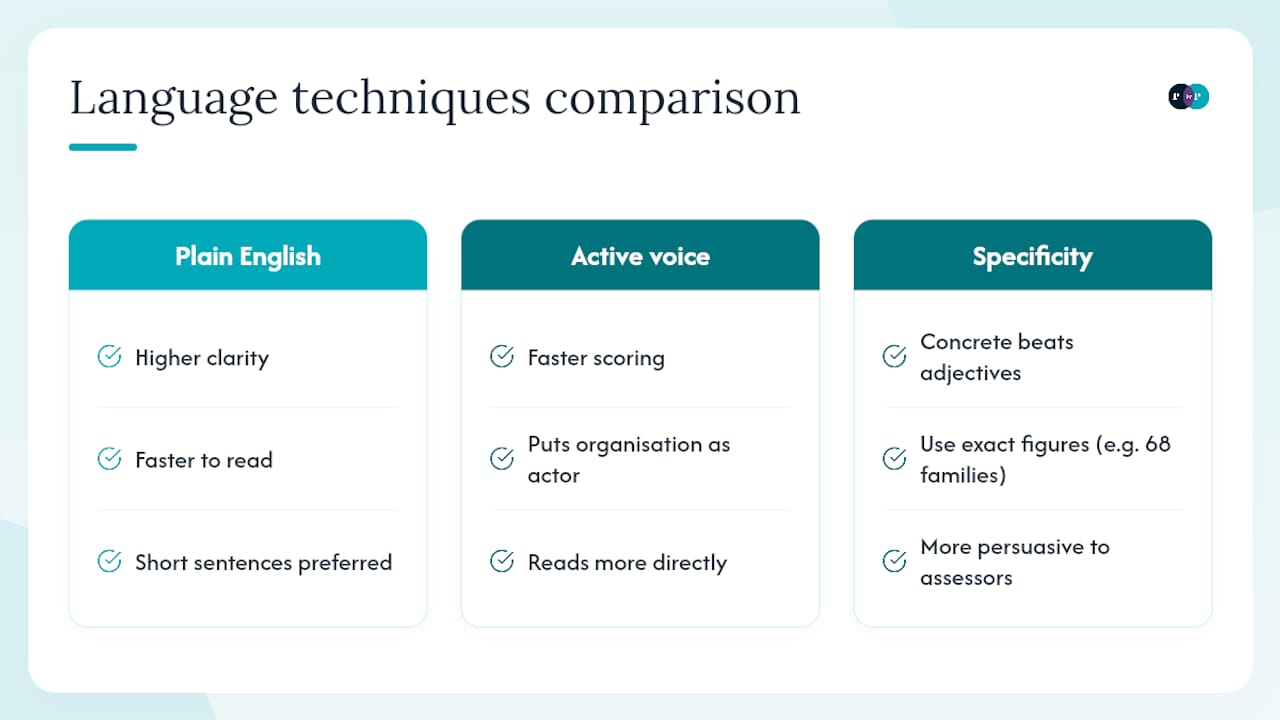
Plain English outperforms formal or dense language in almost every EOI context, because assessors are reading at speed and rewarding clarity over cleverness. Short sentences carry technical content better than long, subordinated ones.
Active voice matters more than most writers realise. "The program will deliver 40 support sessions" reads faster and scores better than "40 support sessions will be delivered by the program." The active version also puts your organisation clearly in the sentence as the actor, which subtly reinforces capability.
Specificity is the real persuasion technique here, not adjectives. Swapping "significant community need" for "68 families on the local housing waitlist" does more persuasive work than any amount of urgent-sounding language. Sector guidance on Australian grant writing consistently points back to this: concrete, plain, and specific beats broad and emphatic every time.
What mistakes cost organisations the grant?
The costliest mistake is treating an EOI as a template exercise, reusing last year's language with a new funder's name pasted in. It shows in tone mismatches and priorities that don't line up with the current guidelines, and assessors notice.
The second most common failure is a narrative and budget that were clearly written separately. If your text describes six activities and your budget shows four cost categories, that gap undermines credibility even when both halves are individually well written.
Third: vague sustainability claims. "We hope to secure future funding" says nothing. Name the actual plan, even if it's modest.
Fourth, and avoidable with a five-minute check: missing the exact attachment format, exceeding a word limit, or lodging through the wrong portal account. These are the failures that knock EOIs out before assessment even starts, and they're entirely within your control to prevent.
What one checklist fix taught a board about EOI risk
One community organisation we've worked with came within a day of lodging an EOI with two mandatory attachments missing: an unsigned board declaration and an outdated insurance certificate. A final compliance pass caught both before submission. The narrative was strong. It would have failed on paperwork alone.
That's the pattern we see most often. Boards spend hours refining language and almost no time on the technical gate that decides whether the narrative gets read at all.
The Planning and Practice Hub supports organisations at exactly this stage, checking eligibility, attachments, and budget-to-activity alignment before lodgement, alongside broader work on governance and tender writing for human services.
So here's the question worth putting to your board or executive team: if your next EOI were due tomorrow, could you show, in one document, that every budget line maps to a named activity and outcome?
— Rachel
Get support writing or reviewing your next EOI
The Planning and Practice Hub is the practical alternative to drafting an EOI cold, or paying for a generalist copywriter who doesn't know a budget-to-activity matrix from a line-item guess. Our grant-writing and compliance review work is built specifically for human services organisations navigating NDIS, aged care, child safe, homelessness, and community services funding rounds, where a missing attachment or an unmatched budget line can sink months of work in seconds.
We review draft EOIs against the funder's own eligibility criteria, check every mandatory attachment, and stress-test whether your narrative and budget tell the same story before you lodge. For organisations preparing multiple submissions across a funding calendar, we also support the broader compliance workload, including tools like our compliance calendar for tracking deadlines across programs.
If your next EOI is due in the coming weeks, the practical next step is a scoping conversation about your draft. Visit our human services consulting page to see how a review engagement works, and get in touch before your submission window closes.
Where to check the rules before you draft
Check the funder's own guideline pages before drafting, not after. These are the pages that hold the eligibility criteria, attachment lists, and portal instructions that override any generic advice.
- Vic for state-level drafting and portal advice
- RDA Illawarra Shoalhaven Grant Toolkit for regional toolkit examples on evidence and letters of support
- Program-specific guideline PDFs, which usually list mandatory attachments in a dedicated section near the front
For grants directed at public safety or municipal service delivery, the types of grants and funding approaches guide is a useful cross-sector reference on how eligibility categories differ.
Sources
FAQ
What is an EOI in community services funding?
An EOI, or expression of interest, is a preliminary submission funders use to shortlist applicants before a full application, typically covering project outcomes, budget summary, and eligibility.
How long should an EOI executive summary be?
Aim for a concise summary of a few sentences that clearly covers the need, the response, the measurable outcome, and the funding amount requested.
What's the most common reason EOIs get rejected?
Technical non-compliance, missing mandatory attachments, wrong templates, or exceeded word limits, disqualifies EOIs before assessors reach the narrative.
Should a budget match the narrative exactly?
Yes. Every activity described in the narrative needs a corresponding budget line, and every budget line needs a named activity, checked using a budget-to-activity matrix.
Can The Planning and Practice Hub review an EOI before I submit it?
Yes. The Planning and Practice Hub reviews EOIs for eligibility, attachment compliance, and budget-to-narrative alignment as part of its grant-writing and governance advisory work.