
Most community organisations in NSW don't lose grants because their work isn't good enough. They lose them because the application doesn't sequence correctly: eligibility confirmation comes after the narrative, evidence isn't attributed, or the timeline collapses in the final week. Getting grant writing for community services in NSW right is less about writing talent and more about operational discipline.
The good news is that NSW has genuinely useful infrastructure for this. The NSW Grants and Funding Finder lists over 466 grants from 46 government agencies in one place. MyServiceNSW personalises those results against your ABN and ANZSIC classification. Local councils like the City of Sydney run structured briefing sessions. Community Builders NSW provides training and toolkits. The pathways exist. The question is whether your organisation is using them well.
Key portals and support resources:
- NSW Grants and Funding Finder at nsw.gov.au: centralised search across all NSW Government grants, mobile-friendly, with filtering by category, open/closed status, and announcement dates
- MyServiceNSW: personalised grant matching via your ABN-linked ANZSIC codes
- City of Sydney Social and Community Grants: direct council funding with briefing sessions and 15-minute applicant consultations
- Community Builders NSW: training, toolkits, and capacity-building support for community sector organisations
- Resilience NSW: grant programmes for disaster risk reduction and community resilience, with published preparation guides
- Northern Rivers Community Foundation (NRCF): free grant writing workshops across the Northern Rivers region
Where to find grant writing support for community services in NSW

The NSW Grants and Funding Finder is the most practical starting point for any community organisation. It consolidates grants from across 46 agencies, allows filtering by category and status, and displays announcement dates so you can plan ahead rather than react. The platform is also mobile-accessible, which matters when staff are working across sites or responding during a crisis event.
Types of grants available through NSW Government portals:
| Grant type | Typical focus areas | Common eligibility |
|---|---|---|
| Community development | Social cohesion, inclusion, local projects | Incorporated associations, NFPs |
| Disaster resilience | Risk reduction, preparedness, recovery | Local councils, community groups |
| Arts and culture | Creative projects, cultural events | Organisations and individuals |
| Sport and recreation | Facilities, participation programmes | Clubs, councils, NFPs |
| Social and community services | Wellbeing, support services, capacity | Registered NFPs, charities |
MyServiceNSW adds a personalisation layer. When you log in with your ABN, the platform matches grants by ANZSIC codes, surfacing the most likely matches first. If your results look off, check and update your ANZSIC codes via your ABN registration. This is a step many organisations skip, and it directly affects what funding they see.
Steps to screen and select appropriate grants:
- Search the Finder using sector-specific keywords (e.g. "community services," "social support," "homelessness")
- Filter by status (open now, opening soon) and check announcement dates for upcoming rounds
- Log into MyServiceNSW to receive personalised suggestions against your ABN
- Review the City of Sydney Social and Community Grants programme if you operate in the local government area
- Check Central Coast Council and other local government grant pages for area-specific funding
- Read the full guidelines before investing time in any application
Treating grant discovery as a pipeline rather than a single search improves planning considerably, particularly for volunteer-reliant organisations. Shortlist rounds, check eligibility, ready your documents, then schedule drafting and review as separate phases. Rushed submissions are one of the most common and most avoidable failure points.
How to prepare a strong NSW community services grant application
The most common application failure isn't poor writing. It's poor sequencing. Funders confirm eligibility before they read your narrative, which means an application that leads with a compelling story but buries eligibility detail will often not progress. Confirm your organisation and project meet the criteria before you write a single word of narrative.
Practical preparation steps:
- Read the guidelines in full and note every eligibility requirement
- Build a timeline working backwards from the closing date, allowing time for document collection, drafting, internal review, and submission
- Map each assessment criterion to the evidence you plan to use before drafting
- Check character limits in the online form to calibrate response length
- Confirm budget alignment with project scope and timeline
Resilience NSW guidance is explicit on this: successful applications require a thorough understanding of program requirements, eligibility, and timelines, with sufficient time built in for preparation and review.
Evidence quality is where many applications lose ground. The Community Grants Hub identifies five categories: quantitative, qualitative, evaluations, expert, and anecdotal. Using a combination strengthens your case. A survey figure from your own records paired with a client interview excerpt is more persuasive than either alone. Attribute every piece of evidence clearly, including data sources and interview subjects where relevant.
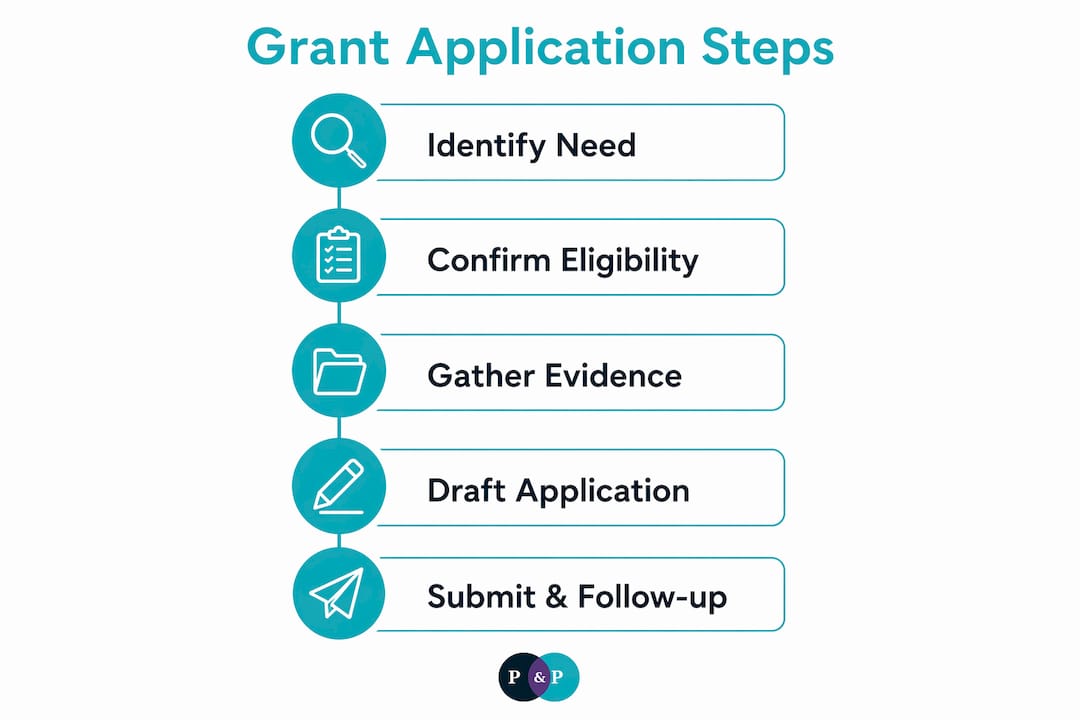
One anonymised example: a mid-sized homelessness NFP in regional NSW had strong community relationships but consistently received feedback that their applications lacked measurable outcomes. After mapping their evidence to each criterion before drafting, and adding ABS census data alongside their own service records, they progressed to funding in the next round. The work hadn't changed. The sequencing had.
Pro Tip: Draft a project logic skeleton before you open the application form. Structure it as: need → target cohort → activities → outcomes → evaluation. Then adapt that skeleton to the funder's required sections. This reduces rewriting and keeps your application coherent across all criteria.
Proofreading alone is not sufficient. A criteria-mapping pass that aligns your evidence to each assessment question, checks budget figures, and verifies timeline accuracy will catch gaps that a grammar check won't. Ask a colleague outside the project to read the application with fresh eyes before submission.
What grant writing workshops and training are available in NSW?
Structured support is available across NSW, and most of it is free or low-cost. The City of Sydney Social and Community Grants programme offers grant writing workshops alongside briefing sessions and 15-minute in-person or online consultations. These sessions address common gaps including unclear need statements, missing documentation, and budget mismatches. Language support is also available.
The Northern Rivers Community Foundation runs free grant writing workshops across eight locations in the Northern Rivers region, with condensed 90-minute online sessions for those who can't attend in person. These cover proposal crafting, funding source navigation, and Q&A on common application challenges. Places are limited, so early registration matters.
Key training and support providers:
- City of Sydney: workshops, briefings, and 15-minute applicant consultations (in-person and online, language support available)
- Northern Rivers Community Foundation: free workshops across eight Northern Rivers locations plus online sessions
- Community Builders NSW: capacity-building training, toolkits, and resources for community sector organisations
- Resilience NSW: published preparation guides and grant writing information sheets for government-funded programmes
- Local councils: many councils including Central Coast Council run grant information sessions; check your local government website
When you attend a briefing or consultation, bring a near-final draft or at least a clear project description. Preparing focused questions beforehand on eligibility, activity alignment, and budget details makes a 15-minute session far more productive than arriving with a general query. Grant officers can give specific guidance when you give them something specific to respond to.
For organisations in the Northern Rivers, a business coach with sector experience can also support funding readiness and strategic planning alongside formal grant writing workshops.
The government tender writing guide from The Planning and Practice Hub covers the overlap between tendering and grant applications in the NSW community services sector, which is worth reading if your organisation is pursuing both simultaneously.
Key takeaways
Strong grant applications in NSW community services depend on eligibility confirmation, sequenced evidence, and a preparation timeline that doesn't collapse under deadline pressure.
| Point | Details |
|---|---|
| Start with the Finder | The NSW Grants and Funding Finder lists a substantial number of grants from many agencies in one searchable portal. |
| Personalise via MyServiceNSW | Log in with your ABN to receive grant suggestions matched to your ANZSIC classification. |
| Sequence before you write | Confirm eligibility and map evidence to criteria before drafting any narrative. |
| Use a project logic skeleton | Draft need, cohort, activities, outcomes, and evaluation before adapting to the funder's form. |
| Access free workshops | City of Sydney and Northern Rivers Community Foundation both offer free grant writing support. |
FAQ
Where can NSW community organisations find available grants?
The NSW Grants and Funding Finder lists a substantial number of grants from many agencies in one place, and MyServiceNSW provides personalised suggestions based on your ABN and ANZSIC codes.
What are the most common reasons grant applications fail in NSW?
Applications most often fail due to poor sequencing: eligibility is not confirmed before the narrative is written, or evidence isn't attributed and mapped to each assessment criterion.
Are there free grant writing workshops available in NSW?
Yes. The City of Sydney offers workshops and 15-minute consultations, and the Northern Rivers Community Foundation runs free workshops across eight locations with online sessions also available.
What documentation do community organisations typically need for NSW grants?
Most programmes require your ABN, evidence of legal incorporation, a project description, a budget, a timeline, and supporting evidence mapped to the assessment criteria. Always check the specific guidelines for each programme.
How does MyServiceNSW personalise grant suggestions?
MyServiceNSW matches grants by ANZSIC codes linked to your ABN, surfacing the most relevant funding opportunities for your organisation's sector and activities.
What's the biggest bottleneck in your organisation's current grant preparation process: discovery, eligibility assessment, or the drafting and review stage?
The Planning and Practice Hub works with community service organisations across NSW on governance, compliance, and funding strategy. If your board needs a clearer pathway through the grant and tender process, that's a conversation worth having.