
The NSW Government's code of conduct review for local government is at a decisive point. Public consultation on the new draft Model Code of Conduct for Councillors closes at 5pm on 7 August 2026. If you are a councillor, governance officer, or general manager, the changes coming out of this review will reshape how conduct is managed, investigated, and enforced across every NSW council.
The headline changes are significant:
- The current Model Code of Conduct is being split into two separate codes: one for councillors, and one for council staff, delegates, and committee members.
- The draft councillor code reduces the existing document from over 100 pages to approximately 2–3 pages, aligned with state parliamentary standards.
- Serious misconduct matters will move from the NSW Civil and Administrative Tribunal (NCAT) to the Land and Environment Court (LEC) under the Local Government and Other Legislation Amendment (Councillor Conduct) Bill 2025.
- Mayors will gain explicit power to expel councillors from meetings for disorderly conduct, with financial penalties including loss of fees attached.
- A new Privileges Committee, made up of experienced councillors, will assess minor behavioural complaints, preserving space for genuine political debate.
What the NSW Model Code of Conduct 2020 currently requires
The Model Code of Conduct for Local Councils in NSW sets the minimum ethical and behavioural standards for all council officials. It applies to councillors, council staff, and delegates, collectively defined as "council officials" under the framework. Its legal basis sits in section 440 of the Local Government Act 1993, which requires every council and joint organisation to adopt a code that incorporates the Model Code's provisions.
The code's purpose is to promote integrity, transparency, and accountability within councils. It covers conflicts of interest, gifts and benefits, the use of council resources, and standards of conduct in public office. Councils can strengthen or supplement the Model Code in their own adopted codes, but cannot dilute the minimum standards it prescribes.
Key features of the current framework include:
- Mandatory adoption: every council must adopt a code incorporating the Model Code's provisions, with no exceptions.
- Scope of application: the code applies to any conduct by a council official connected with their role, including conduct in a private capacity where it relates to their official functions.
- Procedures under section 440AA: councils must also adopt separate procedures for administering their code, based on the prescribed Model Procedures.
- Office of Local Government oversight: the Office of Local Government (OLG) holds review and direction powers over how councils manage complaints, and can direct councils to defer action pending its own review.
- Personal responsibility: compliance is the personal responsibility of each council official, not just a matter for the general manager or governance team to manage on their behalf.
The code has been reviewed every four years since its first iteration in 2005. The current 2020 version is the product of that cycle. The reforms now underway go well beyond a standard four-year update.
What the 2026 reform program actually proposes
The reforms are structured in two stages, and both are now in motion.

Stage 1 centres on the Local Government and Other Legislation Amendment (Councillor Conduct) Bill 2025, introduced in the Legislative Council on 14 October 2025. Its core purpose is to transfer councillor conduct matters from NCAT to the Land and Environment Court, which brings local government expertise and stronger, more transparent decision-making pathways. The LEC will also have power to make disciplinary orders and, where it is in the public interest, to suspend a councillor while proceedings are underway.
Stage 2 focuses on simplifying and strengthening the conduct framework itself. The Policy Statement: Improving Councillor Accountability signals the government's intended direction and is the document currently out for consultation alongside the draft councillor code.
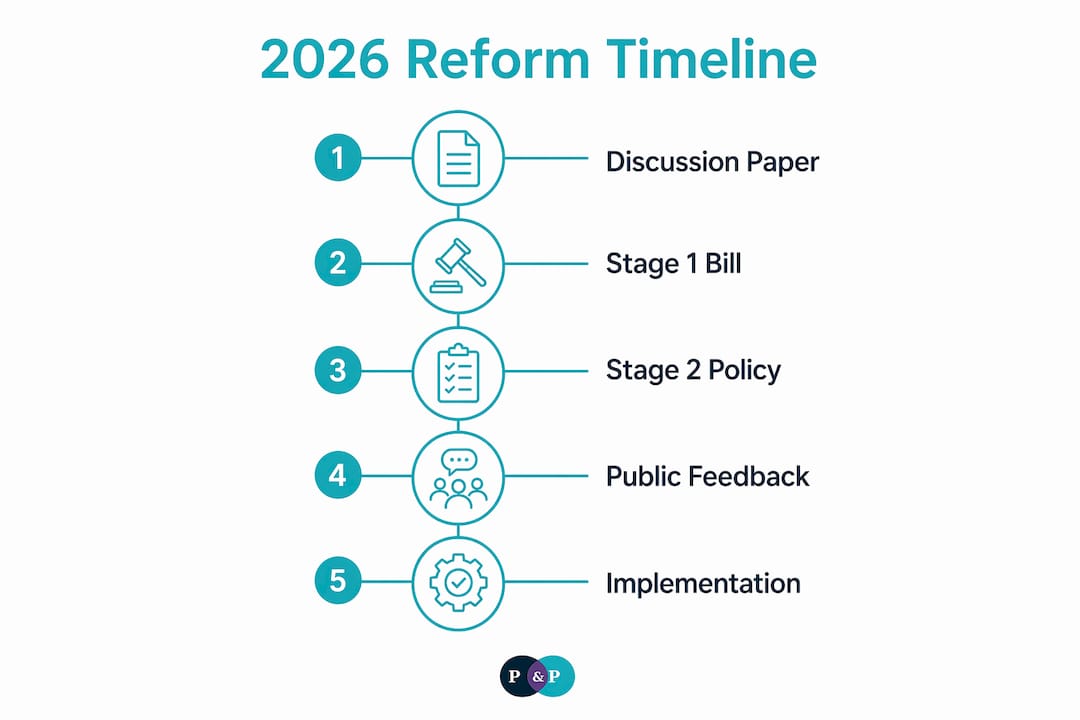
The reform timeline and key milestones are:
| Milestone | Date / Status |
|---|---|
| Discussion paper released | September |
| Free speech in local government guideline issued | June 2025 |
| Councillor Conduct Bill 2025 introduced | 14 October 2025 |
| Draft councillor code released for consultation | 2026 |
| Public consultation closes | 7 August 2026, 5pm |
| Draft legislation and regulations being prepared | Ongoing, OLG |
| Implementation of revised framework | To be confirmed post-consultation |
The rationale for splitting the code is clear: councillors and council staff occupy fundamentally different roles. The new councillor code is designed to reflect the political nature of elected office, operate consistently with the implied freedom of political communication under the Australian Constitution, and remove provisions that have been used to constrain legitimate democratic debate. The staff code will largely retain existing provisions in a simplified form.
Other significant proposals include:
- Centralised complaints management: the OLG will manage the end-to-end complaints process, replacing the current model where councils manage their own complaints with conduct reviewers. This aims to reduce duplication and improve consistency.
- Privileges Committee: a new body made up of experienced mayors and former mayors will assess minor behavioural complaints, with serious matters referred to the LEC.
- Removal of private investigators: the OLG's own investigative capability will be strengthened, removing reliance on private investigators for code breaches.
- Electronic registers for disclosures: modelled on NSW Parliament requirements, general managers will maintain electronic registers with a publicly searchable component and a confidential section for residential addresses.
- Banning closed briefing sessions: except in very limited circumstances, private councillor briefing sessions will be prohibited.
The 4,289 code of conduct complaints lodged over the three years prior to the reform announcement made the case for change hard to argue against. That volume diverted council resources away from core services and prevented the OLG from focusing on genuinely serious misconduct.
Governance responsibilities and compliance under the revised framework
Governance officers need to understand that compliance obligations do not pause during a reform transition. Councils must continue to meet their obligations under section 440AA of the Local Government Act 1993 until new regulations formally replace the existing procedures.
Responsibilities under the current and transitional framework include:
- General managers: maintain the complaints coordinator function, refer complaints about conduct reviewers to the OLG, implement OLG recommendations, and report complaint statistics to council within three months of the end of september each year.
- Mayors: under the proposed reforms, gain explicit powers to expel councillors for disorderly conduct and to remove fee entitlements for the relevant month.
- Governance officers: maintain the panel of conduct reviewers, manage the complaints register, and keep disclosure registers current.
- Councillors: lodge annual declarations confirming the accuracy of their register entries once the new disclosure requirements take effect.
The new disclosure requirements are modelled on the Constitution (Disclosures by Members) Regulation 2026, which applies to NSW Members of Parliament. General managers will be required to keep an electronic register in two parts: a publicly available, searchable section on the council's website, and a confidential section containing residential property addresses. The NSW Parliament's Privileges Committee is also reviewing whether interests of immediate family members should be disclosed; any changes will flow through to councils via both Model Codes.
For councils reviewing their board governance compliance practices, the shift to centralised OLG complaint management is worth noting now, even before the new framework is formally in place.
Practical guidance for governance officers managing the transition
The transition to the revised framework is not simply a matter of swapping one document for another. Governance teams that treat it as a document replacement exercise will find gaps quickly.
One mid-sized regional council we are aware of began its transition planning by auditing every policy that cross-referenced the existing Model Code. The team identified meeting procedure policies, delegation instruments, and induction materials that all needed updating before the new code could operate cleanly. Starting that audit early, rather than waiting for the final code to be gazetted, gave the governance team time to consult with their legal advisers and brief councillors before the changes landed.
The reforms aim to shift the code from being a tool used in political disputes to a constructive framework supporting democratic debate and integrity. Governance officers are best placed to hold that line during the transition.
Practical steps for governance teams right now include following the SEE Checklist NSW: What Must Be in Your Statement? to ensure compliance during the transition:
- Review and submit: read the draft councillor code and the Policy Statement: Improving Councillor Accountability, and submit feedback to the OLG before 7 august 2026.
- Audit cross-references: identify every internal policy, procedure, and induction document that references the current Model Code and flag those for update.
- Brief councillors early: do not wait for the final code. Run a briefing session on the proposed changes, particularly the new disclosure requirements and the Privileges Committee model.
- Check your disclosure register: assess whether your current register structure can accommodate the new two-part electronic format.
- Maintain current obligations: section 440AA compliance continues until formally superseded. Do not let transition planning create a gap in current practice.
Pro Tip: Download the OLG's free speech in local government guideline (issued june 2025) alongside the draft councillor code. The two documents together give you the clearest picture of where the boundaries of legitimate political communication now sit.
For organisations working through a governance review process, the staged nature of these reforms is a useful model: prioritise the changes that require legislative action first, then build the supporting policy and procedural layer around them.
Frequently asked questions and resources for councils
Where can councils access the draft councillor code and submit feedback? The draft new Model Code of Conduct for Councillors and the Policy Statement: Improving Councillor Accountability are available on the OLG's Councillor Conduct Framework Reform page. Submissions close at 5pm on 7 august 2026.
Does the current Model Code of Conduct still apply during the reform transition? Yes. Councils must continue to comply with the existing Model Code of Conduct and their procedures under section 440AA of the Local Government Act 1993 until new regulations formally replace them.
What happens to complaints currently being managed under the existing framework? Transitional arrangements are proposed to support a fair and orderly move to the new framework. The OLG is preparing draft legislation and regulations that will include transitional provisions; councils should monitor the OLG website for updates.
What training resources are available for councillors and staff? The OLG publishes guidance materials on its website, including the free speech in local government guideline issued in june 2025. Local Government NSW (LGNSW) also provides sector-specific training and support for councillors and governance staff navigating conduct framework changes.
Will the staff code of conduct change significantly? The Model Code of Conduct for Council Staff, Delegates and Committee Members will largely retain existing provisions in a simplified form. The OLG is finalising this code separately, and it is not currently out for public consultation.
Key takeaways
The NSW Model Code of Conduct review for local government is the most significant reform to councillor conduct standards since the code's introduction in 2005, and governance officers need to act now rather than wait for the final framework.
| Point | Details |
|---|---|
| Consultation deadline | Public feedback on the draft councillor code closes at 5pm on 7 August 2026. |
| Two separate codes | The current Model Code is being split into one code for councillors and one for staff, delegates, and committee members. |
| Legislative change underway | The Councillor Conduct Bill 2025 moves serious misconduct from NCAT to the Land and Environment Court. |
| Complaint volume drove reform | 4,289 complaints over three years diverted council resources from core services and prompted the overhaul. |
| Current obligations continue | Section 440AA compliance remains mandatory until new regulations formally replace existing procedures. |
If you are working through the governance implications of these reforms for your council or organisation, The Planning and Practice Hub offers governance and compliance consulting grounded in nearly three decades of sector experience.
What is your council's biggest practical challenge in preparing for the split code model: updating disclosure registers, briefing councillors, or aligning your meeting procedures with the proposed changes?
FAQ
When does consultation on the new councillor code close?
Public feedback on the draft new Model Code of Conduct for Councillors must be submitted by 5pm on 7 August 2026 via the OLG's Councillor Conduct Framework Reform page.
What is the main structural change in the NSW code of conduct reform?
The current Model Code of Conduct is being split into two separate codes: one applying specifically to councillors, and one covering council staff, delegates, and committee members.
Which court will handle serious councillor misconduct under the new framework?
The Land and Environment Court will take over from NCAT for serious councillor conduct matters under the Local Government and Other Legislation Amendment (Councillor Conduct) Bill 2025.
What is the Privileges Committee and what will it do?
The Privileges Committee is a proposed new body made up of experienced mayors and former mayors that will assess minor behavioural complaints against councillors, leaving serious misconduct matters for the Land and Environment Court.
Do councils need to do anything differently right now?
Yes. Councils must continue to comply with the existing Model Code and section 440AA procedures while the new framework is finalised, and should submit feedback on the draft councillor code before 7 august 2026.