
Engage a senior child protection compliance consultant with demonstrated experience across the National Principles for Child Safe Organisations, state Child Safe Standards, and reportable conduct schemes. The Australian Human Rights Commission's child safe resources provide the practical benchmark your consultant should work to. The immediate next step is commissioning an independent readiness review and gap analysis from a qualified consultancy such as The Planning and Practice Hub.
Key takeaways
A qualified child protection compliance consultant addresses governance, policy, training, and regulatory liaison as an integrated programme, not a series of standalone documents.
| Point | Details |
|---|---|
| Commission a readiness review first | A gap analysis against the National Principles is the evidence base for every subsequent decision. |
| Governance before policy | Appoint a Child Protection Officer with seniority, independence, and a funded time allocation before updating documents. |
| State standards vary | Know whether your jurisdiction's Child Safe Standards are mandatory or recommended, and check regulator enforcement powers. |
| Build in independent audit | Include safeguarding audits and legal review as explicit line items in scope and budget, not optional additions. |
| The Planning and Practice Hub | Supports Australian human services organisations through readiness reviews, policy development, training, and ongoing regulatory liaison. |
What does a child protection compliance consultant actually deliver?
The scope is wider than most procurement briefs anticipate. A qualified child safety advisor works across six interconnected service areas, each producing concrete deliverables your board can hold to account.
- Policy review and development: a current child safety policy and code of conduct mapped to the National Principles, with role-specific versions for staff and volunteers
- Risk assessment: a child safety risk register covering physical, relational, and online environments, drawing on the Australian Human Rights Commission's online safety checklist
- Screening and recruitment: position descriptions with suitability requirements, Working With Children Check registers, and reference-check frameworks
- Reportable conduct and complaints: a complaint-handling procedure aligned to your state's Reportable Conduct Scheme, with clear escalation pathways and timeframes; see also our complaints management guide for non-profits
- Training and capacity building: separate leader and frontline modules, covering mandatory reporting obligations, recognising harm, and responding to disclosures
- Readiness reviews and audits: a gap analysis report against the National Principles, an action plan with prioritised milestones, and audit-ready documentation
The ACFID guidelines note that the Child Protection Officer role requires genuine seniority and line-of-command independence. Request role descriptions that reflect this, not a generic staff appointment bolted onto an existing position.
How reputable consultancies structure their engagement
Quality delivery follows four phases. The table below shows what each phase produces and indicative timeframes for a medium-sized organisation.

| Phase | What it produces | Indicative timeframe |
|---|---|---|
| Diagnostic (readiness review) | Gap analysis report, self-assessment scores, priority risk list | 2–4 weeks |
| Planning | Prioritised action plan, milestones, acceptance criteria | 2–6 weeks |
| Implementation | Policies, training modules, system and culture changes | 6–18 weeks (scope-dependent) |
| Review | Compliance audit, monitoring framework, ongoing dashboard | 2–4 weeks |
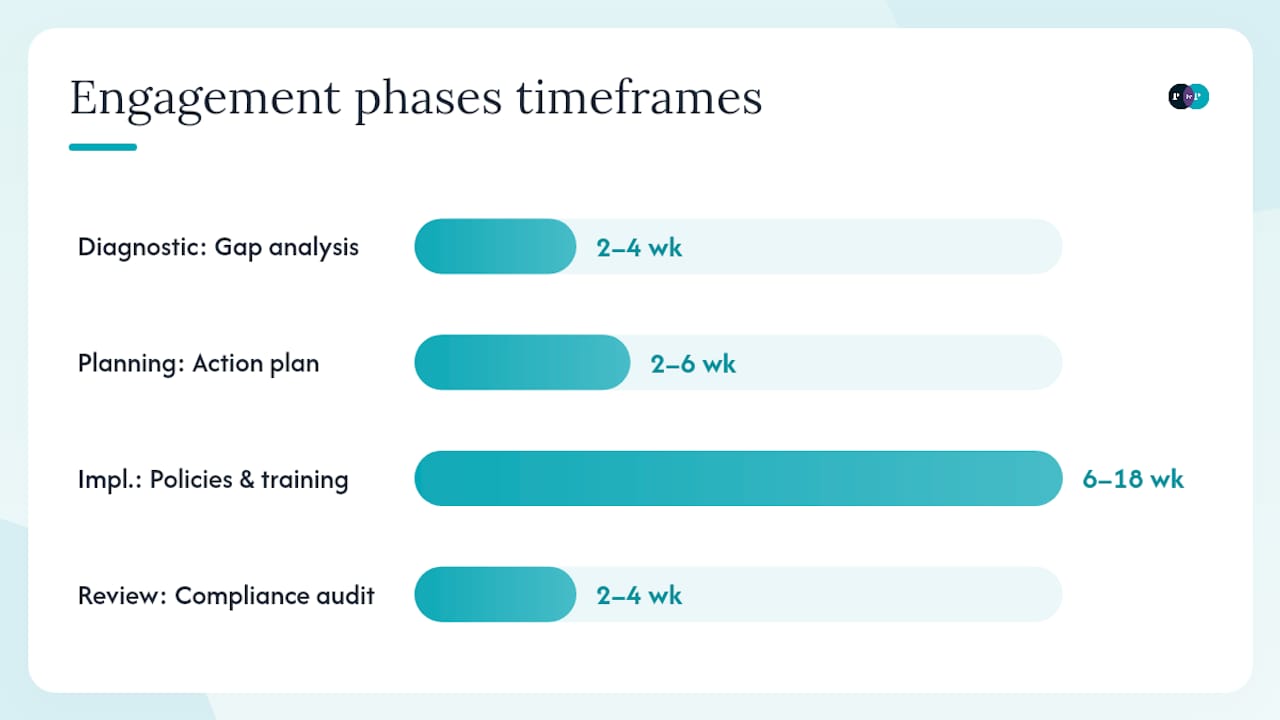
These are example ranges for procurement teams to sanity-check proposals, not fixed quotes. A sport governing body with 40 affiliated clubs will sit at the longer end of implementation; a single-site community organisation may complete the full cycle in 16 weeks.
Three engagement models are common: a fixed-price project for a defined scope (readiness review through to policy suite); a retainer for ongoing regulatory liaison and audit response; and a capability-building partnership where the consultant co-designs implementation with your team rather than delivering a finished product. Independent safeguarding audits and legal review should appear as explicit line items in any scope, not optional extras.
Which laws and standards must a consultant address in Australia?
Any credible child welfare consultant should map their work to the following framework. Use this as a checklist when reviewing proposals.
- National Principles for Child Safe Organisations — the primary national benchmark, led by the National Office for Child Safety in partnership with states and territories
- State and territory Child Safe Standards — mandatory in some jurisdictions; Victoria's Commission for Children and Young People guide sets compliance indicators and enhanced enforcement powers from 2023
- Reportable Conduct Schemes — vary by jurisdiction; the consultant must know your state's specific obligations and timeframes
- eSafety Commissioner — online safety obligations and resources relevant to child-facing digital environments
- Sector-specific standards — NDIS Practice Standards, Aged Care Quality Standards (Strengthened), HSQF (Queensland only), and ACNC Governance Standards where applicable; see our NDIS compliance guide for boards
- Mandatory reporting obligations — state-specific thresholds and reporter categories that training must address
State regulators assess compliance through documented indicators and expect evidence of improvement plans, stakeholder consultation, and capability building. A policy document alone does not satisfy a Victorian or Queensland audit.
How do you choose the right child protection compliance consultant?
Ask every shortlisted consultant these questions before you issue a brief.
- Can you provide examples of work with organisations regulated by our specific state body?
- What does your readiness review methodology look like, and what does the gap analysis report contain?
- Who is the senior consultant on this engagement, and what is their background in child protection practice?
- Do you provide sample deliverables (policy templates, training outlines, monitoring frameworks)?
- Can you supply two client references from comparable organisations?
Red flags to watch for: a proposal with no independent readiness assessment; generic policy templates with no jurisdictional alignment; a staffing model where a junior consultant delivers the work with no senior oversight; and no evidence of engagement with your state regulator's compliance indicators.
Indicative cost bands vary considerably based on organisation size, geographic spread, and implementation depth. As a guide: a scoped readiness review and gap analysis for a small organisation typically sits in the range of a few thousand dollars; an organisation-wide implementation programme covering policy, training, and audit preparation runs materially higher; and an ongoing retainer for regulatory liaison is typically structured as a monthly fixed fee. Request itemised quotes with milestone-based payment terms.
Pro Tip: Structure your scope into discrete milestones with written acceptance criteria for each. Retain a short retainer post-implementation for regulatory liaison and audit response. This protects your organisation if a regulator contacts you between scheduled reviews.
What does this look like in practice?
A medium-sized out-of-home care organisation in a regional area engaged a safeguarding compliance specialist following a change in state Child Safe Standards. Their self-assessment against the National Principles revealed gaps across three areas: complaint-handling procedures, staff training records, and the seniority of their Child Protection Officer role.
The engagement ran across 18 weeks:
- Weeks 1–3: Readiness review and gap analysis, including board briefing and staff interviews
- Weeks 4–8: Updated child safety policy, code of conduct, and complaint-handling procedure, all mapped to the National Principles
- Weeks 9–14: Leader and frontline training delivered across two sites; training completion increased significantly among required staff
- Weeks 15–18: Compliance audit, monitoring dashboard, and a retainer established for ongoing regulatory liaison
The Child Protection Officer role was restructured to report directly to the CEO, with a funded time allocation. The organisation's next regulator contact resulted in no compliance notices.
What experienced consultants know that proposals often miss
Most compliance failures in child-related organisations are not policy failures. They are governance failures. The policy exists; the accountability structure does not. A board that commissions a policy suite without also commissioning a governance review of how the Child Protection Officer role is resourced and positioned has addressed the symptom, not the cause.

The other pattern worth naming: organisations that treat child safe compliance as a one-off project rather than a recurring practice cycle. State regulators are increasingly assessing evidence of continuous improvement, not just a current policy. A consultant who delivers a finished document and exits is not the same as one who builds your team's capacity to sustain compliance through the next regulatory cycle.
Which of these two gaps, governance structure or practice continuity, will you ask a shortlisted consultant to address first?
The Planning and Practice Hub works with organisations ready to act
The Planning and Practice Hub supports Australian human services organisations, including OOHC, community services, and disability providers, through every phase of child safe compliance: from the initial readiness review and gap analysis through to policy development, training delivery, and ongoing regulatory liaison. Founded by Rachel Willis, with close to three decades of sector experience across more than 50 regulatory bodies, the Hub brings the kind of senior, practice-grounded advisory that procurement briefs often describe but rarely find. Engagements are structured as fixed-price projects, retainers, or capability-building partnerships, depending on what your organisation needs. To discuss scope, timeline, and fit, visit the consulting services page or explore the human services consulting options.
This article is general information, not a substitute for advice from a qualified lawyer. Consult a qualified legal professional about your own circumstances before acting on anything here.
Sources
- National Principles for Child Safe Organisations | National Office for Child Safety
- Child safe organisations | Australian Human Rights Commission
- Lead the National Principles for Child Safe Organisations | National Office for Child Safety
- A guide for creating a Child Safe Organisation (accessible version) | Commission for Children and Young People Victoria
- Safeguarding Audits: What Make Them Effective and When Does Your Organisation Need One? - Safe Space Legal
FAQ
What does a child protection compliance consultant do?
A child protection compliance consultant reviews and develops child safety policies, conducts readiness reviews against the National Principles for Child Safe Organisations, delivers staff and leader training, and supports organisations through regulatory audits and reportable conduct processes.
How long does a child safe compliance engagement take?
For a medium-sized organisation, a full engagement from readiness review through to compliance audit typically runs several months depending on scope, geographic spread, and the depth of implementation required.
Are the National Principles for Child Safe Organisations mandatory?
The National Principles set a nationally consistent framework, but mandatory status depends on your jurisdiction. Victoria's Child Safe Standards are mandatory with enforceable compliance indicators; other states have equivalent or aligned requirements. Your consultant should confirm the specific obligations for your state or territory.
What should I ask a consultant before engaging them?
Ask for their methodology for the readiness review, examples of work with your state regulator, the CV of the senior consultant assigned to your engagement, and two client references from comparable organisations.
How does The Planning and Practice Hub approach child safe compliance?
The Planning and Practice Hub works with Australian human services organisations through a four-phase model: diagnostic readiness review, prioritised action planning, implementation support, and compliance review, with ongoing retainer options for regulatory liaison and audit response.