
A theory of change is the concise hypothesis that explains why your chosen activities will produce the long-term change you want. It connects what your program actually does to the outcome you're accountable for, filling in the causal steps that funders, boards, and evaluators need to see. You reach for one at three moments: designing a new program, evaluating an existing one, or writing a funding submission that needs to justify itself in half a page.
Community services teams often confuse this with program logic. A theory of change maps the "missing middle" between activities and impact, while program logic handles the operational detail underneath it.
- Design: test whether your activities logically lead where you say they will
- Evaluation: define what you'll measure and why it counts as evidence
- Funding: give funders a short, causal story instead of a wish list
Key Takeaways
A theory of change works when it names one accountable outcome, states its assumptions plainly, and stays short enough for a funder to actually read.
| Point | Details |
|---|---|
| Define the line | State clearly what your program is and isn't accountable for before setting indicators. |
| Use backwards mapping | Start from the long-term outcome and work back through preconditions to activities. |
| Keep funder ToCs brief | Limit funder-facing models to four to six dot points, with a fuller appendix behind it. |
| Separate ToC from program logic | Use the theory of change for hypothesis and strategy, program logic for delivery and evaluation detail. |
| Review on a fixed cycle | Schedule annual review points and treat contradicting evidence as a finding, not a failure. |
| Get governance-ready support | The Planning and Practice Hub's Practice Assurance Hub helps boards turn a causal model into an auditable practice framework. |
Authoritative resources and templates to consult next
- Theory of change guidance from the Australian Institute of Family Studies
- How to write a Theory of Change, TasCOSS Library
- NSW DCJ program logic guide
- Community Impact Hub's interactive ToC tool
- Theory of Change overview, theoryofchange.org
- Program logic in human services, The Planning and Practice Hub
Why a theory of change matters for community services practice
A theory of change forces you to name what your program is actually accountable for. That's "the line", the point where your influence stops and someone else's begins. Without it, boards approve strategies nobody can trace back to outcomes, and quality managers end up defending activities they can't connect to results.
Get the line right and three things follow. First, boards and funders agree on indicators and reporting frequency upfront, instead of renegotiating every six months. Second, monitoring becomes purposeful. You're tracking things that test your causal story, not just counting outputs because they're easy. Third, co-design gets sharper: when community members can see the causal chain, they can tell you where it's wrong before you've spent a grant cycle finding out yourself.
- Defines what the program is and isn't responsible for
- Sets shared indicators and reporting cadence with funders and boards
- Surfaces where community input should reshape the causal logic, not just the delivery
This is governance work as much as program design. A theory of change built for NFP boards gives directors a defensible, reportable account of why the organisation's strategy should work.
How do you build a theory of change from the outcome backwards?
Backwards mapping is the standard method, and it works because it stops you from designing activities first and hoping they add up to something. You start at the end and work back.
- Write the long-term outcome in one sentence. Not "improve wellbeing", but something testable: "Young people exiting out-of-home care sustain stable housing for 12 months."
- Identify the preconditions. What has to be true before that outcome is possible? Stable income, a support network, tenancy skills. List each one.
- List the short-term outcomes that build each precondition. These are the changes you can plausibly see within a year: increased financial literacy, an active support contact, a signed lease.
- Attach concrete activities and resources to each precondition. Workshops, case coordination, brokerage funds, whatever actually produces the short-term outcome.
- State your assumptions and the evidence behind each causal step. If you're assuming stable housing reduces relapse into crisis services, say so and cite what backs it.
- Define your indicators and confirm the line of accountability. What will you actually measure, and which parts of the chain is your program answerable for versus dependent on partners?
This process is formal guidance from TasCOSS, and it's worth following closely rather than freelancing your own structure.
Pro Tip: Draft the long-term outcome sentence last, even though it sits first in the chain. Teams write clearer outcome statements once they've worked through what's actually achievable underneath it.
ToC versus program logic: what each tool is for
These aren't competing formats, they're different jobs. A theory of change is your hypothesis: why do you believe this sequence of activities produces this change? Program logic is the operational build: what specifically happens, in what order, with what resources, measured how.
Programs that are funded and evaluated seriously need both. The Australian Institute of Family Studies frames the practical split clearly: develop the theory of change with community partners first, then translate its causal pathways into a program logic for delivery and evaluation.
- Theory of change: strategic, causal, built for buy-in and funding narratives
- Program logic: operational, detailed, built for delivery teams and evaluators
- The conversion: a single ToC precondition (say, "families access stable income support") becomes a program logic row with defined activities, outputs, a mechanisms of change column, and a specific outcome measure
The NSW DCJ program logic guide includes templates built exactly for this handover, with mechanisms of change columns that explain how each activity is meant to work.
What should a funder-ready theory of change look like?
Funders don't want your full causal model. They want a short account of why your program will work, with room to interrogate it if they choose to.
Keep the funder-facing version to 4 to 6 dot points, covering the long-term outcome, one or two preconditions, and the primary activities. Funding frameworks generally accept ToCs this brief, provided a fuller model exists behind it.
- State the long-term outcome in a single line
- Name your one or two most critical preconditions
- List primary indicators, not every metric you track
- Add a short note on your key assumption
- Reference a detailed appendix for the full logic and evidence base
Keeping the public-facing model brief works best when a complete version sits behind it, ready if a funder or evaluator asks to see the full chain.
Boards should insist on seeing both versions. A one-page ToC that can't produce its own appendix on request usually means the causal thinking was never done properly in the first place.
An anonymised example, and where governance tools fit
A regional family support service we've worked alongside framed its theory of change around one long-term outcome: children remain safely in the family home. One precondition underneath it: parents access consistent, non-punitive support during acute stress periods. The activity: a rostered after-hours phone line staffed by trained family support workers. The indicator: proportion of after-hours calls that de-escalate without statutory notification within 48 hours.
That's the shift a properly built theory of change should force. Rachel Willis has spent close to three decades inside Australian human services's governance, and the pattern she sees repeatedly is organisations measuring what's easy instead of what their theory of change says matters.
The Practice Assurance Hub exists for exactly this handover, turning a causal model into something a quality manager can actually audit against, not just a document that sits in a strategy folder.
How often should you review and update a theory of change?
A theory of change is a hypothesis, not a certificate. Treat it as something you're actively testing, because the evidence guides from AIFS and TasCOSS both frame it that way, and community feedback should be allowed to change it.
- Set fixed review points, not just crisis-driven ones. Annually at minimum, tied to your board reporting cycle.
- Define triggers for an earlier revisit: a funder query you can't answer cleanly, an evaluation finding that contradicts an assumption, or frontline feedback that a precondition isn't holding up.
- Use your indicators to test the causal links themselves, not just to report activity. If the data says a precondition isn't shifting the outcome, that's a finding, not a failure to hide.
- Feed results back into governance decisions. Commissioning, program continuation, and board risk registers should all reflect what the ToC review found, not run on a separate track.
A Practice Assurance Checklist gives boards a fixed cadence for this instead of leaving review dates to memory.
How do you get stakeholders and beneficiaries genuinely involved?

The mistake most teams make is treating stakeholder engagement as a validation step after the model is drafted. Show people a finished theory of change and ask "does this look right?" and you'll get polite nods, not the correction you actually need.
Bring beneficiaries and frontline stakeholders into the backwards mapping itself, particularly at the precondition stage. People who've used your service usually know which preconditions are fiction. A housing program might assume "clients access private rental listings" is a viable precondition, until someone with lived experience points out that a criminal record check knocks that pathway out for most of your caseload before it starts.
Run this in stages rather than one workshop. Start with frontline staff and beneficiaries to test the preconditions and assumptions, because they see the gaps between policy intent and daily reality. Bring the board and executive in once the causal chain is drafted, to test accountability and resourcing. Bring funders in last, once you have a defensible model, not a half-formed one.
Document disagreement, don't smooth it over. If a community reference group and your executive team read a precondition differently, that tension is often the most useful information in the whole process. It tells you exactly where your evidence is thin or your assumptions are contested.
Terminology matters here too. Confusion between ToC and program logic language genuinely derails partnerships, so agree on shared terms with partner organisations and evaluators before you start drafting together.
What tools do practitioners actually use to build a ToC?
Most community services teams start with a whiteboard and sticky notes for the backwards mapping session itself, and that's not a bad instinct. The causal thinking happens best when people can move preconditions around before anything is locked into a template.
Once the structure holds, move to a digital format. The Community Impact Hub's theory of change tool walks practitioners through vision, problem definition, activities, risks, and indicator selection in a structured interactive format, which is particularly useful for teams who haven't drafted a ToC before and need the prompts.
For teams already comfortable with the method, a simple table or diagramming tool (Miro, Lucidchart, or even a well-structured spreadsheet) is often enough. The format matters far less than the rigour behind it. As Theoryofchange, there's no single correct ToC format. The real test is whether the model gives a logical, testable account of how your activities produce the outcome.
Whichever tool you use, resist the temptation to make it visually elaborate before it's causally sound. A clean diagram with weak logic underneath it is worse than a messy one that's actually been tested against evidence, because it looks more credible than it is.
How does a ToC connect to broader outcomes frameworks?
Your program's theory of change shouldn't exist in isolation from the outcomes frameworks your funders and regulators already use. If you're funded under the NSW Human Services Outcomes Framework, your long-term outcome and preconditions should map visibly onto that framework's domains, not sit as a parallel, disconnected model.
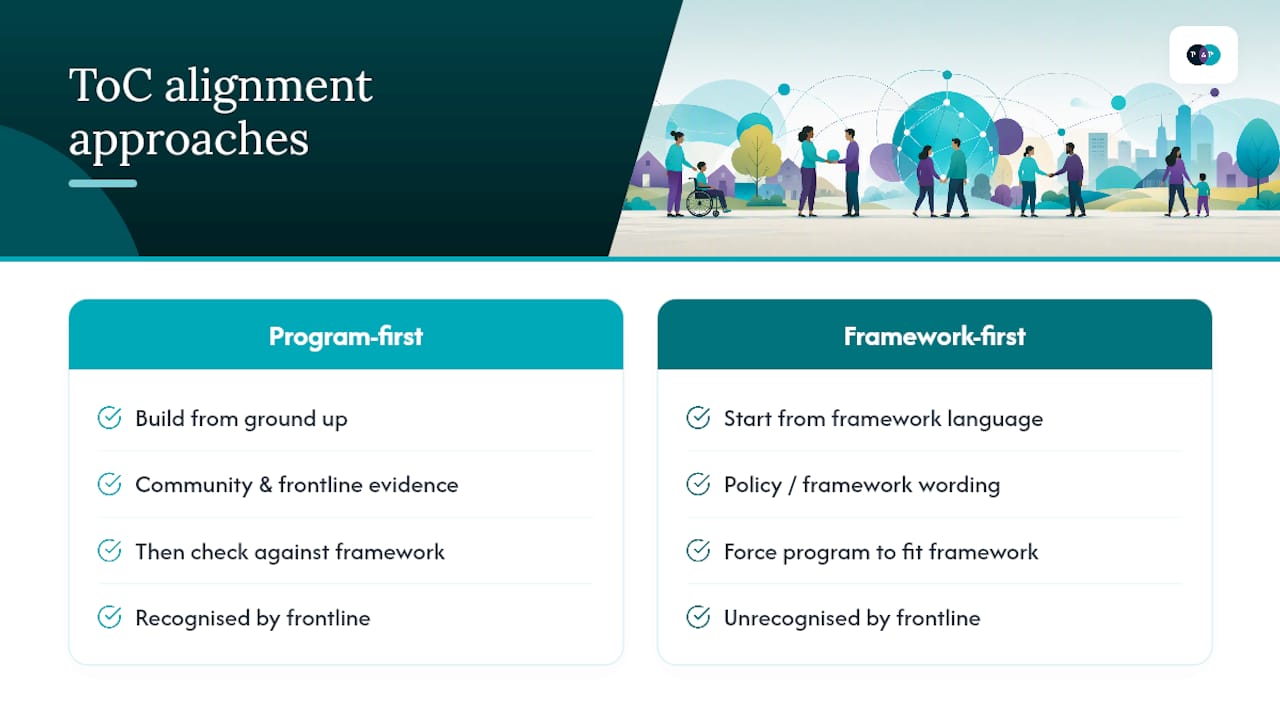
This alignment work happens in one direction most teams get backwards. Build your program-specific theory of change first, from the ground up with your community and frontline evidence, then check it against the broader framework, rather than starting from framework language and forcing your program to fit it. A framework-first approach produces theories of change full of policy language that nobody on the frontline recognises as describing their actual work.
For boards operating under the NDIS Practice Standards, Aged Care Quality Standards (Strengthened), or National Principles for Child Safe Organisations, the alignment question is really a governance question: can you show a regulator or auditor the line between your program's causal model and the standard's requirements? That's harder to do retrospectively than to build in from the start.
Organisations reporting under HSQF in Queensland or working toward ASES Version 9.1 benchmarks face the same task from a different angle: the framework sets what to measure, and the theory of change explains why measuring it makes sense for this particular program.
What the research actually tells us to prioritise
The conventional advice on theory of change treats it as a documentation exercise, something you produce once for a grant application and file away. That's the part worth pushing back on. The strongest guidance from AIFS and TasCOSS both frame it as a living hypothesis, which means the real work isn't drafting the model, it's building the habit of testing it against what your indicators actually show.
Most organisations I'd expect to get real value from this get the backwards mapping right and then stop. They never build the review cycle that would let the model earn its keep over time. That's where boards should push harder than they currently do: ask not "do we have a theory of change" but "when did we last find out it was wrong, and what did we do about it."
If you're starting from scratch, prioritise the line of accountability before the diagram. A causal chain without a clear boundary on what your program owns is just an aspiration with arrows on it. Get that boundary right first, and the indicators, the funder summary, and the program logic conversion all follow more easily than teams expect.
— Rachel
A plain next step for boards and quality teams
If your organisation's theory of change hasn't been stress-tested against a real audit or funding review in the last twelve months, that's usually the first governance gap worth closing. The Planning and Practice Hub's quality compliance consulting service works directly with boards and executives to turn a causal model into something that holds up under NDIS Practice Standards, Aged Care Quality Standards (Strengthened), or ACNC Governance Standards scrutiny, not just something that reads well in a grant application.
Book a scoping conversation with The Planning and Practice Hub to find out exactly where your current theory of change would fail an audit, and what it would take to close that gap before your next funding review.
Sources
- What the theory of change? | Australian Institute of Family Studies
- How to write a Theory of Change | TasCOSS Library
- NSW Human Services Outcomes Framework guide
- Community Impact Planner - Theory of Change
FAQ
What is Carol Weiss's theory of change?
Carol Weiss is widely credited with formalising theory of change as an evaluation approach, framing it as making explicit the assumptions behind why a program's activities should lead to intended outcomes so those assumptions can be tested rather than taken on faith.
What are the core steps in developing a theory of change?
The core method is backwards mapping: define the long-term outcome, identify the preconditions needed to reach it, list the activities that produce those preconditions, and state the assumptions and evidence linking each step.
Can you explain theory of change simply?
A theory of change is a short, testable explanation of why your specific activities will lead to the long-term change you're aiming for, built by working backwards from that outcome rather than forwards from your existing programs.
What does a theory of change look like for a nonprofit?
For most funded nonprofits, it's a brief document, often four to six dot points, stating the long-term outcome, key preconditions, primary activities and indicators, with a fuller logic model held in an appendix for evaluators.
How is a theory of change different from a program logic?
A theory of change is the causal hypothesis, why the activities should work, while program logic is the operational detail underneath it, covering specific activities, outputs and measures used for delivery and evaluation.