
TL;DR:
- Families need to understand each step, including assessment, funding, and provider selection, to avoid delays.
- From October 2026, personal care is fully funded under clinical supports, reducing out-of-pocket costs for families.
Support at Home transition planning is the process families and carers use to manage the shift to Australia's reformed in-home aged care system, securing timely, personalised support for older adults and people with disabilities. Support at Home replaced Home Care Packages and Short-Term Restorative Care on 1 November 2025, with the Commonwealth Home Support Programme transitioning no earlier than 1 July 2027. Getting the process right from the start means understanding eligibility, assessment, funding allocation, and provider selection before gaps in care appear. The Australian Government Department of Health and Aged Care administers the programme through My Aged Care, and the Notice of Decision issued after assessment is the document that unlocks funded support.
What steps are involved in accessing Support at Home services?
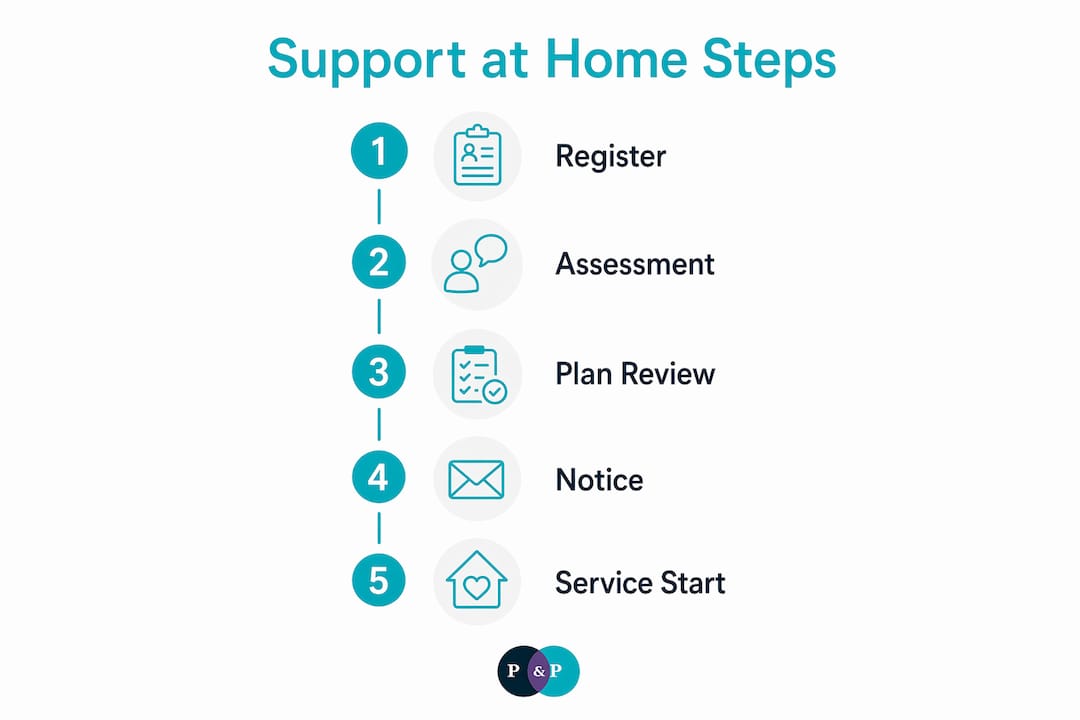
The access pathway follows a clear sequence. Families and carers who understand each step avoid the delays that catch many people off guard.
-
Register with My Aged Care. Contact My Aged Care online or by phone to register the person needing support. A face-to-face aged care assessment follows, conducted by an Aged Care Assessment Team or Regional Assessment Service depending on care complexity.
-
Receive the Notice of Decision. After assessment, the participant receives a Notice of Decision confirming eligibility and the approved support plan. The support plan identifies goals, assessed needs, and the services approved within an individualised budget.
-
Understand your funding pathway. Funding is immediate for Restorative Care and End-of-Life Pathways. Ongoing care funding uses the Priority System, which allocates funding based on approval dates and priority categories. Families on the Priority System may wait before funding becomes available.
-
Select a registered provider. Use the My Aged Care provider finder to identify registered Support at Home providers in your area. Confirm that the provider offers the specific services listed in the approved support plan before signing anything.
-
Finalise a service agreement. Once a provider is chosen, a service agreement must be signed. Participants have 56 days to begin services after funding is allocated. A 28-day extension is available through My Aged Care, but missing the window entirely means returning to the Priority System queue.
Pro Tip: Request a written copy of the support plan at assessment and check it carefully before the Notice of Decision is finalised. Errors in assessed needs are far easier to correct before funding is allocated than after.
How have service categories and funding changed under Support at Home?
The 2026 updates to Support at Home introduced meaningful changes to what families pay and what services are available.
-
Clinical supports now include personal care at no out-of-pocket cost. From 1 October 2026, personal care moved to the clinical supports category. Eligible participants receive personal care with no out-of-pocket cost for services delivered on or after that date. This is a significant financial relief for families who previously managed co-contributions.
-
Restorative Care pathway. This short-term pathway focuses on wellness and reablement, helping participants rebuild capacity and independence. Funding is immediate and time-limited, making it well suited to post-hospital recovery or early intervention.
-
End-of-Life pathway. Participants with a terminal prognosis access an accelerated, fully funded pathway. Families in this situation should request priority assessment directly through My Aged Care.
-
Assistive Technology and Home Modifications scheme. This separate funding stream covers equipment and home adaptations. It operates alongside the core support budget, not within it, so families should ask assessors about eligibility specifically.
All services must align with the approved support plan and individualised budget. Support plans must reflect the participant's goals and assessed needs, and care partners work with families to choose services from the approved list. When needs change, families can request a plan review.
What should families consider when choosing a Support at Home provider?
Provider selection is where many families lose time and money. The rules here are less forgiving than they appear.

Providers choose which services to offer under Support at Home and list them on My Aged Care. No provider is obligated to cover every service category. A provider may be registered for Support at Home but not offer the specific services in your family member's support plan. Confirming the match before any agreement is signed saves weeks of backtracking.
Pricing is the other critical variable. The government deferred imposing price caps for Support at Home to stabilise the market during transition. That means service costs differ significantly among providers right now. Families must check fee schedules directly and compare them against the individualised budget before committing.
Pro Tip: Ask each shortlisted provider for a written fee schedule and compare it line by line against the services in the approved support plan. A provider who cannot supply this promptly is worth reconsidering.
Key checks before signing a service agreement:
- Confirm the provider lists the required services on their My Aged Care profile.
- Request the provider's current fee schedule and verify it matches their My Aged Care portal data. Providers must publish prices on their websites that match portal data, with price reviews every two months.
- Check that the provider operates under the current Aged Care Act requirements and relevant programme manuals.
- For participants transitioning from Home Care Packages, note that providers have 30 days to initiate service agreement finalisation after contribution rates are determined, and participants have 90 days to sign.
What common challenges arise in transition planning and how do you avoid them?
The 56-day service commencement window is the single biggest risk families face. Missing it is not a minor administrative issue. It means the funding allocation is withdrawn and the participant re-enters the Priority System queue, potentially waiting months for funding to become available again.
Families who treat the 56-day window as a hard deadline, not a guideline, consistently avoid the most costly delays in Support at Home transition planning. The window starts from funding allocation, not from the date of the Notice of Decision. Knowing the difference matters.
Common pitfalls and how to address them:
- Priority System delays. Ongoing care funding is not immediate. Families should ask the assessor at the time of assessment what priority category applies and what the likely wait time is. This sets realistic expectations and allows time to plan interim support.
- Provider mismatches. Selecting a provider before confirming service availability wastes the 56-day window. Always confirm service availability first.
- Support plan errors. Assessed needs that do not reflect the person's actual situation lead to underfunded plans. Request a plan review through My Aged Care if the support plan does not match the person's care needs.
- Communication gaps. Proactive contact with both the assessor and the chosen provider during the transition period reduces the risk of missed steps. Do not assume either party will follow up automatically.
Key takeaways
Effective Support at Home transition planning requires early action, close attention to funding timelines, and direct confirmation of provider service availability before any agreement is signed.
| Point | Details |
|---|---|
| Start with My Aged Care assessment | Registration and assessment must happen before any funding or support plan is issued. |
| Know your funding pathway | Restorative Care and End-of-Life funding is immediate; ongoing care uses the Priority System with variable wait times. |
| Act within 56 days | Service commencement must begin within 56 days of funding allocation or the funding is withdrawn. |
| Confirm provider services before signing | Providers choose their own service offerings, so verify the match against the support plan before committing. |
| Personal care is now fully funded | From 1 October 2026, personal care under clinical supports carries no out-of-pocket cost for eligible participants. |
What I have learned from watching families navigate this reform
The families who manage this transition well share one habit: they read the support plan before the Notice of Decision is finalised, not after. That sounds obvious, but in practice most families receive the Notice of Decision, see the word "approved," and assume the work is done. The plan itself, with its specific service approvals and budget allocations, is where the real detail lives.
I worked recently with a family whose mother had transitioned from a Home Care Package. The provider they had used for three years did not list two of the services in the new support plan on their My Aged Care profile. The family assumed continuity. It took four weeks to identify the gap and find a second provider to fill it. Four weeks of the 56-day window, gone.
The other thing I observe consistently is that families underestimate the role of family advocacy in the assessment process. Assessors work from a standardised framework, but the person being assessed often minimises their needs in the room. A family member who can speak to day-to-day realities, with specific examples, produces a more accurate support plan. That accuracy flows through to every subsequent step.
My question for you: does the person in your care have a support plan that genuinely reflects what they need on their worst days, not just their best?
— Rachel
Working through the Support at Home transition with expert guidance
Navigating the Support at Home programme involves multiple government processes, strict timelines, and provider decisions that carry real consequences for care continuity.
The Planning and Practice Hub works with families, carers, and organisations across Australia's aged care and community services sectors to clarify these processes and build plans that hold up under scrutiny. Whether you need help interpreting a support plan, understanding funding pathways, or preparing for a provider transition, the team brings close to three decades of sector experience to the conversation. Explore The Planning and Practice Hub's aged care consulting services or review the full range of consulting and planning support available to families and organisations working through this reform.
FAQ
What is Support at Home transition planning?
Support at Home transition planning is the process of preparing for the shift to Australia's new in-home aged care programme, covering assessment, funding allocation, and provider selection. It replaced Home Care Packages and Short-Term Restorative Care from 1 November 2025.
How long does it take to access Support at Home funding?
Restorative Care and End-of-Life pathway funding is immediate after assessment approval. Ongoing care funding depends on the Priority System, which allocates funding based on approval dates and priority categories, so wait times vary.
What happens if services do not start within 56 days?
If a participant does not begin services within 56 days of funding allocation, the funding is withdrawn and the participant must re-enter the Priority System queue. A 28-day extension is available through My Aged Care before the deadline passes.
Is personal care free under Support at Home in 2026?
From 1 October 2026, personal care moved to the clinical supports category, meaning eligible participants receive it at no out-of-pocket cost for services delivered on or after that date.
How do families choose the right Support at Home provider?
Families should confirm the provider lists the required services on My Aged Care, request a written fee schedule, and verify the provider complies with current Aged Care Act requirements before signing a service agreement.