
If your organisation delivers funded homelessness services, two things sit at the base of your compliance obligations: registration with the Social Services Regulator where your jurisdiction requires it, and accreditation under one approved standard. That is the floor, not the ceiling. The accepted programs include ASES, QIC, AAA‑NZ and EQuIP. Your service agreement will usually name which one applies, so that is where you start.
The immediate next step is simple to state and harder to schedule: pull out your current service agreement, confirm the accreditation standard it specifies, and check when your last self‑assessment was completed. If you cannot answer that in under five minutes, that is your first governance gap.
- Confirm registration status with the Social Services Regulator (where your funding stream requires it)
- Identify which of the four approved programs your contract nominates
- Locate your most recent self‑assessment and note its date
- Book a self‑assessment or gap review if none exists or it is more than 12 months old
Key Takeaways
Funded homelessness services must register where required and hold accreditation under ASES, QIC, AAA‑NZ or EQuIP, treating the 12 to 18 month cycle as ongoing system maintenance rather than a one-off project.
| Point | Details |
|---|---|
| Confirm your standard first | Check your service agreement to see which of the four approved programs it specifies before booking anything. |
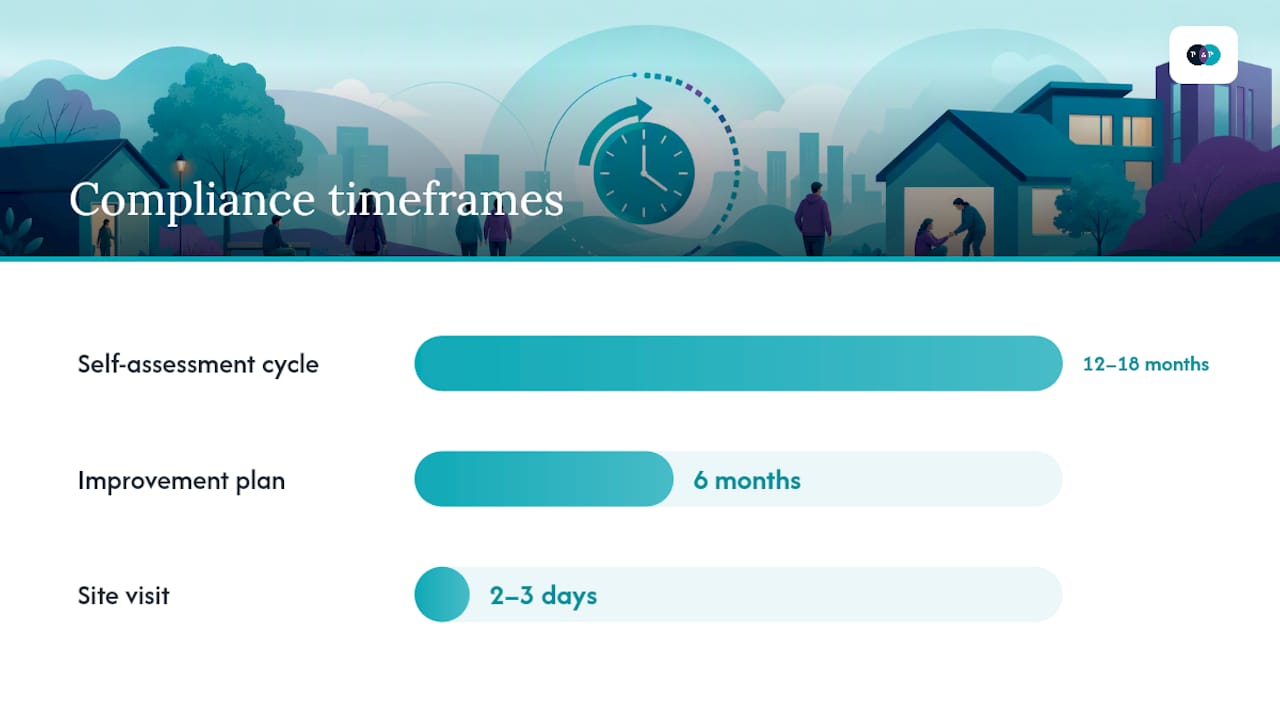
| Budget realistic timeframes | Plan for 12 to 18 months of self‑assessment, a 2 to 3 day site visit, and a 6‑month improvement plan. |
| Centralise your evidence | Use one repository with version control for policies, training records and incident logs to avoid audit-week scrambles. |
| Map governance to outcomes | Tie board reporting directly to the six Social Service Standards, not generic financial oversight alone. |
| Get support to stay audit-ready | The Planning and Practice Hub's Compliance Calendar and Practice Assurance services help boards track dates and close evidence gaps year-round. |
This article is general information, not a substitute for advice from a qualified lawyer. Consult a qualified legal professional about your own circumstances before acting on anything here.
Which regulatory frameworks govern homelessness sector compliance?
Funded homelessness services sit inside a layered structure. At the top is the Social Services Regulatory Framework, which sets registration expectations. Beneath that sit the Social Service Standards, and beneath those sit your specific service agreement, which usually references state-level program guidelines on top of everything else.
In practice, the Social Service Standards ask for evidence across six areas:
- Safe and effective service delivery
- Agency, participation and dignity for people accessing the service
- A safe and appropriate service environment
- Genuine feedback and complaints handling
- Accountable governance
- A safe and skilled workforce
Your service agreement embeds these obligations contractually, and it commonly points back to state guidance documents for the specifics. That linkage matters because frameworks move. Victoria's Homelessness and Housing Support Guidelines were updated in 2025, and Homes Victoria gave funded organisations only 40 business days' notice before requiring parts of the guidelines to be implemented by January 8, 2026. Boards that treat guideline updates as a once-a-year read miss changes like this.
Which accreditation programs are approved, and how do you choose?
Homes NSW requires funded providers to achieve and maintain accreditation under one of four approved programs, and most other jurisdictions recognise the same set:
- ASES (currently at Version 9.1), often specified for homelessness and community services contracts
- QIC (Quality Innovation Performance), used widely across community and health-adjacent services
- AAA‑NZ, an accreditation-level standard with broader reach across allied human services
- EQuIP, more common where an organisation already runs health or aged care programs alongside homelessness services
Some contracts specify the standard outright, which removes the decision for you. Where you do have a choice, weigh up assessor availability in your region, the cost model (per-cycle fee versus ongoing membership), the quality of support resources and templates the program offers, and whether you need whole-organisation scope or can limit assessment to your funded service area. An organisation running one homelessness program alongside a larger aged care or NDIS operation should scope carefully. Running EQuIP across the whole entity might make more sense than running two separate accreditation cycles for two arms of the same organisation.
What compliance rules apply in Victoria, NSW and Queensland?
State frameworks interact with your service agreement in different ways, and getting the detail wrong tends to surface at the worst possible moment, mid‑audit.
- Victoria: the 2025 Guidelines set registration expectations with the Social Services Regulator, define the Social Service Standards in detail, and specify notifiable incident timelines. Providers should treat the January 2026 implementation deadline as a floor, not a future date to plan around.
- New South Wales: Homes NSW runs its own Homelessness Accreditation Policy Framework, which includes three addendums covering background, process detail, and guidance for contract managers and assessors. These addendums define scope and process more precisely than the headline policy, so read them before you scope a self‑assessment.
- Queensland: providers funded by DHLGPPW must comply with the Human Services Quality Framework (HSQF). Other accreditations can count as evidence, but only with contract manager approval and through a specified recognition process, not automatically.
Whichever state you operate in, confirm the current position with your contract manager before you commit resources to a particular program. Cross‑funding recognition between different funding streams is possible in some cases, but it needs early negotiation. Do not assume it will simply carry across.
What is a realistic accreditation timeline?
Accreditation is not a sprint, and treating it like one is how organisations end up scrambling for evidence in month 16 instead of presenting it calmly.
- Self‑assessment and evidence preparation: typically 12 to 18 months. This is where most of the real work happens, gathering policies, aligning practice with documented procedure, and closing obvious gaps.
- External site visit: usually a 2 to 3 day assessment, where an external assessor reviews documentation and speaks with staff and often with people using the service.
- Improvement or action plan: commonly completed within six months of the site visit, addressing any findings the assessor raised.
- Ongoing maintenance: reaccreditation cycles repeat, so the systems built in stage one need to keep running, not get shelved once the certificate arrives.
Some programs, including the NSW framework, offer templates and self‑assessment tools that shorten stage one meaningfully. Use them rather than building evidence frameworks from scratch. If your organisation is running its first cycle, budget the full 18 months. Second and third cycles usually move faster because the evidence culture already exists.
What evidence do assessors expect to see?
Assessors are not looking for a folder that exists purely for their visit. They are looking for proof your systems run all year round, and the gap between the two is usually obvious within the first hour of a site visit.
- A single central repository for policies, procedures and evidence, with clear version control (not five versions of the same policy floating across different drives)
- Training and supervision records that show attendance, not just a training calendar
- Incident logs that are current, not backfilled the week before assessment
- Client feedback and complaints records, including what changed as a result
- A clear decision on scope: is this a whole‑organisation assessment or limited to your funded homelessness service area?
The most common failing is not missing evidence. It is evidence that exists but cannot be found quickly, spread across shared drives, individual inboxes and someone's desk drawer.
Pro Tip: Run an internal "find the evidence" drill three months before your scheduled self‑assessment. Give a staff member five random evidence requests an assessor might ask for and time how long it takes to produce each one. Anything over ten minutes is a system problem, not a filing problem.

How does governance link to incident reporting and funding risk?
Governance evidence should map directly to the six Social Service Standards outcomes, not sit in a separate folder marked "board papers." An assessor reviewing your governance standard wants to see board minutes that reference safety, workforce and complaints data, not generic financial oversight alone.
Incident reporting timelines matter as much as the report itself. Victoria's guidelines require serious incidents to be reported within set timeframes, commonly within three days, with some incidents requiring notification by the next business day. Where your services involve children, obligations under the National Principles for Child Safe Organisations run alongside, not instead of, your homelessness accreditation requirements.
The consequence for getting this wrong is not abstract:
- Failure to maintain registration or accreditation can trigger a funding review under your service agreement
- Missed or late incident notifications are frequently the first thing a contract manager raises in a compliance meeting
- Repeated governance gaps tend to escalate from "improvement plan" to "funding at risk" faster than most boards expect
Treat your service agreement's compliance clauses as operational instructions, not legal boilerplate. They usually are.
What does a 12 to 18 month compliance plan look like in practice?
A workable starter plan does not need to be complicated. It needs a clear owner and a rhythm the board can see.
- Months 1 to 3: confirm accreditation standard, appoint an internal compliance lead, run a baseline gap assessment against the six Social Service Standards
- Months 4 to 9: build the central evidence repository, close identified gaps, start monthly internal audit checks
- Months 10 to 14: complete a full internal self‑assessment, brief the board on readiness, book the external assessor
- Months 15 to 18: host the site visit, respond to findings, complete the improvement plan within the following six months
One mid‑sized service, running two homelessness programs across separate sites, became audit‑ready in 14 months by making one change early: a single shared repository with mandatory version control, reviewed monthly by a designated compliance lead rather than left to whoever had time. Internal audits ran every six weeks instead of once before the assessor arrived.
Accreditation succeeds when the evidence culture is built before the clock starts, not assembled in a rush to meet it. Maintaining an audit‑ready state through routine self‑assessment carries far less risk than scrambling for documents at the end of a cycle.
The leadership actions that made the difference were unremarkable on paper: board oversight of a compliance dashboard, one delegated owner accountable for the repository, and a fixed schedule of internal checks that did not move when things got busy.
What conventional wisdom on accreditation gets wrong
Most sector conversations still frame accreditation as a compliance hurdle, something you clear once every few years and then forget. That framing is backwards. Accreditation verifies that your systems meet minimum requirements, but the certificate itself is not the point. The systems it forces you to build are the point, and those systems either keep running after the assessor leaves or they quietly decay until the next cycle forces a scramble.
I have seen boards spend enormous energy preparing for a single site visit and almost none maintaining what that visit was supposed to verify. That is a governance failure dressed up as a scheduling problem. The organisations that handle this well do not experience accreditation as a project with a start and end date. They experience it as one visible checkpoint inside a system that runs continuously, whether or not an assessor is booked.
So here is the question worth putting to your board: if an assessor turned up unannounced tomorrow, not in eighteen months, would your evidence hold up?
How The Planning and Practice Hub supports your compliance calendar
Most of the compliance failures described above are not knowledge gaps. They are scheduling gaps, evidence sitting in the wrong place at the wrong time, and no one clearly accountable for closing it before it becomes a funding conversation.
The Planning and Practice Hub's Compliance Calendar gives boards and compliance officers a single, dated view of every regulatory task, self‑assessment window and renewal date across your accreditation cycle, so nothing arrives as a surprise three weeks before a site visit. For organisations further from audit‑ready, Practice Assurance works alongside your team to build the evidence repository, close standard-by-standard gaps and prepare for the external assessment itself. CEOs get a clear readiness picture for the board. Compliance officers get a system that does not depend on memory or goodwill. If your last self‑assessment date is not something you can name off the top of your head, book a Compliance Calendar review and get that date, and every one after it, mapped out properly.
Sources
- Accreditation for homelessness providers | NSW Government
- Homelessness and Housing Support Guidelines
- Comply with HSQF for homelessness service providers | Business Queensland
- Accreditation – Homelessness NSW
FAQ
Which accreditation programs are accepted for homelessness services?
The four approved programs are ASES, QIC, AAA‑NZ and EQuIP, and your service agreement usually specifies which one applies to your funding stream.
How long does homelessness accreditation take?
Preparation typically runs 12 to 18 months, followed by a few days of external site visit and several months allowed for an improvement plan to address any findings.
Do all homelessness services need to register with the Social Services Regulator?
Registration requirements depend on your jurisdiction and funding stream. Victoria's Homelessness and Housing Support Guidelines set out when registration applies, so check your service agreement and current guideline against your specific program.
Can one accreditation cover multiple funding streams?
Not automatically. Cross‑funding recognition is possible in some cases, but it requires early negotiation with your contract manager rather than an assumption it carries across.
What happens if a service loses accreditation or registration?
It can put ongoing funding at risk under your service agreement, since accreditation and registration status are typically written in as contractual obligations, not optional extras.