
A homelessness sector strategic plan only earns its name when it shifts spending from crisis response to housing-led prevention and system coordination. Three things are non-negotiable: measurable targets covering both population outcomes and program performance, a governance lead or backbone entity with a genuine mandate, and multi-year funding tied to monitoring and evaluation. Everything else in the plan should exist to support those three.
TL;DR:
- Most effective plans focus on housing-led approaches with explicit targets for social and affordable housing supply, rather than relying solely on aspirational language.
- A dedicated, funded backbone role is essential for coordination, data sharing, and governance, preventing siloed services and ensuring accountability.
- Multi-year, matched funding with clear monitoring and evaluation requirements is necessary for sustainable progress and credible target achievement.
- Service integration requires operational roles such as engagement hubs, outreach, and shared case conferencing, supported by integrated data systems.
- Genuine co-design involves lived experience representatives in decision-making roles, with paid, ongoing involvement incorporated into governance structures.
What should a homelessness sector strategic plan prioritise?
Get the priorities wrong and the rest of the plan is just paperwork. A plan built to change outcomes, not just describe them, needs to weight its energy toward the front end of the system rather than the emergency end.
- Prevention over crisis-only spending. Early intervention (tenancy support, financial counselling, family mediation) costs less than crisis accommodation and stops people entering the system at all.
- Housing-led commitments. Set explicit Housing First targets and back them with supply figures for social and affordable housing, not just aspirational language.
- Priority cohorts named specifically. First Nations-led actions, youth leaving care, women and children escaping violence, and people with complex support needs each need distinct pathways, not a single generic stream.
- Workforce and system capacity. New models (rapid rehousing, assertive outreach) fail without staff trained to deliver them. Capacity planning belongs in the priorities section, not an afterthought in implementation.
The OECD toolkit to combat homelessness frames this as one of nine building blocks: housing-led approaches sit alongside measurable targets and leadership capacity as core, interdependent elements. Leave one out and the others weaken.
Who leads? Governance and the backbone role
Strategies stall when everyone owns delivery and no one owns coordination. A homeless sector strategic plan needs a single policy lead, whether that is a statutory body, a lead department, or a funded alliance with clear terms of reference, holding three functions: convening cross-sector partners, stewarding shared data, and managing the funding pipeline so programs are not rebuilding budgets from scratch each cycle.
- Appoint a funded coordinator role. Backbone work (data, convening, reporting) does not happen as a side task on someone's existing job description.
- Set decision rights up front. Who signs off on reallocating funding between programs? Who resolves disputes between service providers?
- Fix review timelines. Annual strategic reviews, tied to funding agreement milestones, keep the plan answerable rather than aspirational.
Jurisdictional documents like the ACT's Strategic Investment Plan for the Homelessness Sector show what this looks like translated into an actual investment schedule rather than a values statement.
Pro Tip: If your governance model can't name who has authority to reallocate funding mid-cycle, you don't have governance. You have a committee.
How is the plan funded, and what should targets look like?
Funding architecture is where most strategic plans quietly fall apart. Under the National Agreement on Social Housing and Homelessness, the Australian Government provides substantial annual funding to states and territories, including a homelessness funding component; states and territories must match their share of that homelessness funding, which means a plan built on single-year, unmatched grants is structurally weaker than one built to align with NASHH's multi-year, matched-funding logic.
Funding without monitoring and evaluation requirements is money spent blind. Every funding line in the plan should carry:
- A minimum three-year commitment horizon, not annual renewal
- Flexibility to shift funds between prevention and crisis response as demand data changes
- A mandated M&E component built into the contract, not bolted on afterward
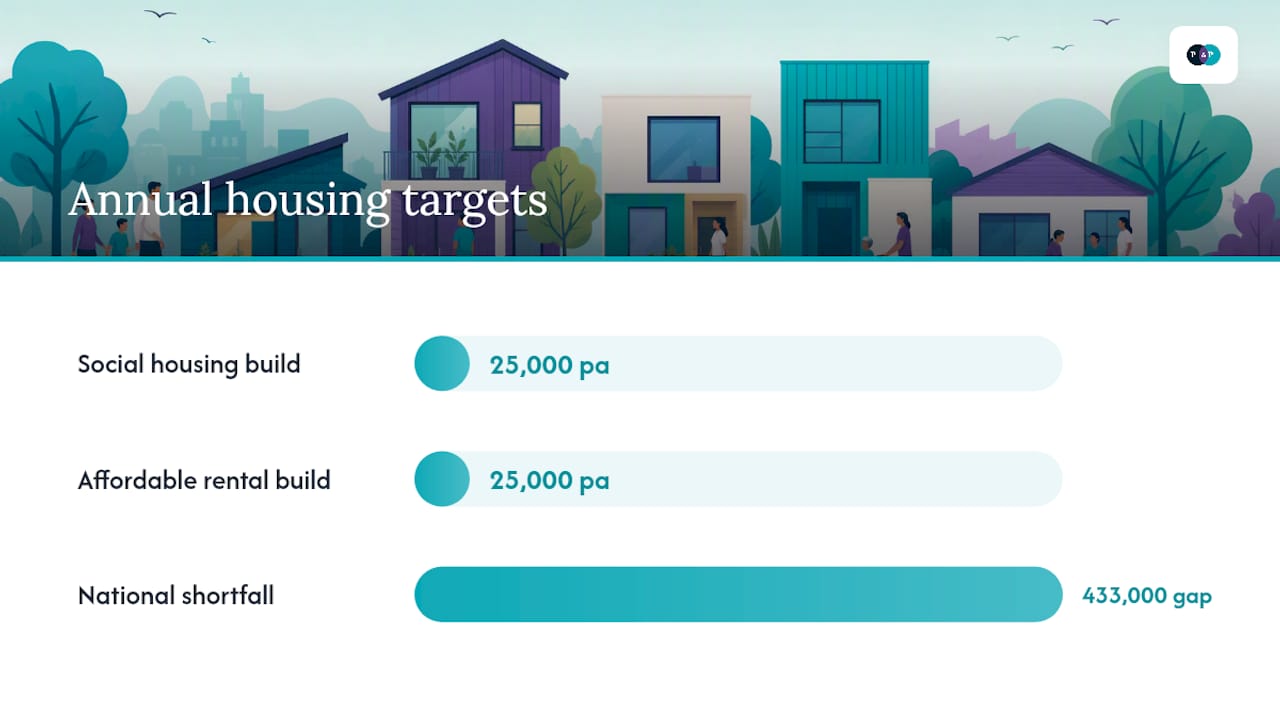
On targets, sector analysis proposes building 25,000 social housing and 25,000 affordable rental properties annually to close a national shortfall of more than 433,000 dwellings. A regional plan can convert that national figure into a local annual target by applying its population share, then anchor delivery milestones to it rather than to sentiment.
What makes service integration actually work?
Integration fails when it stays a values statement instead of a funded set of operational roles. AHURI's analysis identifies seven enablers that make integrated homelessness services accessible in practice:
- Engagement hub — a visible, trusted point of first contact
- Concierge — a warm handover between services instead of a referral into the void
- Outreach — assertive contact for people who won't come to a service
- Client choice and control — options rather than a single prescribed pathway
- Support for transitions — help to move between crisis, transitional and long-term housing
- Service collaboration — shared case conferencing across agencies
- Funding that supports complexity — payment models that don't penalise providers for supporting harder cases
None of this works without integrated data and a single-entry model. AHURI's evidence synthesis found that multiple access points confuse the people trying to use them, while streamlined intake paired with active outreach improves access for priority groups. Regional and remote plans need this translated into mobile engagement hubs, not just a single physical front door.
Pro Tip: Budget for the backbone functions (data stewardship, coordinated intake, a convenor role) as line items, not as "existing staff will absorb this." That's how integration objectives die quietly.

How should outcomes be measured and reported?
Split your measurement framework into two tiers, then hold both to account.
- Population-level measures track whether homelessness is falling across a region: presentations, repeat homelessness rates, average time to housing.
- Program-level measures use a results-based accountability structure. Homelessness NSW's 2023 to 2028 strategy frames this as three plain questions: how much did we do, how well did we do it, and is anyone better off?
- By-name lists with vulnerability weighting turn measurement into allocation. Rather than housing people in order of presentation, weighted lists let coordinators prioritise the people at highest risk first.
Reporting cadence matters as much as the metrics themselves. Build public quarterly reporting into the funding agreement itself, not as a discretionary add-on once resources are stretched.
What does meaningful co-design with lived experience look like?
Consultation events are not co-design. A homelessness sector strategic plan built through genuine partnership gives people with lived experience and First Nations organisations actual decision-making roles, not a feedback session late in drafting.
- Pay lived experience advisors for their time, the same as any other technical contributor.
- Give lived experience representatives a seat on the governance body, not just an advisory panel that reports upward.
- Co-author specific actions with First Nations organisations rather than consulting on a draft written elsewhere.
- Feed lived experience input into monitoring, not just design, so course correction happens in real time.
Homelessness NSW's guidance on lived experience partnership makes the case plainly: shared decision-making roles produce better-designed programs than isolated consultation ever will, because the people closest to the problem catch design failures before they get built into a funding round.
How do you turn the strategy into an actual delivery program?
A strategy document with no milestone map is a wish list. Set a three-phase timeline with named owners at each stage.
- 0 to 6 months: confirm governance structure, appoint the funded coordinator role, and finalise the measurement framework before any new program funding rolls out.
- 6 to 18 months: stand up the seven enablers, begin integrated data sharing between lead agencies, and run the first co-designed program pilots.
- 18 to 36 months: evaluate against population-level targets, adjust funding allocation based on what the data shows, and formalise cross-sector agreements with health and justice partners.
Capacity building runs parallel to all three phases: workforce training in trauma-informed and Housing First practice, secondments between homelessness and health services, and dedicated backbone staffing so frontline workers aren't absorbing coordination duties on top of casework.
Build in a sunset clause and a fixed refresh cycle from day one. Treating the plan as a living document, reviewed against funding agreement milestones rather than a fixed political term, keeps it aligned as national funding arrangements shift.
Pro Tip: If your implementation plan doesn't name who reviews it and when, assume it will still be "current" five years after it stopped matching reality.
How The Planning and Practice Hub supports strategy development
Rachel Willis founded The Planning and Practice Hub after close to three decades working inside Australia's human services regulatory environment, and the gaps described above are the ones she sees clients hit hardest: a strategy with strong priorities but no funded backbone to deliver them.
The Planning and Practice Hub's work maps directly onto these gaps:
- Compliance Calendar — schedules reporting and funding milestones so M&E obligations don't slip
- Practice Assurance Hub — ongoing quality monitoring that supports the governance and measurement functions a plan depends on
- Tender and grant support — helps organisations write funding applications that reflect matched-funding and multi-year requirements
One regional homelessness alliance The Planning and Practice Hub worked with had a strong strategic document but no funded coordinator role. Within a year of resourcing a backbone position and formalising governance triggers:
Presentations to the region's single-entry point dropped as prevention referrals increased, and repeat homelessness rates fell within the first reporting cycle. The change wasn't the strategy itself. It was resourcing someone to run it.
Peer perspective: the failures that keep repeating
The same three failures show up in strategic plan after strategic plan. Services silo because no one holds cross-sector convening as an actual job. Backbone functions get named in the document but never funded, so coordination becomes whoever has spare capacity that week. Co-design gets treated as a consultation round instead of a shared decision-making role, and the resulting program design doesn't fit how people actually access support.
Before your next board meeting, run this checklist: Is there a named, funded person accountable for coordination? Does your measurement framework separate population outcomes from program performance? Do people with lived experience sit in the room where funding decisions are made, or only in the room where the draft gets reviewed?
What would your organisation's plan look like if the backbone function had to survive its first budget cut?
— Rachel
Where to get help building the backbone your plan needs
Other homelessness strategic plans read well and still fail, because the document was never the problem. The gap is almost always the same one this article keeps returning to: no funded coordination role, no working M&E schedule, no governance structure built to survive a change in political priorities. The Planning and Practice Hub works with boards and executive teams to close exactly that gap, co-developing the governance and compliance infrastructure a strategy needs to actually run, not just launch.
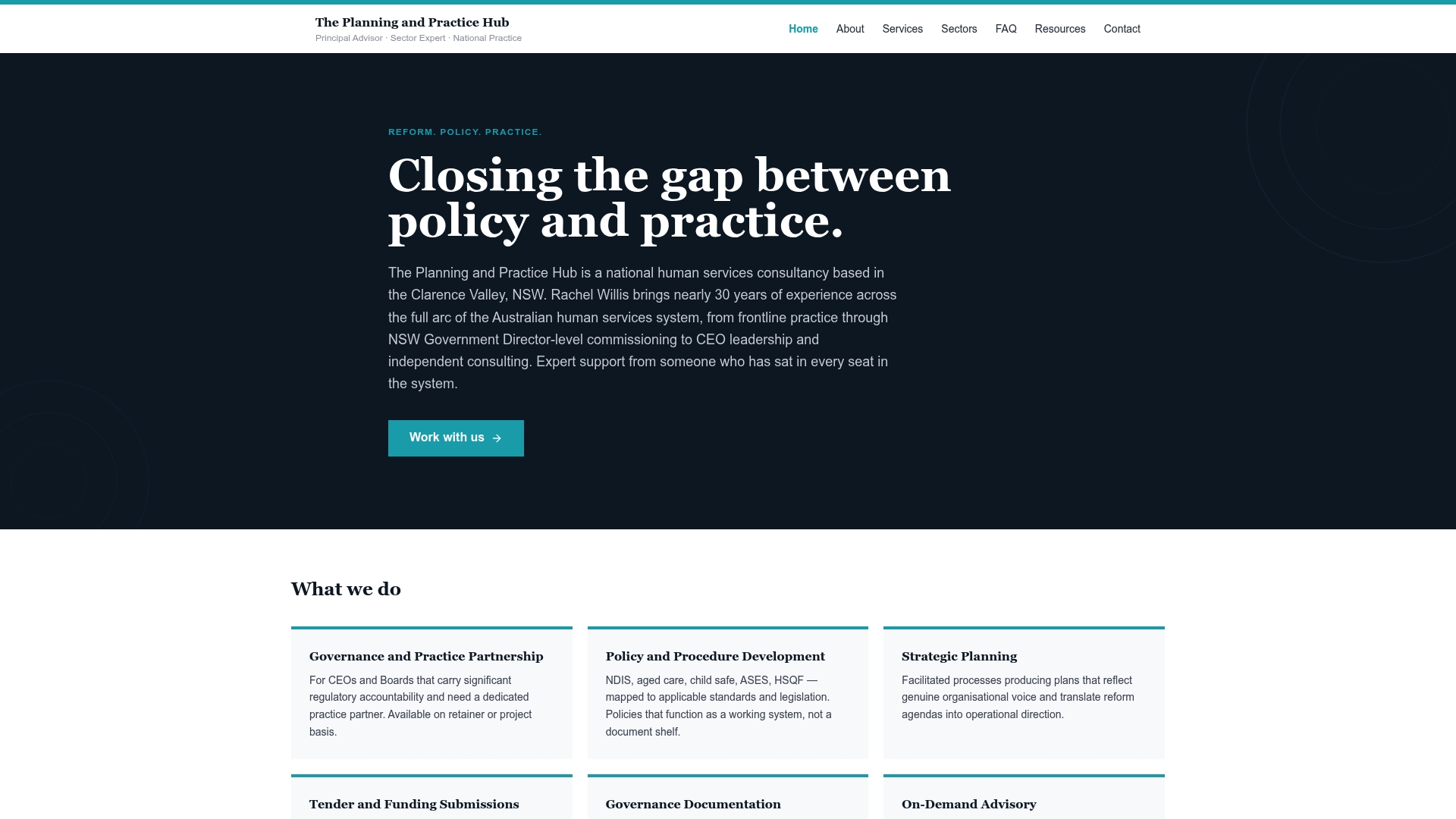
Two tools do most of the heavy lifting here. The Compliance Calendar keeps funding milestones, reporting deadlines and review triggers visible to your whole leadership team instead of living in one coordinator's head. The Practice Assurance Hub supports the ongoing quality monitoring that turns a one-off strategy launch into a genuinely live, accountable program.
If your organisation is drafting or refreshing a homelessness sector strategic plan, get in touch with The Planning and Practice Hub for a scoping conversation about where your governance and compliance gaps sit.
Sources
- Treasury
- Housing budget analysis and shortfall proposals | Parliamentary Library
- OECD toolkit to combat homelessness
FAQ
What is a homelessness sector strategic plan?
It's a coordinated document setting priorities, funding architecture, governance and measurable targets to shift a region's homelessness response from crisis management to housing-led prevention.
How much funding supports homelessness strategies in Australia?
Under the National Agreement on Social Housing and Homelessness, the Australian Government provides around $1.8 billion annually to states and territories, including a $400 million homelessness component that states must match.
What is Housing First and why does it matter in strategic planning?
Housing First places people into stable housing before addressing other support needs, rather than requiring "housing readiness" first, and it's identified as a core building block in the OECD's toolkit for effective national strategies.
What are the seven enablers of service integration?
They are the engagement hub, concierge, outreach, client choice and control, support for transitions, service collaboration, and funding that supports complexity, as set out in AHURI's analysis of integrated homelessness services.
How can organisations get support building a strategic plan?
The Planning and Practice Hub supports governance, compliance and strategic delivery for human services organisations, helping translate strategy documents into funded, monitored programs through tools like the Compliance Calendar and Practice Assurance Hub.