
A procedural fairness workplace investigation requires three things: a clear statement of the allegation, a genuine opportunity to respond before any decision is made, and an impartial decision-maker. Get any one of those wrong and the process is defective, regardless of how strong the underlying evidence is.
The immediate actions an employer must take are:
- Issue written particulars of the allegation (who, what, where, when and which policy applies)
- Provide the key evidence the respondent needs to understand the case against them
- Set a reasonable response timeframe for routine matters
- Offer a support person for any meeting or interview
- Confirm who will investigate and who will decide the outcome
Under s.387 of the Fair Work Act 2009, the Fair Work Commission must consider whether the person was notified of the reason for dismissal and given an opportunity to respond. Providing that opportunity only after a termination decision has been made does not satisfy the requirement. The Fair Work Commission is explicit: the response must be capable of influencing the outcome.
What are the core legal principles of procedural fairness?
Procedural fairness is synonymous with natural justice. It concerns the quality of the decision-making process, not whether the final outcome was correct. Australian law, as reflected in Fair Work Commission guidance and confirmed by Norton Rose Fulbright, rests on three rules:
- Hearing Rule: the respondent must be told the case against them, given access to significant evidence, and allowed a real opportunity to respond before a decision is made.
- Rule Against Bias: the decision-maker must be, and must be seen to be, impartial. Actual bias and apparent bias both undermine the process.
- Requirement for Probative Evidence: findings must rest on facts and reasonable inferences, not speculation or assumption.
These principles apply whether the matter involves misconduct, performance, or a complaint. Law firms including Clayton Utz and Miller Harris treat them as the baseline for any defensible investigation in Australia.
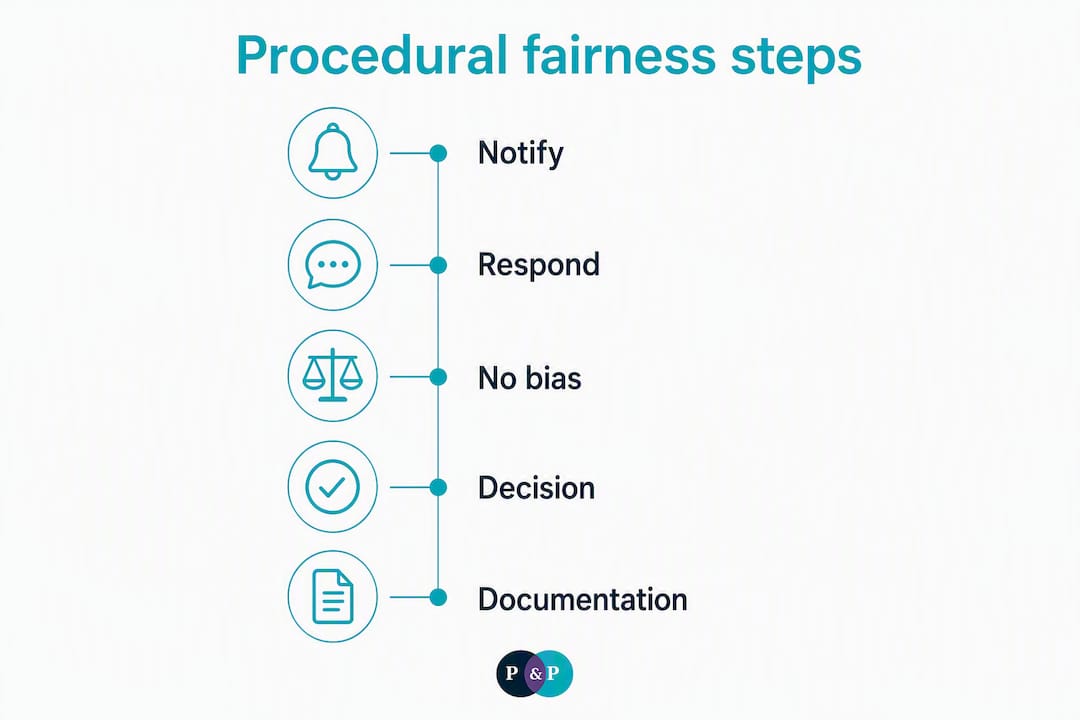
What does 'an opportunity to respond' actually look like?
Translating the Hearing Rule into practice means following a structured sequence. A respondent cannot genuinely respond to a vague summary or a verbal conversation. The process needs to be concrete.
- Issue an allegation letter containing specific particulars: the date, location, conduct alleged, the policy or standard said to have been breached, and the identity of the investigator and decision-maker.
- Provide relevant evidence the respondent needs to understand the case, including witness accounts (appropriately de-identified where safety requires it).
- Set a response timeframe for routine matters; extend this where the allegation is complex, the respondent needs to obtain advice, or a support person is unavailable.
- Offer a support person for any interview or disciplinary meeting. Unreasonably refusing this request is itself a factor the Fair Work Commission considers under s.387(d).
- Conduct a response interview or accept written submissions, giving the respondent a genuine chance to contest facts, provide context, or introduce new evidence.
- Consider the response before deciding. The response must be capable of changing the outcome, not merely noted after the decision is already made.
Anonymised practice example: A community services organisation issued an allegation letter to a support worker on a Friday afternoon, set a Monday morning response deadline, and scheduled the outcome meeting for Monday afternoon. The respondent had no realistic time to obtain advice or gather supporting records. When the matter reached the Fair Work Commission, the compressed timeline was a central procedural defect. Extending the response period by three business days, and confirming the support person's availability before scheduling the meeting, would have been straightforward and defensible.
Pro Tip: Always confirm in writing that the respondent received the allegation letter and understands they may have a support person present. A brief acknowledgement email creates a contemporaneous record that this step occurred.
Who should decide, and how do you manage conflicts of interest?
Role clarity is one of the most frequently mishandled aspects of fair investigation practices. The investigator gathers and weighs evidence; the decision-maker determines the outcome. Conflating these roles, or assigning both to the same person who was involved in earlier disciplinary steps, creates an apparent bias problem.

| Role | Function | Who should hold it |
|---|---|---|
| Investigator | Gathers evidence, interviews parties, produces findings report | HR, senior manager, or external investigator |
| Decision-maker | Reviews findings, issues show cause, determines outcome | Senior leader not involved in investigation |
| Support person | Assists the respondent | Union rep, colleague, or adviser of respondent's choice |
Common conflicts that require management include:
- A line manager who initiated the complaint or was a witness to the alleged conduct
- An HR adviser who recommended a prior disciplinary outcome for the same respondent
- A board member with a personal relationship to either party
Where a conflict exists, the options are to reassign the role to someone without the conflict, or to appoint an independent workplace investigator. In regulated human services settings, the threshold for external appointment is lower because regulatory scrutiny of process is higher.
What happens when procedural fairness is not followed?
The consequences are practical and immediate. Parke Lawyers identify the most common exposures: unfair dismissal claims, general protections disputes, discrimination claims, and regulatory attention. Where procedural defects exist, the Fair Work Commission can order compensation, require a matter to be reopened, or find a dismissal harsh, unjust or unreasonable even where the underlying conduct was serious.
The practical indicators of a defective process are consistent across cases:
- The outcome was decided before the response was received or considered
- The respondent was not given the evidence they needed to respond meaningfully
- A support person was denied without reasonable grounds
- Documentation is absent, inconsistent, or clearly reconstructed after the fact
- New allegations were raised after the termination decision
In human services, a defective investigation also carries regulatory risk. Under the Clyde & Co framework, investigations in regulated sectors are governance matters, not just HR tasks. A poor process can trigger scrutiny from the NDIS Quality and Safeguards Commission, the Aged Care Quality and Safety Commission, or a child safe regulator.
How do you adapt the process for vulnerability and trauma?
Norton Rose Fulbright frames procedural fairness and trauma-informed practice as complementary. Adjusting process for a vulnerable participant does not mean reducing the respondent's rights; it means designing the process so both parties can participate meaningfully.
Practical adjustments include:
- Providing allegations in plain language and offering to explain them verbally
- Scheduling interviews at times that reduce fatigue or anxiety
- Allowing breaks during interviews and avoiding rapid-fire questioning
- Accepting written submissions as an alternative to a face-to-face interview where the respondent has a disability or trauma history
- Giving witnesses the option of a support person and explaining the process in advance
For human services organisations, the regulatory stakes are explicit. The NDIS Practice Standards require organisations to manage incidents and complaints in ways that respect participant rights. The Aged Care Quality Standards (Strengthened) place obligations on providers around safe and respectful conduct. The National Principles for Child Safe Organisations require that child safety concerns are handled through processes that protect children while maintaining procedural integrity. Organisations working under NDIS and aged care frameworks should treat these standards as a floor, not a ceiling.
Pro Tip: Where a complainant or witness has a trauma history, brief the investigator before interviews. A trauma-informed approach to questioning, such as avoiding "why" questions and allowing narrative responses, produces more reliable evidence and reduces re-traumatisation risk.
How do you document the investigation so it is defensible?
Moores are direct on this: absent or retrofitted notes render an otherwise solid factual case indefensible. The document set must be contemporaneous and complete.

| Document | Owner | Purpose |
|---|---|---|
| Allegation letter | HR / investigator | Establishes notice and particulars |
| Evidence log | Investigator | Records all materials gathered and their source |
| Interview notes | Investigator | Contemporaneous record of each interview; confirm with interviewee |
| Findings report | Investigator | Sets out facts found, evidence weighed, and conclusions |
| Show cause letter | Decision-maker | Puts proposed outcome to respondent before final decision |
| Outcome letter | Decision-maker | States decision, reasons, and any consequences |
The outcome letter deserves particular attention. It should state the allegation, summarise the evidence considered, explain why the decision-maker accepted or rejected the respondent's account, and identify the policy or standard breached. A decision letter that simply announces an outcome without reasons is almost impossible to defend before a tribunal. Embedding investigation procedures within your broader governance policy framework helps to ensure these documents are produced consistently, not just when a matter becomes contentious.
A practical checklist for a routine misconduct investigation
The Sprintlaw guidance on workplace investigation steps aligns with standard Australian practice. For a routine misconduct matter, the following sequence applies:
- Triage and plan (Day 1): Assess severity, identify parties, confirm investigator and decision-maker, check for conflicts of interest. Owner: HR.
- Preserve evidence (Day 1–2): Secure relevant records, CCTV, communications, and system logs before they are altered or deleted. Owner: HR / IT.
- Notify the respondent (Day 2–3): Issue allegation letter with particulars, evidence summary, response timeframe, and support person offer. Owner: HR / investigator.
- Interview complainant and witnesses (Days 3–7): Conduct structured interviews; take contemporaneous notes. Owner: Investigator.
- Interview the respondent (Days 7–10): Provide the respondent a genuine opportunity to contest facts and introduce evidence. Owner: Investigator.
- Weigh evidence and prepare findings (Days 10–14): Produce a findings report setting out facts, evidence, and conclusions. Owner: Investigator.
- Issue show cause (Day 14–15): If findings support disciplinary action, put the proposed outcome to the respondent and allow a response. Owner: Decision-maker.
- Decide and communicate outcome (Days 16–18): Consider show cause response, make final decision, issue outcome letter with reasons. Owner: Decision-maker.
For complex matters involving multiple parties, serious allegations, or vulnerable participants, allow 4–8 weeks. Matters requiring external investigators or regulatory notification will take longer. The signal that a matter needs more time is almost always the presence of conflicting accounts, not the seriousness of the allegation alone.
Where a matter involves disciplinary or regulatory dimensions that may require legal oversight, engaging specialist legal advice early in the process reduces risk significantly.
When should you commission an independent investigator?
The criteria for external appointment are practical, not theoretical. Moores and Clyde & Co both identify the same triggers: conflicting accounts with limited corroboration, perception-of-bias risks, regulatory sensitivity, and absence of internal expertise.
At The Planning and Practice Hub, we recommend external appointment when:
- The decision-maker or investigator has a prior relationship with either party
- The matter involves a senior leader, board member, or responsible person
- The allegation intersects with a regulatory reporting obligation (NDIS, aged care, child safe)
- Internal HR lacks experience with complex misconduct or trauma-informed interviewing
- The organisation's size means any internal investigator is known to all parties
Anonymised sector example: A mid-sized homelessness service engaged us after an internal investigation into a senior team leader was challenged by the respondent on bias grounds. The original investigator had co-managed the team leader for two years. We recommended appointing an external investigator, produced a fresh scope and interview plan, and the subsequent findings report withstood a Fair Work Commission conciliation process without amendment. The board's governance committee received a summary of process improvements, which were embedded into the organisation's HR policy framework.
An external brief should specify: the scope of allegations, the evidence available, the interview plan, the expected deliverables (findings report and recommended outcome options), and the timeline. What it should not do is pre-determine the outcome.
Pro Tip: When briefing an external investigator, provide the allegation letter and evidence log but not the decision-maker's preliminary view. Contaminating the investigator's independence at the briefing stage defeats the purpose of the appointment.
Key takeaways
A procedural fairness workplace investigation is only defensible when the process is documented, the respondent had a genuine chance to affect the outcome, and the decision-maker was impartial throughout.
| Point | Details |
|---|---|
| Notify before deciding | Issue written allegations and allow a response before any termination or disciplinary decision is made. |
| Separate roles | Keep the investigator and decision-maker roles distinct to protect against apparent bias. |
| Document contemporaneously | Produce the allegation letter, evidence log, interview notes, findings report, show cause, and outcome letter as the process unfolds. |
| Adapt for vulnerability | Adjust interview style and timing for trauma or disability without reducing the respondent's right to respond. |
| Escalate when needed | Appoint an independent investigator where conflicts of interest, regulatory sensitivity, or lack of internal expertise exist. The Planning and Practice Hub provides this service for human services organisations. |
What the 'conclusion-in-advance' trap looks like in practice
The most consistent failure pattern we see is not a deliberate denial of fairness. It is organisational pressure to resolve a matter quickly, combined with a process that goes through the motions without giving the respondent a real chance to affect the outcome.
The conclusion-in-advance trap works like this: the decision-maker forms a view early, the allegation letter is drafted to confirm rather than genuinely test that view, the response interview is scheduled with the outcome meeting immediately after, and the respondent's account is noted but not genuinely weighed. The documents look complete. The process looks followed. But when the matter is scrutinised, the response never had any prospect of changing the outcome.
What I find striking is how often this happens in organisations with strong values and genuine care for their people. The pressure is not malicious; it is operational. A key staff member is involved, a client is affected, and the board wants resolution. The antidote is not more process for its own sake. It is a clear internal rule: the decision-maker does not form a preliminary view until the findings report is received, and the show cause response is read before the outcome letter is drafted.
If you are a CEO or board director reading this, the peer question worth taking to your executive team is: In our last investigation, could the respondent's answer have changed the outcome, and how do we know?
The Planning and Practice Hub supports workplace investigations in human services
Human services organisations face a higher bar on investigation process because regulatory scrutiny follows the outcome. The Planning and Practice Hub works with NDIS providers, aged care organisations, child and family services, and community services NFPs to design and conduct workplace investigations that are legally defensible and governance-ready.
Whether you need an independent investigator appointed, an existing process reviewed, or an investigation policy built from scratch, we can help. Our workplace investigations service covers scoping, evidence management, interviewing, findings reporting, and outcome documentation. To discuss your organisation's needs, visit our consulting services page or get in touch directly.
Useful sources
- Fair Work Commission: Opportunity to respond — timing obligations and case examples on the right to respond before dismissal
- Fair Work Commission: Other relevant matters (procedural fairness) — the Commission's own framing of procedural fairness principles
- Fair Work Act 2009, s.387 (AustLII) — statutory criteria for assessing whether a dismissal was harsh, unjust or unreasonable
- Norton Rose Fulbright: Procedural fairness and trauma-informed investigations — core legal principles and trauma-informed framing
- Sprintlaw: Workplace investigations and procedural fairness — practical step sequence, documents checklist, and show cause guidance
- Parke Lawyers: Procedural fairness in workplace investigations — legal exposures and proportionality principles
- Moores: Procedural fairness in workplace investigations — independent investigator criteria, documentation, and the conclusion-in-advance trap
- Clyde & Co: Workplace investigations in Australia — investigations as governance and risk in regulated sectors
FAQ
What does procedural fairness require in a workplace investigation?
Procedural fairness requires that the respondent is told the case against them, given access to relevant evidence, and allowed a genuine opportunity to respond before any decision is made. The three core rules are the Hearing Rule, the Rule Against Bias, and the Requirement for Probative Evidence.
When must an opportunity to respond be given?
The opportunity to respond must occur before the final decision is made. Under s.387 of the Fair Work Act 2009, providing it only after termination is legally insufficient and risks a finding of harsh, unjust or unreasonable dismissal.
What happens if procedural fairness is not followed?
A defective process can result in an unfair dismissal finding, compensation orders, a requirement to reopen the investigation, and regulatory scrutiny. In human services, it can also trigger attention from sector regulators such as the NDIS Quality and Safeguards Commission.
When should an organisation appoint an independent investigator?
External appointment is appropriate where the internal investigator or decision-maker has a conflict of interest, the matter involves a senior leader, the allegation intersects with a regulatory reporting obligation, or internal HR lacks the expertise to conduct the investigation fairly. The Planning and Practice Hub provides independent investigation services for human services organisations.
What documents must an employer keep from a workplace investigation?
The core document set is: allegation letter, evidence log, interview notes, findings report, show cause letter, and outcome letter with reasons. All records should be produced contemporaneously, not reconstructed after the process concludes.